Don’t force electric cars on drivers – cut taxes instead
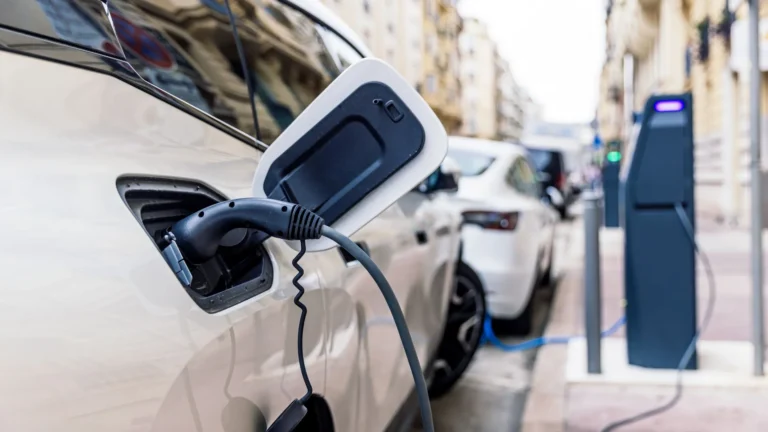
An electric car is charging at a public charging station in an urban environment.
What do Richard Tice, Kevin Hollinrake and Peter Kyle all have in common?
I wish I had a wittier answer to what sounds the set-up to a poor joke, but unfortunately I only have one answer – they all own an electric vehicle (EV).
If three men, who have wildly diverging political views, lifestyles and backgrounds, can all look at an EV and go, ‘that’s the one for me’, perhaps they’re onto something. And with the ZEV mandate – the government’s pathway towards all new cars and vans being zero emission by 2035 – now on the chopping block, it is the time to look at the state of the EV market and ask if it is actually working for drivers or climate action.
So much of the oxygen in the EV debate has been dedicated to the ZEV mandate that we have ignored the red tape and taxes slowing down the sector’s growth
Let’s first look under the bonnet and see why people might have been tempted in the first place. While oil prices have been so unstable and slowly rising, especially with the Ukraine and Iran wars, there is certainly an affordability benefit. EVs now cost between 3-8p per mile to run, compared to 19-21p per mile for petrol cars. Who doesn’t want to save money at the pump each week?
Additionally, the cost of an EV has become increasingly more competitive, with Autotrader reckoning that a brand new EV is now cheaper than a fresh petrol car.
And once they put their foot down on the gas-not-gas, 91% of EV drivers say they will never go back to a petrol car.
Then of course there are the numerous benefits for the country. The EV industry has already brought in £41 billion worth of investment into the UK, while also helping cut the carbon emissions of Britain’s highest emitting sector and cutting air pollution.
With this powerful combination of economic growth, environmental benefits and financial savings for consumers, it’s not surprising to see the rest of the world jumping on the bandwagon. In Europe, 92% of new car sales in Norway are EVs, while in Asia there are currently 33 million EVs driving around China’s roads.
The EV genie is out the bottle; so why isn’t everyone clamouring to get one yet?
Here we return to the controversial ZEV mandate. With hindsight, the ZEV mandate was an unnecessary, overly statist policy that undermined consumer choice. It needs relaxing. But in order for that to be a real victory for individual freedom, we have to ensure EVs are an attainable alternative to petrol cars.
To reap the benefits they offer, ranging from cheaper driving to climate action, we need to go further, harnessing market-led policies that make the switch not only possible, but a net benefit.
So much of the oxygen in the debate has been dedicated to the ZEV mandate that we have ignored the red tape and taxes slowing down the sector’s growth.
A common problem is the lack of public charge-points for potential EV drivers. A very valid concern. But despite increasing demand as more EVs hit the roads, the expansion of the charging network has been slowed down and made more expensive by red tape.
Private installers, for example, must fill out individual tender forms with each individual council, requiring hundreds of pieces of paperwork, all with completely different regulatory requirements, procurement frameworks and costs. How are we meant to build the infrastructure for EVs when the process is so mind-bogglingly complicated and slow? This simply delays construction and deters people from buying EVs.
Additionally, there still remains an additional 20% VAT levy on people who wish to charge their car on the street, while those with private, household charge points face just 5% VAT – and from October 1, nothing at all, as the Government’s temporary zero rate on domestic electricity kicks in. Not only is this a tax break that overwhelmingly benefits the wealthiest with driveways, but it deters drivers in towns and cities – where EVs have the greatest environmental benefits, but where off-street parking is limited – from making the switch.
These are perfect examples of the growing pains with the EV industry, which Whitehall has failed to fix.
This is without going into the government’s premature pay-per-mile tax that will seriously hamper EV take up. Yes, we will need to replace the lost revenue from fuel duty at some point, but not until the industry is firing on all cylinders and we have a solid level of EV charge-point infrastructure.
Taken together, these changes would also show to the industry that the Government is still committed to rolling out EVs, helping to secure investment in EV manufacturing and chargepoints.
There is a slow, positive realisation when it comes to climate action. Westminster is finally waking up to the fact that saving the world from climate change shouldn’t cost the world.
EVs should be a prime example of this approach. Instead of using bans to force the technology on consumers, we should get out of the way and help make the better option cheaper and easier to grab hold of.
If three men, who couldn’t be more different, think EVs are worth it, surely we should expand this opportunity to more people? If we want more British people to feel the benefits of EVs, it is time to stop acting like a deer in EV headlights, and adopt a positive, pro-market approach to EVs. Cut regulations for the roll out of infrastructure and cut taxes to make them cheaper.


Nobody ever built a wind farm with wind. An energy transition is always a project that uses its current energy source to build its replacement while keeping everyone fed and warm. Every turbine, panel, pylon and battery is made, moved, installed and replaced with the help of cheap oil. The question under the plan for […]

A century ago you had to be rich to get any kind of choice over your clothes. And if you weren’t in the upper echelons of society you could forget going on a foreign holiday. Today, mass production ensures there is an abundance of clothes to choose from at all budgets, and cheap flights have […]

The UK only has 13 days worth of natural gas storage capacity, and it’s about to be cut in half. Britain needs gas storage now, and it will need it as North Sea extraction declines. Otherwise, we’re badly exposed to another energy crisis. Centrica has seemingly given us an easy out by offering to regenerate […]