Stop trashing Britain’s inheritance
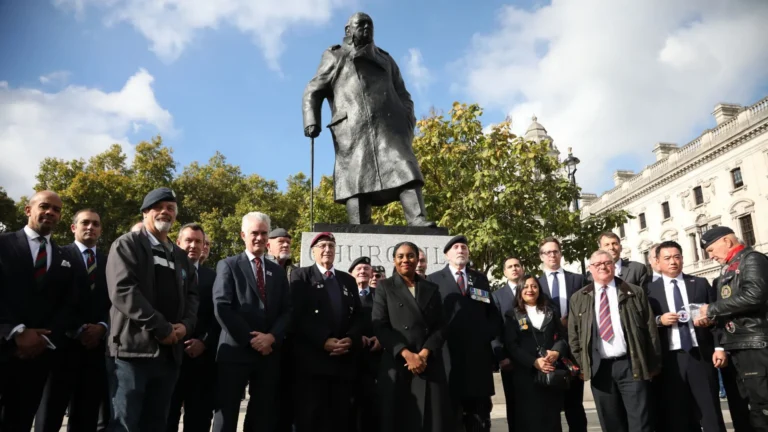
Alishia Abodunde/Getty Images
As an Anglo-Scot, I had a dog in the fight that was the Scottish independence referendum 12 years ago. I was a visceral opponent of the dismemberment of the United Kingdom, which, I believed, would damage everyone in the British and Irish Isles. As the UK’s ambassador to the UN in 2014 put it, ‘it was clear that Scottish independence would have had a devastating impact on the UK’s standing in the world, much greater than withdrawal from the EU ever would’. His Russian counterpart could barely contain his excitement at the prospect.
Still, I felt obliged to consider Scottish nationalists’ arguments, and one I came across was this: Britain equals Empire equals evil. Therefore, the Scots must separate themselves and sail off into a bright new, sin-free, independent future. Having read British imperial history for over 20 years, I knew that the simple equation ‘Empire equals evil’ is historical and ethical nonsense. But that was when I first noticed that a distorted narrative about Britain was being used to fuel a destructive political cause. And I said to myself, ‘Someone needs to correct the record.’
British history – just like any other – has been populated by creatures and sinners, not gods and saints
Scroll forward seven years to 2021. The Tory Minister for Equalities, Kemi Badenoch, is concerned about the divisive effects of the Left’s racial identity politics. She’s just championed the report of the Commission on Race and Ethnic Disparities, which urges us to stop thinking in terms of white oppressor and black victim, since, in terms of educational and other outcomes, Asian Britons are doing very well and those at the bottom of the social heap are poor whites. Kemi has called me and the Cambridge historian, Robert Tombs, into her office. ‘What can we do’, she asks, ‘to tell a better story about Britain?’
That moment was the germ of the book that Robert and I have just published. In four brisk chapters, ‘Our Islands’ Story: A Better Story about Britain’ presents the history of this country and its empire. To recent generations of Britons, whose school education has left them with only fragments of historical knowledge – say, how it felt to be in the trenches during the First World War, or what it was like to be an African slave in the 18th century, or what the Nazis did – we want to give a coherent narrative of how the country they live in came into being.
What we have here in Britain didn’t drop out of the sky. It had to be built over many centuries, sometimes at very great cost. I have stood on the hill in northern Italy, where my mild-mannered father found himself playing stretcher-bearer in the miserable winter of 1944. What was he doing there? Defending the country he’d inherited against the massively murderous regime in Nazi Berlin, both for his sake and the sake of generations to come.
If we don’t understand what it’s taken to create and protect what we’ve received, we’ll have no idea how extraordinarily privileged we are. Ignorant and arrogant in equal measure, we’ll take our inheritance for granted. We’ll casually trash it. Maybe, like the schoolkids in France today, we’ll gleefully burn it to the ground.
The story that Robert and I tell is no fairy tale. Britain’s history has had its fair share of failures and horrors. We don’t airbrush them out; we show them – dreadful civil war, abominable slave-trading, terrible famines, atrocious massacres. No doubt, all this is lamentable. But it really shouldn’t surprise. British history – just like any other – has been populated by creatures and sinners, not gods and saints.
Nevertheless, our imperfect ancestors succeeded in creating some very valuable traditions and institutions. So, in the final chapter of ‘Our Islands’ Story’, we distil Britain’s history into an admirable legacy of 11 traditions and institutions. These include a centuries-long constitutional history of rule by wide consent; a Common Law tradition that constrains judges to heed the wisdom of the past; a national preference for patient, incremental change that is effective and persistent, over counterproductive spasms of anarchical revolution; a mixed constitution that combines popularly elected representation in Parliament’s lower house, an ‘aristocracy’ of expertise in its upper one, and a head of state who transcends politics to nurture civil society; multinational diversity-in-unity; Christian establishments in England and Scotland whose theology affirms a high esteem for the individual, and which no longer inhibit the religious, civil, or political rights of non-Christians; a culture of free enquiry and inventive thinking; a humanitarian tendency to liberate the oppressed, raise up the poor and treat all human beings as equal regardless of race; a centuries-long habit of worldwide engagement, not just commercial, but also humanitarian and liberal; and a realistic appreciation that the defence and promotion of humane and free ways of life sometimes, tragically, requires the use of hard power.
One of these, the tradition of racial equality, contradicts the Left’s divisive tale of Britain as a racist hellhole. The movement to abolish slavery in the late 1700s was based on the Christian conviction that all human beings are fundamentally equal, which was extraordinarily popular: in 1791 about 30% of the adult male population signed anti-slavery petitions. When the famous African American abolitionist, Frederick Douglass, visited England in 1845, he remarked, ‘I saw in every man a recognition of my manhood, and an absence, a perfect absence, of everything like that disgusting hate with which we are pursued in [the United States]’. In the 1860s, textile workers in Lancashire went hungry rather than work on slave-produced cotton from the American South. And in the 1940s, British locals and policemen refused to comply with the US Army’s attempts to impose racial segregation. Now – according to the 2019 report of the European Union Agency for Fundamental Rights, ‘Being Black in the EU’, and the 2023 World Values Survey – Britain is among the least racist countries on earth.
This is the precious, heartening legacy of our islands’ story. These are the national features that deserve our admiration. And if our admiration, then also our loyalty.
Our Islands’ Story: A Better Story about Britain, by Nigel Biggar and Robert Tombs is published by Swift Press.

Even before he became Prime Minister in July, Andy Burnham had talked about the country in institutional, positively mechanical ways. He promised to ‘give Britain the circuit-breaker it needs’, and said that his Number 10 North, part of the Office for the Prime Minister and Cabinet based – where else? – in Manchester, would be […]
On September 29, 1976, Britain’s Chancellor of the Exchequer, Denis Healey, announced his intention to apply to the International Monetary Fund (IMF) for a $3.9 billion loan, the largest ever requested. Britain, The Economist announced, was ‘bust’. This was a national humiliation, the crux of a decade of economic turmoil. Britain before 1979 was not […]

If there was one event that ended Fukuyama’s ‘end of history’, it was 9/11. The growth and predominance of globalisation were followed by anti-Western intellectual movements. Many, especially on the Left, are still obsessed with rationalising the insanity of the attackers – most notoriously streamer Hasan Piker, who claimed in 2019 that ‘America deserved 9/11’. […]