Reform are gearing up for government
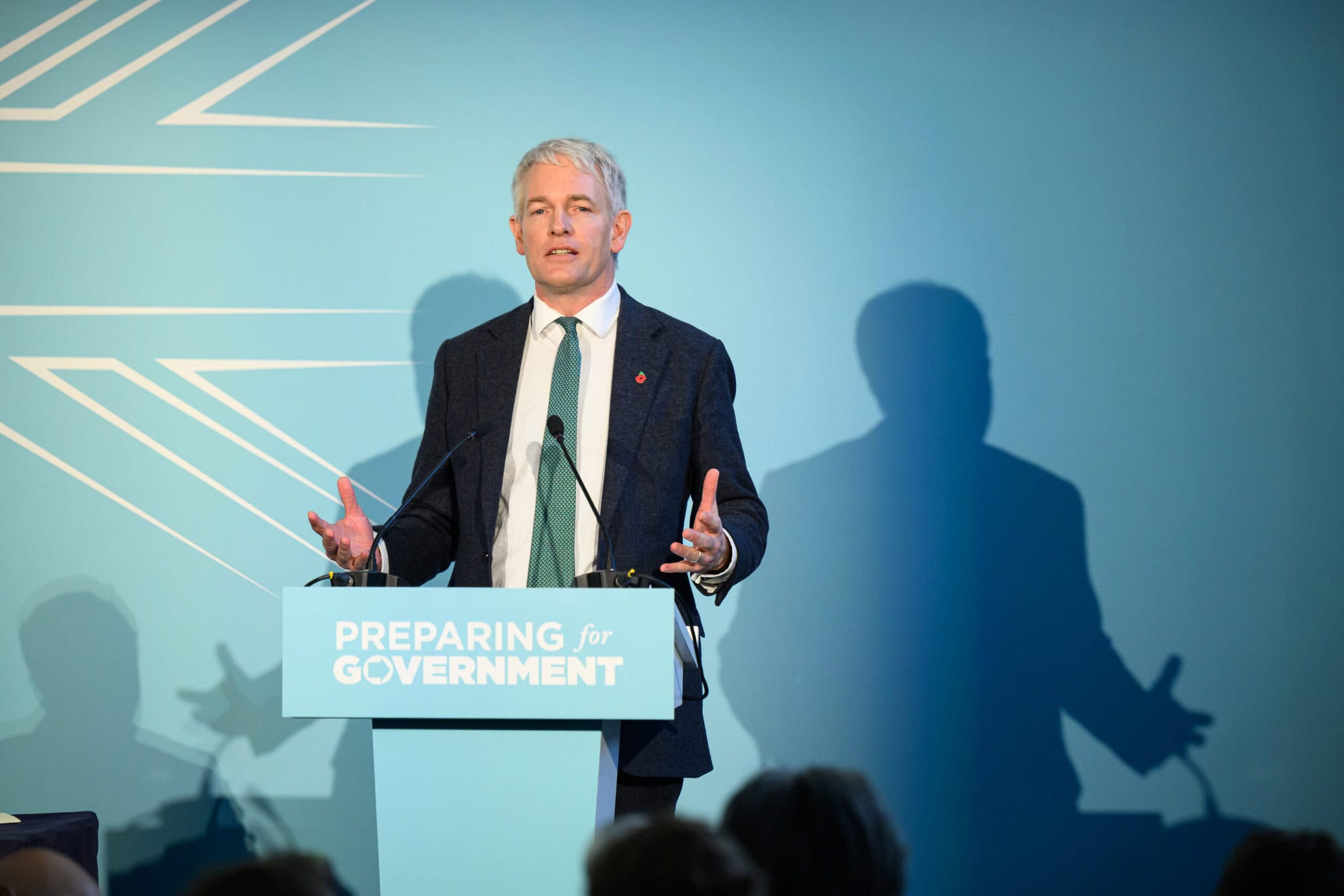
Photo: Leon Neal/Getty Images
Has a party without power ever been scrutinised as thoroughly as Reform?
Kent is Britain’s biggest county council by population, so it should come as little surprise it is being seen as a litmus test for how Reform UK would govern Britain. The answer, so far, is decidedly mixed.
This seems to confirm the laziest assumptions about Reform. They are simply unfit, unprepared and unsuited to govern a council. But what of their national plans?
Today, Danny Kruger – who was announced as the party’s head of a new ‘preparing for government’ unit when he defected from the Tories – and Zia Yusuf made an announcement on how Reform would approach government.
Kruger identified problems that many voters see every day; nothing works, the streets are dirty, taxes and prices are far too high and that immigration is changing our country both too fast and for the worse.
How have we ended up here? Since 1997, he argues, Britain has had governments that have not shared the attitudes of the country, and that were not ‘properly in charge of the state’ – a direct nod to Reform’s intention to undo much of the Blairite constitutional settlement.
Kruger argued that Reform would run a government of ‘national preference’ that puts Britain – and Britons – unashamedly first. To get here, however, he outlined four steps.
The first thing is preparedness; Kruger said that he wanted Farage ‘to sit the civil servants down and tell them the plan’, rather than the other way around; ‘and the plan’, he continued, ‘is going to be a lot bigger and more structural than a few pieces of decorative legislation’. Kruger told the press afterwards that he was drawing inspiration from Trump 2.0.
The second step is to ‘grip to Civil Service’. In order to take back control of the Whitehall machine, Reform will bring in a new Civil Service Code which will make it clear that officials are directly responsible to ministers, not permanent secretaries. That includes being responsible for their jobs, meaning a Reform government will look more towards an American system of a politicised civil service. They will also decrease the size of the Civil Service to pre-Brexit levels – a 30% cut in the size of the Whitehall behemoth.
Third will be the process of ensuring neutrality over what Kruger called ‘the wider system’. This involves addressing potential secondary roadblocks to Reform’s agenda; Kruger identified the potential for the House of Lords to block legislation, for trades unions to ‘sabotage’ plans for public sector reform. He also address legal problems, indicating that a Reform government would exit international conventions that no longer work for Britain. ‘There is a glaring objection that I have to the ministerial code’, Kruger said, ‘which is that it requires them to acknowledge international law in their decision-making. That is an immediate change we would make’. He also said that a Farage government would reform the process of judicial review, in order to curb judicial activism.
Finally, the constitutional fuel that powers the whole endeavour; Reform will reaffirm the notion of parliamentary sovereignty, and restore Parliament’s central role in governing the country. For someone who has written extensively on the need for the decision space of British politicians to be radically expanded, these are more than welcome steps – they are essential, necessary and unavoidable.
Kruger’s underlying contention is that British politicians increasingly do not have the authority to make decisions, and have found their viable political choices are constrained by quangos, international obligations, legal activism, bureaucratic resistance, fiscal oversight, activist pressure and the growing social conformity of an increasingly narrow political class. Placing Parliament – and thus political decision-making – back at the heart of government would resolve the dilemma of ‘shallow sovereignty’ – a condition where governments seem to wield power but are effectively unable to exercise it due to a web of institutional and societal constraints.
But more than anything, Kruger’s plans are helping to put to bed the idea that Reform are not serious about governing. They seem to be thinking about little else. On Bloomberg Weekend, Nigel Farage spoke about his reading list; he has just finished ‘Balfour’s Poodle’ by Roy Jenkins. The book explores the constitutional clash between the early 20th-century Liberal government and the House of Lords. This confrontation began with the 1909 People’s Budget and spanned two general elections, culminating in the Lords’ acceptance of the Parliament Act in 1911. What happens, he asked, if the Lords sought to block a Reform government?
Perhaps the more pertinent question is what happens if they succeed. Should Reform arrive into power with a democratic mandate to address the situation and are prevented from doing so, how will the electorate see it? Will they lay the blame at the feet of Farage, or will they blame the system that stymied him? Given 14 years of failure under Tories who blamed the system, followed by Labour’s seemingly inevitable failure to manage Britain, it seems unlikely to be the former. Then, perhaps, the question will cease to be which democratic party can govern Britain, but if democracy itself can.

Talk about reforming the machinery of government often sounds like a wine tasting. One expert raises the glass, considers the latest initiative and says: ‘An interesting effort, but not enough depth.’ Another detects ‘promising notes of delivery, rather spoiled by departmental silos’. A third finds ‘hints of innovation and accountability, but with a disappointingly familiar […]

Andy Burnham’s Manc-a-Lago plan to escape the Westminster bubble by shipping bits of No.10 to the North is fated to fizzle out: the wrong answer to a problem misdiagnosed. The idea seems to be that physical proximity will make people feel the heart of government better understands them, while the new office will be full […]

For those of us old enough to remember Andy Burnham as a not-especially-effective member of Gordon Brown’s Cabinet in the late 2000s, it is sometimes difficult to see what qualities have made some sections of the Parliamentary Labour Party speak of him as if he were a Merseyside Aragorn. To them, after a self-imposed exile, […]