Property rights could save British fishing
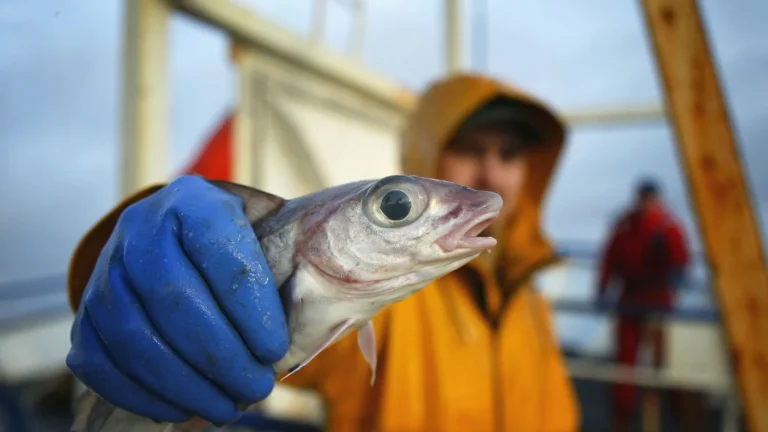
Chris Furlong/Getty Images
When Waitrose suspended mackerel sales over fears of overfishing, it was a warning. Weeks later, M&S followed suit. And as stocks continue to plunge, retail giants like Sainsbury’s and Morrisons sit poised to take similar action.
The crisis in our seas has finally hit the supermarket shelves, but in reality, it runs far deeper. Today, half of our top ten fish species are either overfished or overexploited, and only two catch levels are deemed ‘sustainable’.
Britain’s fishing industry is undeniably on the rocks. Since 2015, the number of fishermen has dropped by 15%, while the size of the fleet has fallen by almost a fifth.
Desperate to grease the wheels of their EU ‘reset’, ministers signed away Britain’s piscine leverage
When a market consolidates, it is supposed to leave those who survive better off. But in this case, it has not. Fishing remains one of Britain’s most poorly paid and dangerous occupations. The rate of fatal injury is 115 times the national average, while the sector is the third-lowest paid in the economy. To dismiss these conditions as challenging is a profound understatement.
It’s a far cry from what fishermen were promised just a decade ago. As Boris Johnson’s battle bus trundled across the country, he heralded Brexit as an opportunity for fishermen to ‘take back control’. British waters would be sovereign once again.
That message was echoed throughout the campaign, and fishermen took it at face value. Over 90% of the industry backed Leave. And from innumerable photo opportunities at fish markets and quaysides, to Nigel Farage’s ‘Brexit Armada’ chugging up the Thames, politicians were eager to turn this goodwill into campaign momentum.
Even after the vote, promises continued to flow. Between Michael Gove’s ‘green Brexit’ guarantee and Theresa May’s assurance that Britain would return to the world stage as an ‘independent coastal nation’, fishermen were promised a ‘sea of opportunity’.
Brexit made all this possible. But ten years after the vote, the gains have been minimal.
Instead of opportunity, the first months of post-Brexit reality brought chaos. Seafood was met with a slew of customs declarations and reams of red tape, and the result was catastrophic. In January 2021, exports to Europe fell by 83%, and catch rotted in trucks marooned at the border. The cost was vast. The agrifood sector lost £60 million from the first year’s paperwork alone, and fishermen picked up a bill estimated at £1 million per day.
Many in the industry were prepared to tolerate the teething problems in the hope of something better. That ‘something’ was to arrive in June 2026, when the transition arrangement was set to end, and Britain would regain control of its waters.
But that day never came. Almost a year earlier, the government sold out its Brexit promises once and for all. Desperate to grease the wheels of their EU ‘reset’, ministers signed away Britain’s piscine leverage. In the twelve years to come, European boats will continue to fish our seas on pre-Brexit terms. The quota uplifts fishermen longed for remain a pipe dream.
Yet despite the broken promises, we cannot be despondent. Whitehall may have surrendered access to our waters, but new ASI research shows how we can use our Brexit freedoms to throw the industry a lifeline through radical domestic reform.
Britain must grant fishermen a stake in the resources they help to conserve. While already a reality for the largest operators, for smaller day-boats that comprise 80% of the fleet, it remains a distant hope. Replacing their insecure allocations with permanent, tradeable assets will give small-scale fishermen a tangible resource to use, sell, or pass down to the next generation.
But property rights alone are not enough. To unlock their true value, we must modernise how quota is bought and sold. By relaxing rigid restrictions and introducing electronic transfers, fishermen can trade in real time. The benefit is flexibility. When a small-boat owner cannot go to sea, they lease their allocation to someone who can. If they exceed their quota, they can buy more in an instant.
Of course, the system needs safeguards. The lesson of Iceland looms large, and we must not make the same mistakes. Proportionate ownership caps are vital, and protecting active, local fishermen from blatant speculation must be a priority.
These ideas are not untested. In the 1980s, facing chronic overfishing and coastal collapse, New Zealand pioneered a similar system. Forty years later, employment and fish stocks have been preserved, and fishermen now operate in an industry that is safer and more efficient. We can have this too.
For too long, our politicians have watched on as the fishing industry languished in a state of managed decline. While we cannot rip up the agreements already signed in Whitehall, we have the power to overhaul the rules that govern our own waters. By seizing these domestic freedoms, Westminster can rebuild trust after a decade of broken promises, and the industry can chart its course for a sustainable and prosperous horizon.
Read the report ‘Plenty More Fish in the Sea’, published by the Adam Smith Insitute here.

‘Just when I thought I was out, they pull me back in,’ says Michael Corleone in ‘The Godfather Part III’. A decade after we voted to leave the European Union, much of the establishment is still in denial about the verdict that was delivered. Andy Burnham has been absolutely shameless. Campaigning in the Makerfield by-election, […]
Whenever I think about Boris Johnson, the old French proverb ‘après moi le déluge’ comes to mind. It means a blithe, even nihilistic disregard for whatever ruination ensues after one’s own time. For many years, it was thought to have originated with Louis XV or his mistress Madame de Pompadour in the 1750s. It thus […]

At a few minutes past six on Friday morning, in a leisure centre on the Essex coast, the returning officer reached the bottom of a ballot paper roughly a metre long and announced a number that deserves more attention than it is likely to receive. Nigel Farage, 22,239 votes. The commentary had settled into its […]