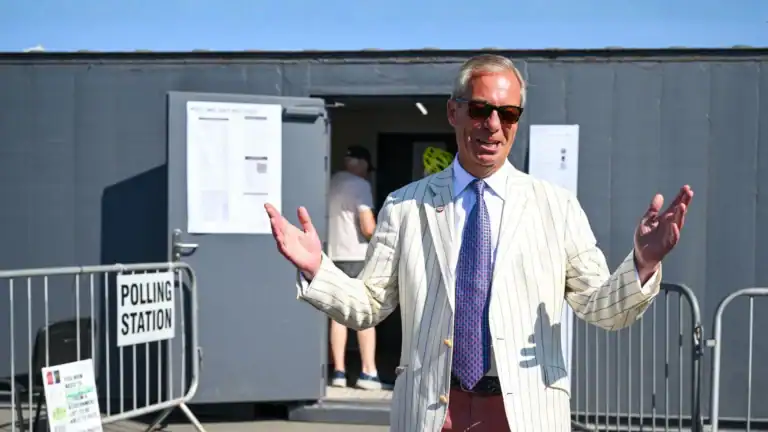
At a few minutes past six on Friday morning, in a leisure centre on the Essex coast, the returning officer reached the bottom of a ballot paper roughly a metre long and announced a number that deserves more attention than it is likely to receive. Nigel Farage, 22,239 votes.
The commentary had settled into its groove long before the count. A fake by-election, a coronation, a man beating a bin. Kemi Badenoch declined to contest what she called Farage’s ‘fake by-election’, Labour and the Liberal Democrats stayed away, and the field was left to the comedian Jonathan Harvey (aka Count Binface), to Laurence Fox, to three separate Monster Raving Loony candidates and to a gentleman calling himself Woke Trump Carrzee. There were 34 candidates in all, a record, beating the 26 who stood against David Davis when he engineered his own by-election at Haltemprice and Howden in 2008. It took the returning officer seven minutes merely to read the thing.
So what could such a pantomime possibly tell us? More than the sniggering allows. Buried beneath the jokes is a result of a kind Britain has produced perhaps twice since the War.
Once a by-election becomes a question of legitimacy rather than representation, voters grow more determined to be heard, not less
At the general election in July 2024, with every major party on the ballot, 21,225 people voted for Farage in Clacton. On Thursday, at an August by-election whose outcome was never in doubt, on a turnout fourteen points lower, 22,239 did. His share of the vote tells us little, since anyone can produce a spectacular percentage when the opposition declines to turn up. His actual vote is another matter. Twenty-two thousand two hundred and thirty-nine people walked to a polling station in the middle of August to vote for a man who could not lose.
Incumbents do not do this. By-election turnout has not exceeded the corresponding general election turnout since Greenwich in 1987, and a defending candidate increasing his raw poll is rarer still. Douglas Carswell could not manage it here in 2014, in the defining by-election of the UKIP years. His 21,113 votes made him UKIP’s first elected MP, and they were still fewer than the 22,867 he had polled as a Conservative in 2010. Davis’s vote at Haltemprice fell sharply. The pundits reaching for the 2014 comparison have it the wrong way round.
The company Farage has just joined is small and instructive. Winchester, November 1997. Mark Oaten had won the seat in May by two votes, a Conservative petition overturned the result and the electorate was required to vote again in the autumn. Turnout fell 10 points and Oaten’s vote rose from 26,100 to 37,006, a majority of two becoming a majority of 21,556. The other case is Fermanagh and South Tyrone in 1981, where Bobby Sands polled 30,492 on an 87% turnout and Owen Carron, five months later, exceeded even that. While the atmosphere there was grief and national conflict rather than electoral theatre, the lesson is the same. Make a by-election a test of a candidate’s legitimacy, and voters grow more determined to be heard, not less.
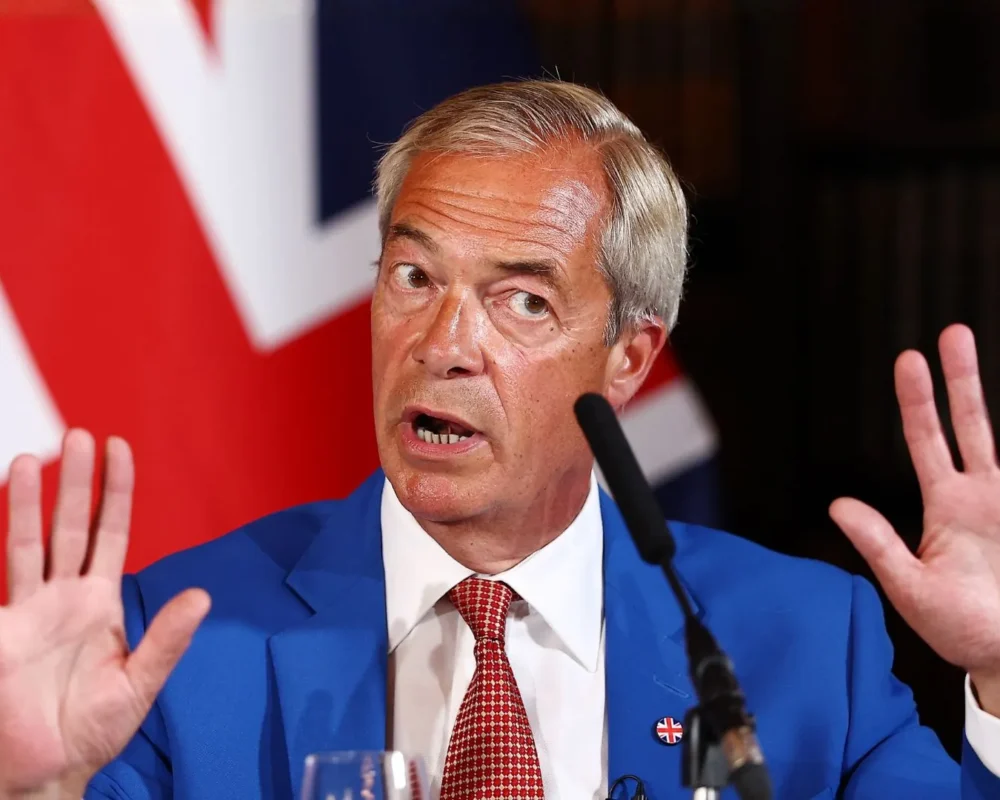
Opponents will focus on Farage’s 63% share of the vote, and argue it is at the lower end of expectations. But vote share means little when the serious opposition has vacated the field. The raw vote is far harder to explain away. Some 35,111 valid votes were cast, against roughly 46,000 at the general election, and the whole of that contraction, and then some, came out of the anti-Farage column, which fell from about 24,700 to 12,872. Farage kept 105% of his general election vote while the contest shrank to three quarters of its previous size.
The abstaining parties meant to demonstrate that the whole exercise was beneath serious politics. What they actually did was strip out the noise. Their absence, novelty candidates aside, left one man who was bound to win, and the people still motivated enough to vote for him just to prove a point. That does not tell us what Farage would poll against a full field. It tells us something his opponents would be unwise to ignore: that offered the easiest imaginable excuse to stay on the beach, more than 22,000 of his voters turned up regardless.
The rest of the ballot paper is a core sample of contemporary English politics. Rejoin EU finished third on 492 votes, 1.4%, in one of the heaviest Leave constituencies in the country. Handed a free run at any residual continental enthusiasm, with no Labour or Liberal Democrat candidate in the way, the cause of re-entry was beaten 19 to one by a man dressed as a bin.
Meanwhile Laurence Fox’s Reclaim managed 347, behind two unknown independents. The assorted standard-bearers of the online harder right scraped barely 600 votes between them in perhaps the most favourable seat in England. Calling Farage a sell-out might generate attention on X, but this electorate had little time for it.
In all, 32 of the 34 candidates lost their deposits. The bin did not. Jonathan Harvey’s 9,455 is the best result a satirical candidate has ever recorded at Westminster. But the protest vote has to go somewhere, and when the big parties funk the fight it will settle on whatever is standing, up to and including a bin.
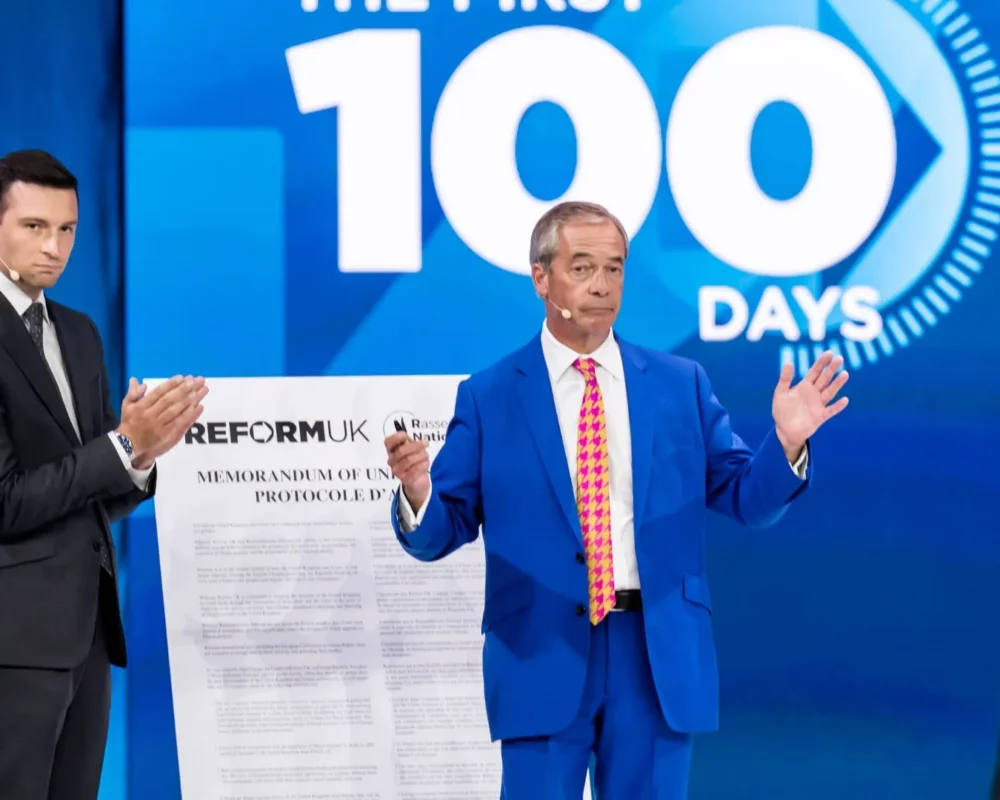
There was a quieter dividend for Reform UK. For six weeks Clacton served as a live electoral exercise of the sort parties would pay handsomely to buy. Thousands of activists worked the party’s election software under battle conditions, running canvass returns, manning the telling and practising getting supporters to a polling station. The parties that stayed away learned nothing, and armies that skip manoeuvres discover what they’ve missed when the shooting starts. Reform, meanwhile, now holds a more detailed map of its support in Clacton, and of its absences, than any party holds anywhere in the country. In the long run that may be worth more than the 63%.
Stay informed with our free daily briefing.
The Standards Commissioner has wasted no time in reopening his investigation into Farage’s donations, and will report in due course. If the committee recommends a suspension of more than 10 sitting days, a recall petition will follow – and Binface has more than enough voters to trigger another by-election. Badenoch has already promised that next time the ‘grown-up’ parties will graciously attend. Perhaps they will. But what then? Every modern instance of the political class requiring a constituency to vote again has ended with the electorate returning the same verdict more loudly. Clacton has just signalled its willingness to follow suit.
So will there be another by-election? Perhaps. Parliament’s machinery grinds on and the committee corridor has its own micro-climate. But the voters’ answer won’t change. If the parties that boycotted this contest have any sense, they will leave well enough alone.
Gawain Towler is Senior Adviser at Bradshaw Advisory and the former Director of Communications at Reform UK.
More Reform
16 Sep 2026
Ideas
Andrew Tettenborn
Billionaire donors are good for democracy
You could almost hear the revolutionary vitriol dripping onto the Labour benches during Monday night’s Lords debate on political donations, following the announcement of Reform’s £72 million bonanza from two crypto billionaires with UK voting rights but recent residence abroad. ‘An undermining of democracy and rampant Americanisation’, one peeress spat out. A case of ‘the […]
09 Sep 2026
Energy & Environment
Ted Newson
The Right can care about the climate without Net Zero
The verdict is clear. The Right has woken up to the innate statism associated with a statutory Net Zero target. Reform UK reject it outright, and the Conservatives have pledged to scrap the 2050 deadline and the 2008 Climate Change Act by which net-zero targets are enforced. Both accept the approach is a millstone around […]
04 Sep 2026
Reform
Joseph Dinnage
Can Reform deliver their post-Thatcherite promises?
The last time I wrote about Reform UK’s annual conference I was doing it as the Deputy Editor of this fine publication. A year on, how much has changed? Greeting you as you enter the conference hall is the familiar fare for the familiar fee. Chicken and chips stands sit next to anti-Labour propaganda, accompanied […]
Manage Consent
To provide the best experiences, we use technologies like cookies to store and/or access device information. Consenting to these technologies will allow us to process data such as browsing behavior or unique IDs on this site. Not consenting or withdrawing consent, may adversely affect certain features and functions.
Functional Always active
The technical storage or access is strictly necessary for the legitimate purpose of enabling the use of a specific service explicitly requested by the subscriber or user, or for the sole purpose of carrying out the transmission of a communication over an electronic communications network.
Preferences
The technical storage or access is necessary for the legitimate purpose of storing preferences that are not requested by the subscriber or user.
Statistics
The technical storage or access that is used exclusively for statistical purposes.The technical storage or access that is used exclusively for anonymous statistical purposes. Without a subpoena, voluntary compliance on the part of your Internet Service Provider, or additional records from a third party, information stored or retrieved for this purpose alone cannot usually be used to identify you.
Marketing
The technical storage or access is required to create user profiles to send advertising, or to track the user on a website or across several websites for similar marketing purposes.