Burnham’s EU dreams would be an expensive nightmare
Before the Brexit referendum, the think tank Open Europe estimated that 100 EU regulations alone cost the UK £33 billion each year
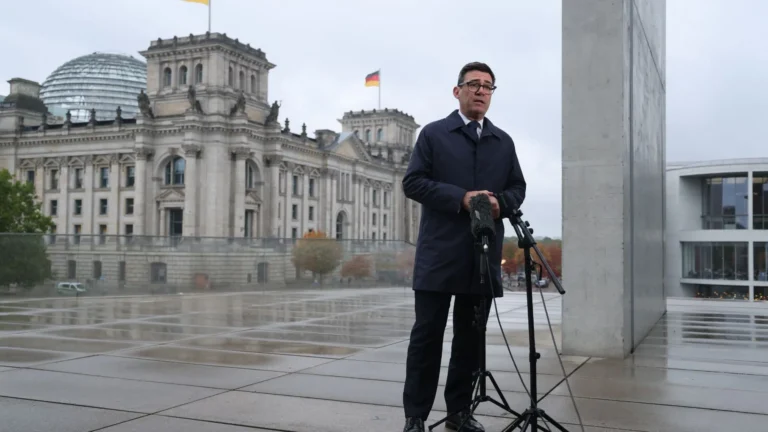
Sean GALLUP / POOL / AFP via Getty Images
Before the Brexit referendum, the think tank Open Europe estimated that 100 EU regulations alone cost the UK £33 billion each year
‘Just when I thought I was out, they pull me back in,’ says Michael Corleone in ‘The Godfather Part III’. A decade after we voted to leave the European Union, much of the establishment is still in denial about the verdict that was delivered.
Andy Burnham has been absolutely shameless. Campaigning in the Makerfield by-election, before he became Prime Minister, he said: ‘I am not proposing that the UK considers rejoining the EU. I respect the decision that was made at the referendum and it’s going to undermine everything I’ve said about strengthening democracy if we don’t respect that vote.’ That was just five months ago.
We would be expected to abolish the pound and join the euro. We would be obliged to accept free movement. We would have to scrap our independent trade deals
Then last month he told the BBC he wanted to ‘look at the options’, adding that to stay as we are is an option. Or: ‘We could look at what George Osborne has said about a customs union, we could look at what the Liberal Democrats said at their conference about the single market or we could go all the way.’
To help undermine the referendum result, he told The Rest is Politics podcast there had been Russian interference. ‘I’ve had the clear answer that, yes, there was,’ he said. This went much further than the previous official position that such interference was attempted, but did not succeed. His official spokesman later issued a statement confirming that the Prime Minister does accept the referendum result as ‘legitimate’, but the damage was done.
I do vaguely remember that Russia Today broadcast pro-Brexit messages to its tiny number of British viewers. To the extent it had any influence at all, it made Brexiteers like me feel embarrassed to have Putin on our team.
In any event, once Brexit had finally been delivered, Putin had little reason to be pleased. The UK was months ahead of other countries in providing military supplies and training to Ukraine. It is rather doubtful we would have been able to operate with such agility had we been within the confines of the EU’s Common Foreign and Security Policy, needing approval from the EU’s High Representative and their other structures – with all the deliberations about whether a member state acting unilaterally broke the ‘doctrine of sincere cooperation’. We might reflect on how Russia’s invasion might well have gone much more smoothly had it not been for Brexit.
A more familiar charge that the EU referendum was not legitimate was that the electorate had been misled. There have been endless complaints about the notorious declaration on the Vote Leave campaign bus which read: ‘We send the EU £350 million a week, let’s fund our NHS instead. Let’s take back control.’ This was the gross figure and did not take account of the rebate. Vote Leave defended it on the grounds that we did not have control over how the EU spent money in the UK and that the rebate was not something we could count on as of right. Yet Remain campaigners were duly provoked – and spent a lot of time declaring that the true sum was £250 million or £120 million a week. The punters concluded it was rather a lot whichever figure was accurate and that it would be prudent to cancel our subscription.
There was a broader case to be made that the biggest savings could come from no longer following EU directives. For instance, the EU Renewable Energy Directive obliged us to have higher energy bills – with the threat of fines for missing various climate change targets. But since we replaced that with similarly onerous net zero domestic legislation, Brexit hasn’t made much difference in that respect. Before the referendum, the think tank Open Europe estimated that 100 EU regulations alone cost the UK £33 billion each year. But timidity has meant our potential to ease red tape has been a missed opportunity, thus far.
But going back to the direct cost of our membership subscription, what would it be if we rejoined? Doubtless there would be protracted negotiations. There would still be some argument and complexity about the most reasonable figure to highlight. What is pretty clear is that the cost would be much more than £350 million a week. Probably around double.
For a start, the EU budget has got much bigger. It’s up from €143.9bn in 2016 to €190.1bn this year.
We dodged a huge final bullet with Brexit – the EU Covid Recovery Plan. ‘We have the vision, we have the plan, and we have agreed to invest together €806.9 billion,’ boasted the European Commission. ‘The largest stimulus package ever.’ Repayment on that debt starts in 2028.
Then there is the matter of the UK-EU budget rebate. That was negotiated in June 1984 by Margaret Thatcher at the Fontainebleau European Council summit – after she persistently told them: ‘I want my money back.’ Nobody seriously expects we would be able to keep the rebate if we go back in now.
Britain Unbound has offered a hypothetical analysis of United Kingdom contributions to the EU as a full member state in 2028. The central estimate is €42 billion – around £35.5 billion, which would come to £680 million a week.
But the bill would keep going up after that. This week the Financial Times reports efforts by Ireland to seek agreement over the escalating costs, which has prompted disgruntlement from net contributors such as Germany. The Irish propose ‘new EU-wide taxes of €55 billion a year’ as a way forward. However much arguing there is, it is hardly likely the budget will come down.
In some ways, rather than rejoining, the UK’s wish to become an EU member would be treated as a new application. Any special concessions from the past would not apply. Rather the contrary, we could expect punitive terms as a warning to anyone else seeking to escape the bloc in the future.
We would be expected to abolish the pound and join the euro. We would be obliged to accept free movement. We would have to scrap our independent trade deals.
Once the implications are explained, the support for the idea in opinion polls tends to plummet. It’s not a realistic proposition, and I suspect Burnham probably realises this. The political rationale is that with a fragmented voting share across several parties, the need to woo tactical votes from Liberal Democrat and Green Party supporters becomes ever more important. The danger for Burnham is that as the details emerge, the cynical nature of the ploy will be all too apparent.

Whenever I think about Boris Johnson, the old French proverb ‘après moi le déluge’ comes to mind. It means a blithe, even nihilistic disregard for whatever ruination ensues after one’s own time. For many years, it was thought to have originated with Louis XV or his mistress Madame de Pompadour in the 1750s. It thus […]
At a few minutes past six on Friday morning, in a leisure centre on the Essex coast, the returning officer reached the bottom of a ballot paper roughly a metre long and announced a number that deserves more attention than it is likely to receive. Nigel Farage, 22,239 votes. The commentary had settled into its […]
This weekend the Telegraph ran a story with the striking headline ‘Burnham told to trade nuclear umbrella for access to single market’. The idea is the brainchild of Nick Boles, the former Conservative MP who quit the party in 2019 over Brexit, switched his allegiance to Labour and helped to advise Keir Starmer on the […]