Net Zero is falling apart, one target at a time
The Government is set to water down the Zero Emission Vehicle mandate, which sets targets for the sale of new cars
Ian Forsyth/Getty Images
The Government is set to water down the Zero Emission Vehicle mandate, which sets targets for the sale of new cars
This week it seems that another Net Zero domino will fall. The Government is reported to be on the point of announcing that the Zero Emission Vehicle (ZEV) mandate, which lays down targets for the sale of new cars, will be watered down. This follows a consultation launched in August. At present, manufacturers are under an obligation to ensure that a rising percentage of their vehicles are pure electric or else face punitive fines of up to £12,000 for every petrol and diesel vehicle they sell over the limit. The required proportion rises from 33% in 2026 to 80% in 2030 and thereafter to 100% by 2035, at which point even hybrids will be banned. The UK car industry is falling well short of the targets, in spite of offering large incentives on electric vehicles. 26.6% of new cars sold in Britain so far this year have been pure electric. The industry also fell short of the 22% and 28% targets in 2024 and 2025 but largely avoided fines because of get-out clauses which made some allowance for increased hybrid sales.
Virtually every interim target on the way to the Government’s overall, legally binding 2050 Net Zero target is being abandoned, or relaxed, as it flies headlong into reality
Actually, the situation for UK manufacturers is more dire than the above figures suggest. A growing share of electric vehicle sales are coming from Chinese manufacturers who are able to undercut European ones, thanks in part to China’s dominance in battery manufacturing. Jaecoo accounted for 1.2% of the UK market in 2025 and 3.4% so far in 2026. BYD increased its market share from 2.3% to 3.9% over the same period. In other words, European manufacturers are falling shorter of the ZEV target than the overall figures suggest. It is becoming painfully clear that a continuation of the ZEV mandate on its current trajectory is going to cause further serious damage, if not deliver a fatal blow to UK car manufacturing. Some ministers, including Business Secretary Jonathan Reynolds, are said to favour reducing the 2030 target to 50%.
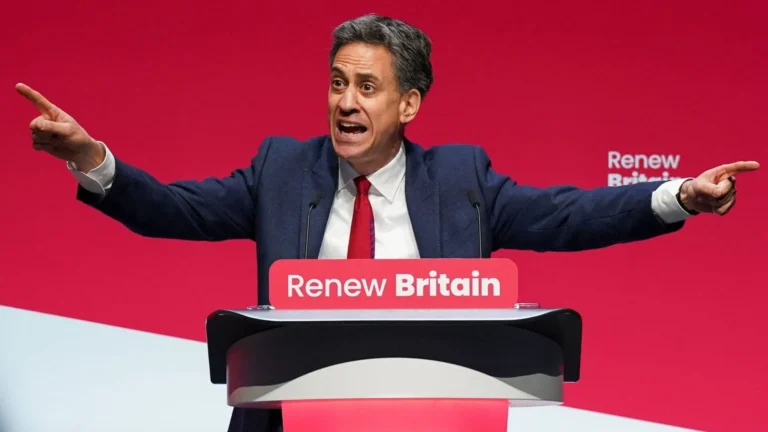
Unsurprisingly, Labour’s Net Zero fundamentalists such as Ed Miliband are reported to be against reducing the target. But the issue is complicated by Andy Burnham’s negotiations for a reset of Britain’s relations with the EU. Electric vehicles represent one area in which UK regulation, post-Brexit, has been more stringent than EU regulation. EU rules already allow for a small proportion of cars manufactured after 2035 to have internal combustion engines. The European Parliament’s Environment Committee last week voted for a further relaxation. If Burnham signs up for a deal which forces Britain into ‘dynamic alignment’ with EU regulations, it will almost certainly mean us having to adopt the same EV targets as the EU. Labour ministers who are both Europhile and Net Zero fundamentalists are going to have to choose what is most important to them.
But there is something even more significant to be drawn from the revision of ZEV targets. Virtually every interim target on the way to the Government’s overall, legally binding 2050 Net Zero target is being abandoned, or relaxed, as it flies headlong into reality. New oil-fired boilers were due to be banned from 2026, gas-fired boilers by 2035. There were going to be 600,000 heat pump installations a year by 2028.
All these targets have gone, once it became clear that they could not be met. Moreover, the electricity grid was going to be fully decarbonised by 2030; that target has already been subtly downgraded to 95% carbon-free and is coming under constant pressure. Another target soon to go will likely be the one requiring 10% of jet fuel used by airlines to be Sustainable Aviation Fuel (SAF) by 2030. The Government confirmed this target last month, but as with ZEV, the use of SAF is running well behind track.
Yet at the same time the Government continues to insist that it remains committed to its overall Net Zero target of 2050. But how does it expect to be able to achieve that when it is on a trajectory well short of what it used to think was necessary to achieve this? The year 2050, perhaps, still lies such a distance into the future that the current generation of ministers and MPs feel they don’t need to worry about it too much. At some point, though, the 2050 Net Zero target is going to reach a crunch point at which it has to be relaxed, if not abandoned altogether. I doubt the current Government will want to make the call, but I will give the 2050 Net Zero target until 2030 at the latest.

Ed Conway is a great economic commentator. Yet even the best of us err. In a long essay for the New Statesman, the Sky News economics and data editor recently argued that Britain runs on what he calls the ‘MoneySavingExpert model’. ‘The country’s guiding principle,’ Conway wrote, ‘from the Thatcher years to the Blair ones […]
This week, Nimby Watch is in Cardiff Bay, at the site of the Welsh Senedd Oooh…Wales. Why are we here? Surely you’re not about to kvetch about the Senedd building. They finished it 20 years ago! I’ll admit it’s not my favourite building from the outside – very generic glass-and-steel – but the inside is […]
A quick show of hands. How many of you have a working torch in the kitchen drawer, and not just on your phone? Candles, matches or a working pack of AA batteries? What about a week’s worth of tinned food, a camping stove, a full jerry can? A generator? Most readers will have answered no […]