Let’s get Britain working again
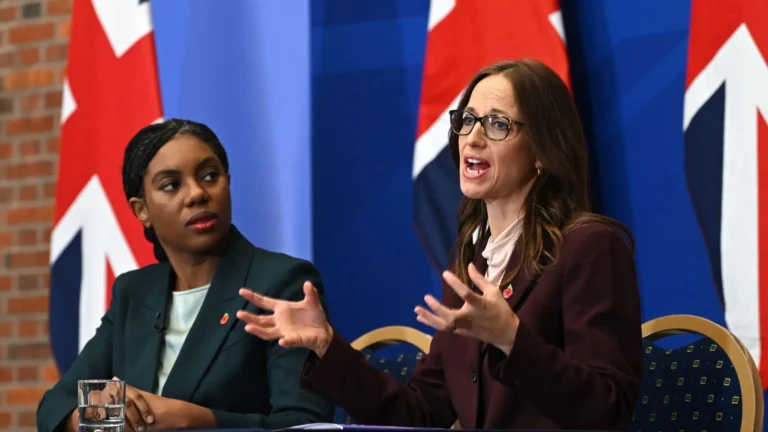
Leon Neal/Getty Images
This is the transcript of a speech delivered on November 10, 2026.
Nikki is a mum in her fifties. On Universal Credit – since her job in a nursery became all too much. Without qualifications and – as she put it – no good at computers, she’s been struggling to find another job.
But that’s not why she came to see me.
Her real worry was her son, Jack – who signed on the moment he turned 18. He’s got autism and ADHD, but Nikki wants him to work. She’s frustrated the state is paying him money to stay at home – and she desperately wants the Jobcentre to get on his case.
But no sign of that. So Jack is literally left to his own devices – gaming in his bedroom most of the time. Who would want that life for their child?
But stories like Jack’s are increasingly common. It’s a disaster. Hundreds of thousands of young people setting out on a life on benefits.
Next week Alan Milburn will tell us the answer to the NEETs crisis is to spend yet more money: on subsidised work placements and ineffective government schemes. We have a better plan
When William Beveridge set out his vision for the post-war welfare state, he did not foresee this.
A system to help widows, the war-wounded and the desperately poor is now paying benefits to 25 million people: 6.7 million of working age, but out of work; 700,000 under 25.
How has it gone so wrong?
I started my job as Shadow Welfare Secretary by going to see for myself. Blackpool, Birmingham, Manchester, Newcastle, Cardiff, Leicester, Margate… even Germany.
Insiders have come forward to speak to me. Jobcentre coaches, tribunal judges, Personal Independence Payment (PIP) assessors, psychiatrists, GPs, charity workers. All exasperated by the system they work in.
I’ve met families where three generations have never worked… and a young man trying to break that cycle, only to find his family told him to stop working because his alarm clock was waking them up.
People are making a mockery of the system. Bragging about their free Motability cars, flaunting their new keys on TikTok. They think it’s a victimless crime. It isn’t.
18 million working households will each pay £50,000 in taxes for working-age welfare this Parliament. Every pound claimed by someone exploiting the system comes from somebody else. Someone who gets up, goes to work and pays their taxes, and most likely will never afford a brand-new car.
This wasn’t the aim of our post-war welfare state. It’s the sign of a deeply broken one. And we will fix it.
Labour have made benefits more generous and easier to claim. Their taxes and red tape have destroyed jobs, so work is harder to find. No wonder unemployment is up, inactivity is up – and welfare is up.
Last time Labour left power, David Cameron’s government inherited high unemployment and a rising welfare bill. In opposition, Iain Duncan Smith had already done the hard work on welfare reform. We had a plan. We introduced Universal Credit – and we turned the economy around.
Hundreds of thousands of people came off welfare and into work. But then came the 2020s. Benefit claims for mental health and neurodiversity started to rise. We had the pandemic. Assessments moved online. ‘Sickfluencers’ took to social media to coach people how to game the system.
And then Labour showed up with no plan.
They cancelled our reforms, U-turned on their own and have flailed about ever since – with neither the will nor the way to bring it down.
As my counterpart the Welfare Secretary said, all Labour MPs ask is how they can tax people more to pay for more benefits.
Not that reforming welfare should be done, to coin a phrase, through ‘crude cuts’. It takes hard graft: working out who should get support, what help they should get and how you make sure the system does what you intend it to do.
We have not gone about this by plucking a big round number out of thin air. We are publishing the detail behind our savings policies.
We will tighten eligibility for sickness benefits, so you can no longer claim for mild mental health and routine back and joint pain, and reform child Disability Living Allowance (DLA) to move to a support-based model, saving £13.7 billion and £2.8 billion respectively.
We will end benefits for foreign nationals, saving £9.5bn.
We will save £4.5bn by reforming housing benefit and bring back the two-child benefit cap, saving £3.1bn.
We’ll strengthen the Household Benefit Cap, end VAT exemptions for non-adapted Motability cars and crack down on benefit fraud, between them saving £3bn.
And finally, we’ll tackle long-term unemployment, saving another half billion. Altogether, even allowing for £1bn to account for overlapping impacts, this takes us to £36.1bn in savings.
We know this won’t be easy. We will need the courage of our convictions to see it through. And if we’re going to ask people to fund our welfare system, it needs to do what they want it to do.
That’s why our plan is grounded in five clear – and widely held – principles: fairness, contribution, responsibility, welfare as a safety net – not a lifestyle choice – and living within our means.
Fairness – because people on benefits shouldn’t be better off than people in work.
Some households are getting thousands more in welfare than from a full-time job. And people who’re working say to me – why do I bother? Our reforms will make work pay, and we will restore the two-child limit, because working families don’t get a pay rise when they have another child. Nor should people on benefits.
We’ll restore contribution in our welfare system. Over a million people have been unemployed and claiming Universal Credit for over six months. Some have never worked. If you’ve paid in, it’s right you get help to get back on your feet. So people who’ve worked will continue to get Universal Credit as normal.
But those who’ve chosen not to work will see their benefits drop by a third after six months, and paid onto a ‘Back to Work’ card that can’t be used for alcohol, cigarettes, gambling or cash.
For those who suggest this is a nanny-state measure – not at all. This is not their money: it’s taxpayers’ money.
We back personal responsibility. The state shouldn’t always be the first port of call. For British citizens, there’s an implicit social contract. You pay in when you can – but anyone can fall on hard times. There should be a safety net.
But our social contract has limits. Our welfare state cannot support everyone who comes to Britain. Migrants come here believing we will give them money, free healthcare and a house. That has to change.
We will stop giving benefits and social housing to foreign nationals with indefinite or limited leave to remain. As well as the savings, that will free up 230,000 social homes for British people.
We cannot be a cash machine for the world.
We want people who are seriously sick and disabled to live with dignity. But the number of people claiming PIP has doubled since 2019 to 4 million. Our country has not got twice as sick.
Child DLA is rising rapidly too. Half a million more children will be signed on under this Government. Some have serious illnesses. But not all.
We are telling hundreds of thousands of children that they are disabled – and that they need to have handouts from the state. Most will go straight from DLA onto PIP.
We’ve created a conveyor belt onto a lifetime on benefits. This is a terrible thing. That’s why we will reform child DLA and the PIP system.
One in six PIP claimants say they don’t have extra costs from their condition. For those with milder conditions we will shift from cash handouts to treatment and support. And you won’t get free Motability cars for anxiety and ADHD.
We are going to return welfare to its proper purpose: a safety net, not a lifestyle choice.
And finally – we need to go back to living within our means. The best way to do that is to get people off welfare and into work. Which brings me back to Jack.
There are almost a million young people not in education, employment or training (NEET). Writing anyone off on benefits is wrong – but writing off a young person is unforgivable.
Next week Alan Milburn will tell us the answer to the NEETs crisis is to spend yet more money, on subsidised work placements and ineffective government schemes.
We have a better plan.
Young people I speak to want real jobs. So we will halve Labour’s Jobs Tax for under-25s and scrap swathes of their Employment Rights Act. We’ll bring back the Saturday job, the summer holiday job. There’ll be thousands more first jobs for young people. And our ‘tough love’ plan will get young people off welfare and into work.
Do not think for a second that Labour will fix welfare. After two years and two prime ministers, all they have done is kick the can down the road.
They U-turned on their welfare reforms. They’ve admitted they won’t make any savings this Parliament. As for Burnham’s 10-year plan – there won’t be any savings in that.
Thank goodness Labour are not going to get 10 years.
We know what needs to be done. We have a plan. No more taxpayers being taken for a ride. Help for those who need it most. Fewer people taking out, and more people putting in. The bill back under control. A welfare safety net, not a lifestyle choice.
We will fix welfare – and get Britain working again.

Andy Burnham’s much-promised strong and decisive leadership has been long on vibes, short on action during his first 100 days. With one telling exception. He has stuck to his guns about what the nation should call white bread rolls. Namely, ‘barm cakes’, as they do in his new constituency of Makerfield. In doing so, he’s […]
The problem with being a political golden boy like Labour pensions minister Torsten Bell is that it paints a target on your back, putting you firmly in the crosshairs of rivals and commentators in your own party and the opposition every time you do or say anything at all. Kudos, then, to the man widely […]
In 2010, Paul Krugman wrote a New York Times column titled ‘Learning From Europe’. For decades, Europe was the model that American left-leaning economists wanted America to follow: a big welfare state, generous welfare programmes and large-scale redistribution. But it seems something has changed. Krugman has now written about France being on a ‘fiscally unsustainable […]