Labour are taking us down a path of humiliation
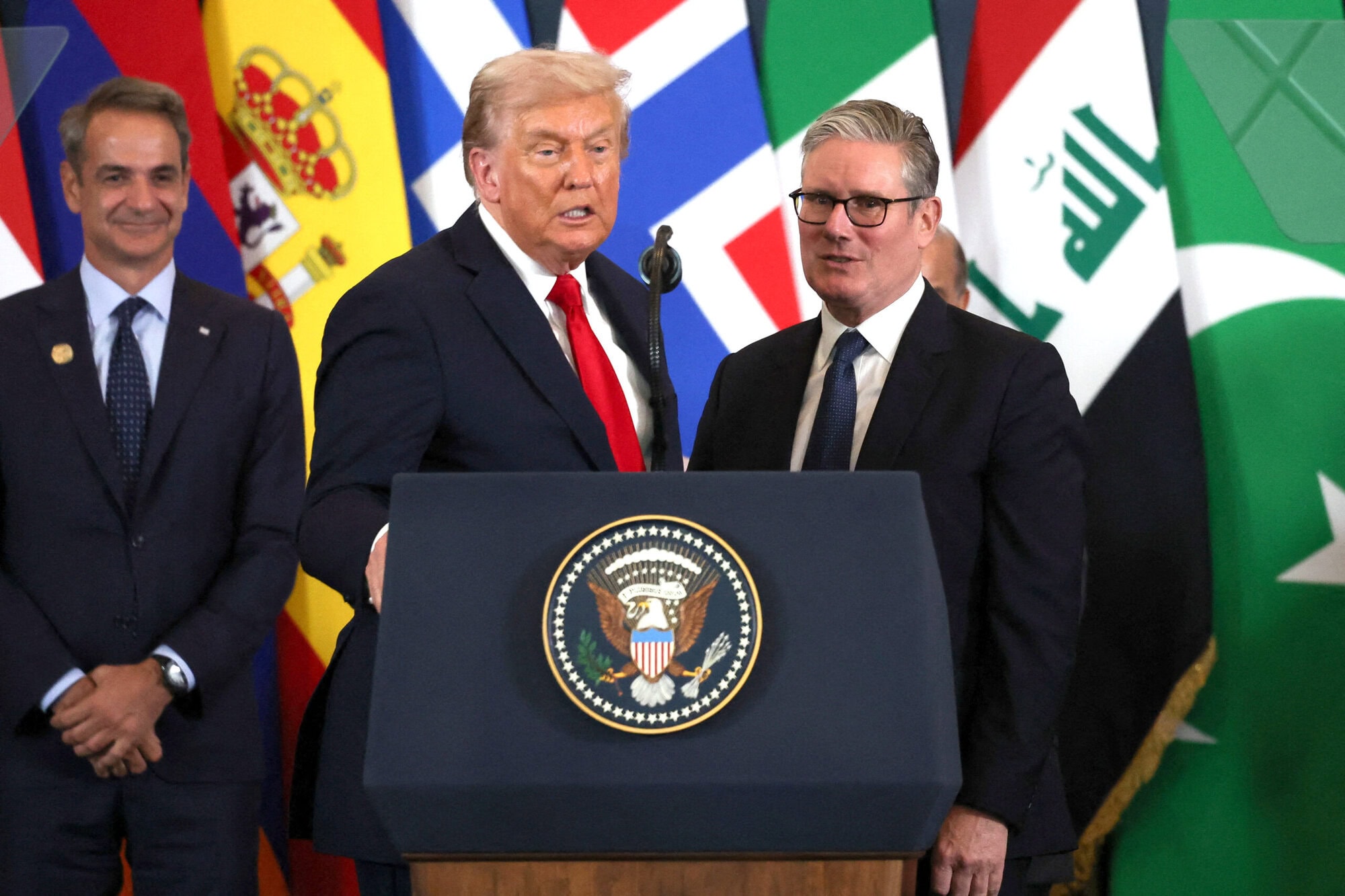
Photo: Suzanne Plunkett - Pool / Getty Images
Just over two years on from one of the worst attacks on Jews since the Holocaust, and the beginning of a conflict that has left Gaza in ruins, it looks as though a semblance of peace may be brought to the Middle East. Under the terms of a ceasefire deal brokered by Donald Trump, the remaining hostages in Gaza will be exchanged for Palestinian prisoners held in Israeli prisons.
In Sharm el-Sheikh, the Donald had this to say:
All I’ve done all my life is deals. The greatest deals just sort of happen… That’s what happened right here. And maybe this is going to be the greatest deal of them all.
It’s hard to argue with him – even those on the Gaza-obsessed Left have to concede that Trump has achieved something remarkable with this agreement.
Since its establishment, the state of Israel has remained perpetually at war with its neighbours, and forging peace in the region has defied generations of Western statesmen. Trump, however, is a very different beast. Unlike presidents who came before him, he is not a politician constricted by the need to subscribe to the rules and conventions of an imagined liberal international order. He recognises that most of the world is not like the United States or cushy western Europe, with our comfortable living standards and democratic peace. In actuality, it is the state of nature that prevails, and to bring about peace between nations whose raison d’etre is to see the other destroyed requires brutal trade-offs and naked incentives.
While getting this deal over the line was an extraordinary achievement, the ceasefire is already proving fragile. The wording of one grim section of the 20-point plan has caused issues: ‘For every Israeli hostage whose remains are released, Israel will release the remains of 15 deceased Gazans.’ Israel is claiming that one of the corpses returned by Hamas yesterday is not one of the hostages who were held in Gaza and that this could constitute a breach of the deal. Clearly, there is still much to iron out.
Whatever the long-term outcome of this deal, one thing is certain – the supranational rule-making bodies of the liberal order are out, and the transactional diplomacy of realism is in. This makes it all the more fascinating that Tony Blair – whose approach to the Middle East as prime minister was the high watermark of all the contradictions and duplicity of that old system – has been so intricately involved in drafting this agreement. The final ceasefire deal was modelled on a document drawn up by Blair and Jared Kushner, and so liked is he in Washington that Trump is considering appointing the former prime minister to sit on the ‘Board of Peace’ that will administer Gaza.
Blair is patently no fool and recognises that the nature of geopolitics is shifting. He is also a man blessed with many influential contacts, the most relevant of which – to us in the UK at least – is our dear Prime Minister. Perhaps he could advise Keir Starmer on how his Government could sharpen its approach to international relations.
Although he is no longer Foreign Secretary, David Lammy has set the UK’s foreign policy on a disastrous and often confusing course. This has been done under the banner of what Lammy calls ‘progressive realism’. The man himself defines it as this:
Progressive Realism advocates using realist means to pursue progressive ends. For the British government, that requires tough-minded honesty about the United Kingdom, the balance of power, and the state of the world. But instead of using the logic of realism solely to accumulate power, progressive realism uses it in the service of just goals – for example climate change, defending democracy, and advancing the world’s economic development. It is the pursuit of ideals without the delusions about what is achievable.
Given that Lammy is also the man who went on Mastermind only to claim that Henry VII succeeded Henry VIII, the irony of his words may be lost on him. Labour have indeed pursued all of this, and in doing so proven how self-destructive the Government’s obsession with ‘just goals’ can be.
The high point of Lammy-thought was the Chagos Islands debacle. By agreeing to cede control of the British Indian Ocean Territory to Mauritius to atone for our imperial past in Africa, we have given a Chinese ally a dangerous level of access to the US-UK Diego Garcia airbase, and to top it off, we’re going to pay for the pleasure – an estimated £34.7 billion over the next century. The good folk at Guido Fawkes reported yesterday that the Mauritians have now signed a deal with India to allow New Delhi to set up a ‘satellite tracking station’ near Chagos.
Labour’s foreign policy blunders don’t stop there of course. In addition to using taxpayer bucks to give African island nations carte blanche to carve up our former overseas territories, the Government is now embroiled in a scandal over its relationship with China. After it was reported that the case against two British parliamentary staffers accused of spying for China had been dropped by the Crown Prosecution Service, many are speculating whether the decision was political. After all, given that Labour have failed so catastrophically in their mission to get our economy growing, they have had to court the Chinese for increased investment. Accused of using his influence to collapse the trial, Jonathan Powell – another of Labour’s international tsars alongside Blair – has been dragged into the centre of the scandal. Although the Government strongly denies these charges, the pressure has now reached a critical point and today Starmer confirmed that he will publish the evidence the Government submitted in the case.
Yet despite the obvious failure of their foreign policy strategy, senior Labour figures are still churlishly defensive against the changing international political scene. On Sky News, Bridget Phillipson – the Education Secretary – gave her two cents on Trump’s peace deal. She was keen to stress the ‘key role’ the UK apparently played in getting it over the line, but was less willing to congratulate the US President.
What the likes of Powell and Blair – who, whatever you think of them, are canny and effective operators – have been able to grasp that the Parliamentary Labour Party often has not is an essential fact of modern British life: that despite the afterglow of imperial grandeur, we are no longer meaningfully a great power.
It would be one thing to grandstand about Palestinian statehood and the right of the Mauritians to claim our territory if we had an economy and military the size of America’s, but we do not. When we make these pronouncements, they are done on the basis of shoring up our soft power, but in reality it degrades our international standing by making us look like delusional, impotent pushovers. Britain still has much to offer the world and we can clearly play a significant role in influencing global events, but as long as our leaders stick their fingers in their ears and operate under geopolitical rules that no longer apply, we will continue down this path of humiliation.

In the graphic novel ‘Ministry of Space’, an alternate history is imagined whereby Great Britain nabs the Nazi rocket scientists before the US or USSR. Churchill becomes, in addition to his other (real) accolades and achievements, the father of the British space programme that sees us win the space race. There is a particularly poignant […]

Sam Altman, CEO of OpenAI, and Dario Amodei, CEO of Anthropic, have called for increased regulation of AI to slow down the pace of development. They warn in apocalyptic terms of the dangers their own technology poses. After Jacob Coxon, a researcher, resigned from Anthropic, stating that he could no longer justify working on AI […]

We live in an age of rapid economic change. New technologies are having an impact on the world that was unthinkable a generation ago; and industries are more mobile than ever, meaning that supply chains get reshaped, new centres of growth emerge and we see the resulting shifts in the balance of economic power. Yet […]