Labour’s China strategy faces its first real test

STEFAN ROUSSEAU/POOL/AFP via Getty Images
Keir Starmer will be packing his suitcases and selecting his travel outfit for his visit to Beijing later this week, the first for a British premier since Theresa May in January/February 2018. Like his predecessor, the Prime Minister will be accompanied by a substantial delegation of business and trade leaders, as well as the Chancellor of the Exchequer, Rachel Reeves. Both Reeves and Starmer may well have calculated that even a genocidal dictatorship will currently offer them a warmer welcome than Westminster.
Starmer also has the same objective as May did: desperate for economic growth to breathe life into a disintegrating premiership and stave off even would-be assassins as unprepossessing as Andy Burnham and Wes Streeting, he sees China as a glittering source of investment and commerce. He will have been given hope by the recent visit of Canadian Prime Minister Mark Carney, as a result of which China will slash its tariffs on canola seed imports; in return, Canada has agreed to lift its effective import ban on Chinese electric vehicles.
Mark Carney is striking out towards a transformed relationship with China. ‘We are forging a new strategic partnership,’ he announced, ‘that builds on the best of our past, reflects the world as it is today and benefits the people of both our nations.’ He does so informed by the volatile attitude of his southern neighbour, the United States, with which the Canadian premier can no longer rely on a near-inseparable and fraternal alliance.
When Canada’s deals with China were unveiled a fortnight ago, President Donald Trump appeared to be unconcerned. He told a White House press conference:
‘Well, it’s OK. That’s what he should be doing. I mean, it’s a good thing for him to sign a trade deal. If you can get a deal with China, you should do that.’
There are, however, apparent limits to the President’s nonchalance. Carney made a punchy and defiant speech at the World Economic Forum in Davos last week, in which he admitted that Canada’s ‘old comfortable assumptions that our geography and alliance memberships automatically conferred prosperity and security’ were ‘no longer valid’. Trump’s immediate response was to withdraw his invitation for Carney to join his shady, corporate-scam-like ‘Board of Peace’ for Gaza, later warning that ‘Canada lives because of the United States. Remember that, Mark, the next time you make your statements.’
The decisive proof that the President was not, in fact, totally fine with Canada’s new rapprochement towards Beijing came at the weekend following suggestions that the two countries might conclude a free-trade agreement. Trump’s Truth Social platform witnessed the detonation.
‘If Governor Carney thinks he is going to make Canada a ‘Drop Off Port’ for China to send goods and products into the United States, he is sorely mistaken. China will eat Canada alive, completely devour it, including the destruction of their businesses, social fabric, and general way of life. If Canada makes a deal with China, it will immediately be hit with a 100% Tariff against all Canadian goods and products coming into the USA.’
This poses an obvious and immediate dilemma for Keir Starmer. He prides himself on his ability to manage and sustain a good relationship with Washington despite Trump’s unpredictable, unapologetic, acquisitive, paranoid and aggressive approach to every policy issue which crosses his desk. The Deputy Prime Minister, David Lammy, went even further last week, telling the BBC’s Nick Robinson that the de-escalation of the crisis over Greenland was due to the British Government having ‘expressed their displeasure’ after which ‘our great ally, the United States, despite the noise, has responded to our concerns’.
Recollections may vary.
In truth, the potential displeasure and threat of economic consequences from the United States is only one element of the circle Starmer is trying to square. Since before he took office, he has professed an internally contradictory and incoherent policy on China which he has tried to present not as nonsensical but sophisticated. Labour’s 2024 election manifesto promised a government that ‘will co-operate where we can, compete where we need to, and challenge where we must’, as if articulating three different notions somehow reconciled them.
When Lammy, then Foreign Secretary, presented edited highlights of his much-delayed and diminished ‘China audit’ to the House of Commons last June, he repeated this meaningless formula:
‘The UK’s approach to China will be founded on progressive realism, taking the world as it is, not as we would wish it to be. Like our closest allies, we will co-operate where we can and challenge where we must.’
The cooperation is easy to see, as visible as the desperation for closer economic links to boost the UK economy. Any ‘challenge’ is much harder to discern and will certainly not be a major feature of Starmer’s forthcoming visit: no Prime Minister invites dozens of business leaders to a stand-up row with another government.
The possibility of American disapproval adds yet more complication. How is the Government to flatter and seduce China, reassure the United States and assuage domestic critics as well as public opinion which increasingly sees Beijing as hostile? Eventually, Starmer will have to pick a lane, and there will be adverse consequences as well as benefits.
But for the moment, he and his ministers cling to Professor Pangloss’s interpretation of Leibniz, that ‘all is for the best in the best of all possible worlds’. It is an open question when (or if) they will grasp that Voltaire was presenting Pangloss as a satire, not a policy prescription.

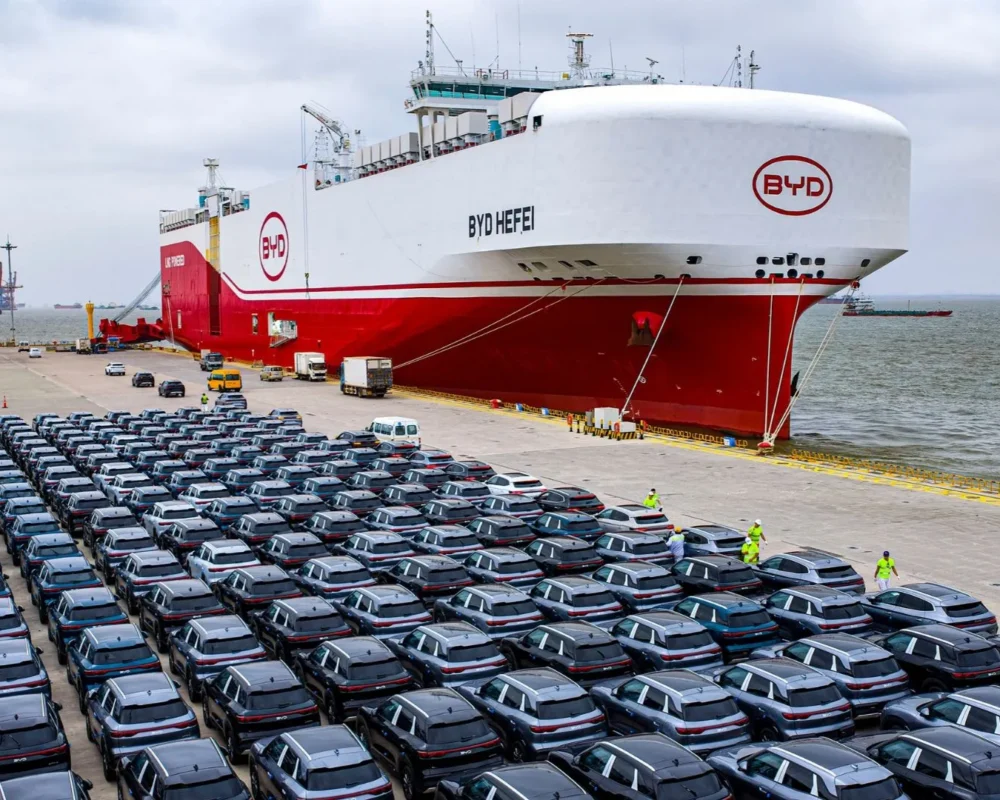
It has been reported that the UK looks set to follow the example of the EU in imposing tariffs on electric vehicles from China. This would be a mistake, for five main reasons. First, we have to look at the main reason why the UK is considering doing it. The EU is using its proposed […]

In the graphic novel ‘Ministry of Space’, an alternate history is imagined whereby Great Britain nabs the Nazi rocket scientists before the US or USSR. Churchill becomes, in addition to his other (real) accolades and achievements, the father of the British space programme that sees us win the space race. There is a particularly poignant […]

Sam Altman, CEO of OpenAI, and Dario Amodei, CEO of Anthropic, have called for increased regulation of AI to slow down the pace of development. They warn in apocalyptic terms of the dangers their own technology poses. After Jacob Coxon, a researcher, resigned from Anthropic, stating that he could no longer justify working on AI […]