How to make Islington beautiful again
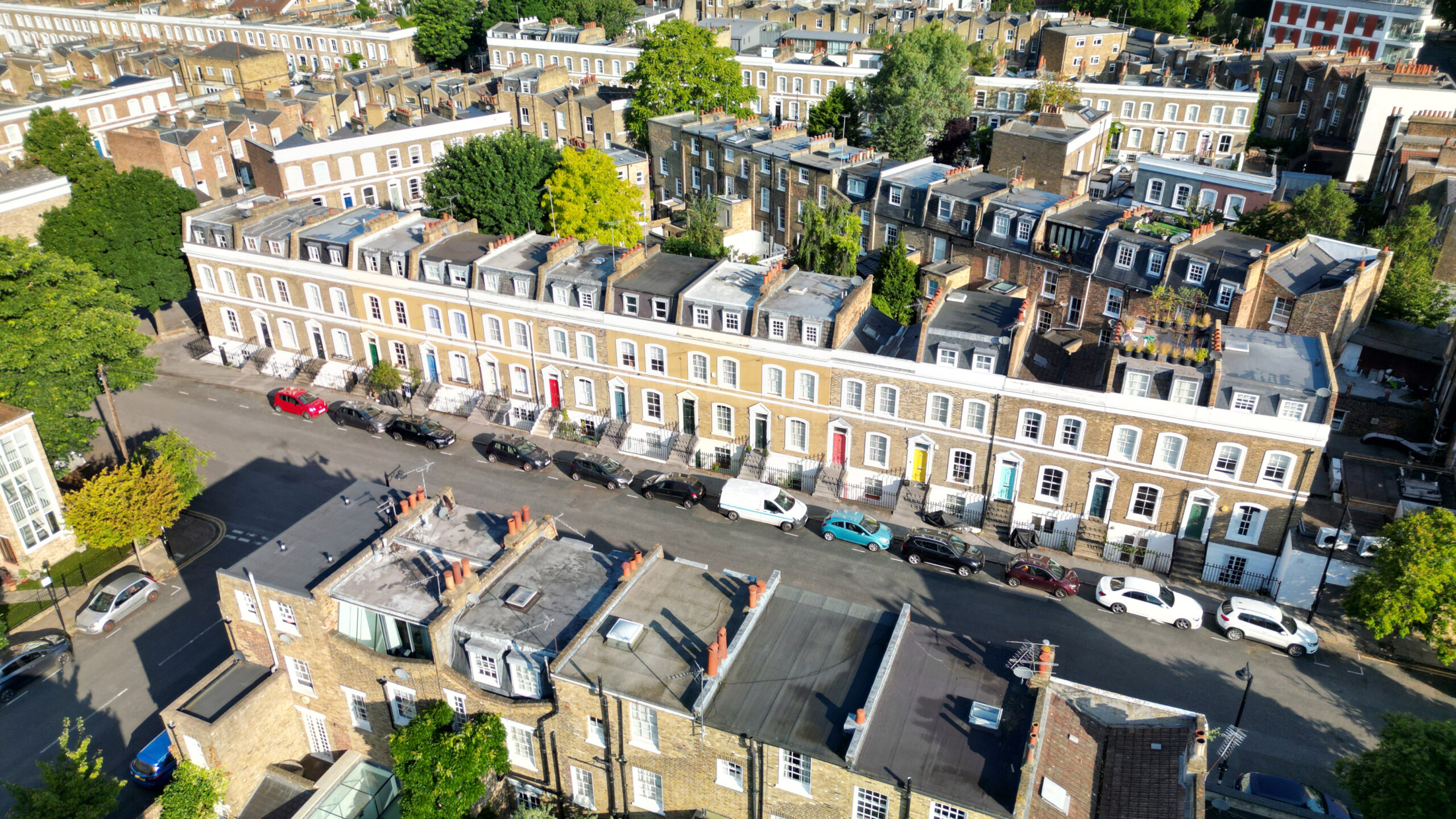
Photo: Getty Images
Islington is one of the nicest districts in London. Much of it consists of row after row of beautiful terraced houses, built to a common pattern: white rusticated stucco on the ground floor, giving way to London stock brick surrounding generous sash windows on the upper floors. They will typically be four stories high, plus a basement, although the basic pattern is flexible enough to be extended upwards.
But like many beautiful places, Islington is pockmarked with the architectural errors of the past. On one side of the street, terraces; on the other, a 1960s monstrosity. The postmodernism of the 1990s mixes with restrained Georgian classicism. Islington may be beautiful, but in many respects it is an architectural mess.
In theory, there is a mechanism to fix this. The Borough has over 40 conservation areas, covering all of the beautiful areas. Under the planning system, if a planning application is made in a conservation area, the planning authority has to pay ‘special attention to the desirability of preserving or enhancing the character or appearance of the area’.
But this is only one planning consideration among many. It does not create a mandate to build beautifully. Most of Islington’s conservation areas were designated over 50 years ago, and many of the offending buildings are younger than that. Even though the conservation area has probably helped make things less bad, it has not made them better. Ultimately, the planning system is reactive to proposals put forward by developers: civic authorities have little ability or incentive to restore the appearance of beautiful districts proactively.
To fix this, we should set up an institution which I call the Islington Restoration Trust. Its primary purpose would be to conserve and restore the built environment of Islington. Properly understood, ‘conservation’ does not mean pickling Georgian terraces in aspic, never allowing the area to change: tradition, as Gustav Mahler said, is not the worship of ashes, but the preservation of fire. Conserving the beauty of Islington means enabling building, demolishing the ugliness and putting something beautiful its place.
To conserve and restore Islington, the Restoration Trust would have the power to grant planning permission through a mechanism called community land auctions. These rely on the fact that land goes up in value when it is granted planning permission. At the moment, this increase in value mainly goes to the landowner. Community land auctions enable it instead to go to the planning authority, so it can be used for public purposes – and they give the planning authority an incentive to approve more building.
In practice, the Islington Restoration Trust would run a kind of competitive tender for development. It would invite sealed bids from landowners who wish to sell their land for development. It would open the bids, and accept bids on the sites which it wishes to be developed.
It would grant planning permission for those sites, with strings attached: it would use a pattern book to specify what kinds of designs, materials and colours are acceptable, aiming to create new buildings that are fully in-keeping with the style of the Georgian terraces. It would have strict rules about the height of buildings as a function of the width of the street: no skyscrapers in Barnsbury, but instead gentle density and six-story mansion blocks.
Finally, the Restoration Trust would hold a second auction to sell the land to developers, who develop them in accordance with the planning permission. The Restoration Trust keeps most of the difference, with a proportion going to Islington Council.
In selecting sites, the Restoration Trust would be conducting a balancing act between the amount of money it can receive, and the suitability of sites development, in accordance with its mandate to conserve Islington. It might grant planning permission to one of the ‘rotten teeth’ postwar buildings in the middle of a row of beautiful terraces. It might enable some of the smaller terraced buildings to be demolished and replaced with small blocks of flats in a Georgian style.
Most ambitiously, it could rebuild Islington’s ugly council estates. Some 40.2% of households in Islington rent socially, the second-highest in the country, just behind neighbouring Hackney. To redevelop them, the restoration trust model could be combined with estate regeneration ballots, a tool which has been used dozens of times all over London: regeneration requires the approval of a supermajority of residents of the estate, who are incentivised to vote in favour because they will be guaranteed a better, nicer flat at the end of the process. Following a successful ballot, the Restoration Trust would turn 1970s slab blocks into Georgian terraces.
Community land auctions mean money flowing to the Islington Restoration Trust. What would it do with this money? Some of it would be used to help create coalitions in favour of new construction. Nimbyism is often a rational response to the fact that local communities see the costs of new housing – construction noise, pressure on GPs, traffic – but not the benefits. Although some people hate development no matter what, many locals can be won over if they credibly believe that these costs will be mitigated, or if they are given a generous share of the benefits of new development. But even though these benefits are very large, the planning system makes it hard to share them with the people who have to bear the costs. Community land auctions have this feature built in.
The Islington Restoration Trust could also copy the best-governed part of London, the City. The City of London Corporation could be described as a hedge fund with a council attached. It has a fund built up over eight centuries, known as the City’s Estate (formerly City’s Cash), which has £2.8 billion in net assets. The proceeds from these investments are spent on the common good of London: the City manages Hampstead Heath and Epping Forest, runs Smithfield Market, and helps fund the Barbican Centre. Likewise, the Islington Restoration Trust could fund things that provide for the common good of both Islington and the whole of London.
All these things could be done by Islington Council, of course. But it does not have a track record of trying to make Islington more beautiful. And it is burdened with existing obligations: there are about 1,300 separate things that local authorities must do (nobody knows the exact number), including providing adult and child social care, which takes up 68.5% of local government spending. And ultimately, it is often easier to create new institutions than reform existing ones. By creating a new organisation, with a narrow purpose and well-aligned incentives, we can make Islington beautiful again.

If rumours are to be believed, Kemi Badenoch and the Conservative Party are thinking about scrapping inheritance tax. Inheritance tax is a pernicious tax that punishes people for doing things that we are supposed to do: building things, saving and investing. Crucially, it is also a tax on loving your family and wanting to leave […]
If you think this summer has been sticky, count yourself lucky you were not in the Cabinet in August and September 1931, in the midst of possibly the worst economic crisis the country has ever faced. It is worth looking at what happened then, because high energy and Government borrowing costs mean a crisis of […]

This week, Nimby Watch is on its way to Edgware – but it’s taking the long route… Ummm…where are we? Because I’m going to be honest, this doesn’t look too familiar… Well, for now, we’re in the West Bank, the larger of the two territories that make up Palestine – the other, of course, being […]