There are many phrases of Adam Smith that are well worth echoing today, and one of the most significant is this: ‘The end of all production is consumption.’
It is not to create jobs. The people who talk of new industries creating many new jobs are putting the cart before the horse. The aim of production is not to give people work to do, it is to produce goods and services that people will freely buy because they help improve their lives.
From the sick man of Europe, we became one of the most prosperous. Growth reached unprecedented heights, and Britain became the place to do business
There are four words that I would like to see framed on the wall of every business and every government department: ‘jobs are a cost’. Jobs are what we have to do in order to get the goodies we want. As Ayn Rand and others have pointed out, it is capitalism that delivers those goodies, that makes people richer and that improves their lives.
Eamonn Butler and I founded the Adam Smith Institute (ASI) at a very opportune time. It was easy to discredit the postwar consensus and the so-called mixed economy, because their visible failure was all around us.
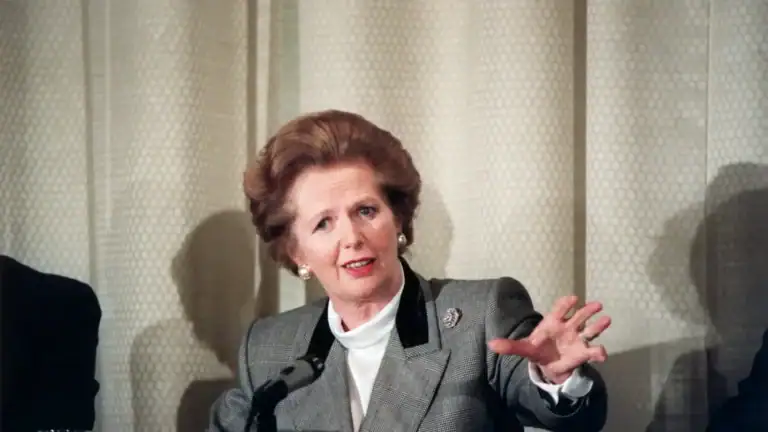
What’s more, there was someone prepared to offer and to fight for an alternative. Margaret Thatcher was ready to tackle the status quo with bold initiatives to replace it.
She became Prime Minister just after the Winter of Discontent. It gained that name because nearly all public services were on strike for higher pay to cope with record inflation.
Ambulance workers who had been called out on strike stopped work and left their patient on a stretcher in the snow. Gravediggers went on strike in Liverpool, so the council had to prepare for burials at sea.
Car workers went on strike, and so did oil tanker drivers and road haulage drivers. Railway workers struck, as did local authority manual workers. When school caretakers and cooks took industrial action, many schools had to close. I don’t think anyone noticed when civil servants joined the strikes, and the one good thing that might have come out of it all was thwarted when BBC technicians settled instead of blacking out Christmas television.
When Margaret Thatcher took office, she had two priorities. One was union power, now so great that government policies were directed to placating unions rather than serving the country and its citizens. The other was state industries, now loss-making and uncompetitive abroad.
Thatcher learned from history. Earlier, the Wilson government had tried to limit the power of the unions and to bring them within the law. But Barbara Castle’s white paper ‘In Place of Strife’, setting out how this would be done, had to be withdrawn after only a few months because of union pressure. Edward Heath’s attempt a few years later had similarly led to his defeat at the hands of the unions after they choked off coal supplies to the power stations, causing power cuts and the imposition of a three-day week.
Rather than face failure with a third attempt to break their power in a single go, Thatcher adopted a salami-slicing approach: a series of bills, each limiting union power a little further.
Her technique was not to confiscate union power, but to distribute it downwards to the members, thus weakening the leaders. She introduced secret ballots for union elections paid for by the government. Instead of militants being elected at intimidating workplace show-of-hands elections, members voted by postal ballot from the comfort of their own homes. In secret, surrounded by their families rather than by shop stewards, they tended to elect more moderate union leaders.
Her next redistribution of power was to require ballots before strike action could be taken. Union leaders had to achieve a certain proportion of votes before they could call their workers out on strike. Previously, they had been able to hold wildcat strikes on the spur of the moment.
Her third move was to bring unions within the law. She effectively repealed the Taff Vale judgment of 1906 which had ruled that unions could not be sued for losses caused by their strikes. Her new law said that if unions failed to consult their members and to obey the new rules, their funds would be at stake in legal action.
This approach worked, so much so that Britain went from having the highest number of days lost through strikes in Europe to having the lowest in Europe.
Then Thatcher tackled the state industries. In a series of papers which gained wide publicity, we at the ASI pointed out that if these industries were put into the private sector, they would be subject to the forces of competition which would force them to become more efficient and more innovative.
Furthermore, the unions would face the possibility that in the event of a ruinous strike a private company would go broke. Under public ownership, the government could always dig deeper into the pockets of taxpayers – not anymore. Unions and workers now faced the possibility that their strike could cost them their jobs.
The ASI published a paper that recommended the wholesale privatization of local government services, starting with bin collection. Thatcher liked it so much that she had it photocopied 10,000 times and sent a copy to every Conservative councillor in Britain.
Thatcher didn’t like the word ‘privatization’, because it sounded new and strange. She wanted to call it denationalisation. But we pointed out that we were going to apply it to industries that had never been nationalised in the first place. We still insisted on spelling it with a ‘z’ to make it look like something new.
The first to go was Cable and Wireless, then BP, but the first big public flotation was of the Post Office telephone service, a state monopoly. Rather than sell it to a private company, the government decided to sell it to everyone, with a flotation in which the public were invited to apply for shares. To keep the telephone workers on side, they were offered 200 free shares if they bought 200. The union ran a hostile campaign showing a telephone cable being cut with scissors, but 96% of the workforce took the money instead.
This set the pattern for future privatizations. It set off a frenzy of share buying. Even the lifelong left-leaning Daily Mirror introduced a stock market column. As ever more of the state industries were sold, it felt like being on a carousel that was continually going round faster and faster.
Stay informed with our free daily briefing.
Along with our friends in the IEA and the CPS, we daily banged the drum for free enterprise and lower taxes, and the message got through. As chancellor, Nigel Lawson made a policy of reducing taxes in every Budget and abolishing at least one tax altogether in every Budget. It was what Britain needed, and it turned the country around.
From the sick man of Europe, we became one of the most prosperous. Growth reached unprecedented heights, and Britain became the place to do business.
Unfortunately, our current Prime Minister has faulty eyesight. He sees the calamity that was the 1970s as a golden age, and looks back on the prosperity of the 1980s as a disaster area. He should have gone to Specsavers.
Dr Madsen Pirie is President and Co-Founder of the Adam Smith Institute.
More Economics
27 Oct 2026
Welfare
Mani Basharzad
Europe’s welfare state is turning young against old
In 2010, Paul Krugman wrote a New York Times column titled ‘Learning From Europe’. For decades, Europe was the model that American left-leaning economists wanted America to follow: a big welfare state, generous welfare programmes and large-scale redistribution. But it seems something has changed. Krugman has now written about France being on a ‘fiscally unsustainable […]
26 Oct 2026
Technology
Matthew Lesh
Data regulations are strangling British businesses
Most people experience data regulation pretty much every day through those insufferable cookie pop-ups. This tick box process of getting user consent ultimately benefited nobody while practically annoying everyone. Hundreds of millions of human hours have been spent clicking through those things on websites across the internet. The previous Conservative government promised to get rid […]
23 Oct 2026
Taxation
John Penrose
How Kemi Badenoch can make sure work always pays
Making sure it always pays to work is political motherhood and apple pie: something so obvious it’s barely worth saying. Odd, then, that last week when Kemi Badenoch suggested changing childcare rules which leave successful parents facing crazy 100%-plus tax rates if they earn more than £100,000, she faced a barrage of criticism. The critics […]
Manage Consent
To provide the best experiences, we use technologies like cookies to store and/or access device information. Consenting to these technologies will allow us to process data such as browsing behavior or unique IDs on this site. Not consenting or withdrawing consent, may adversely affect certain features and functions.
Functional Always active
The technical storage or access is strictly necessary for the legitimate purpose of enabling the use of a specific service explicitly requested by the subscriber or user, or for the sole purpose of carrying out the transmission of a communication over an electronic communications network.
Preferences
The technical storage or access is necessary for the legitimate purpose of storing preferences that are not requested by the subscriber or user.
Statistics
The technical storage or access that is used exclusively for statistical purposes.The technical storage or access that is used exclusively for anonymous statistical purposes. Without a subpoena, voluntary compliance on the part of your Internet Service Provider, or additional records from a third party, information stored or retrieved for this purpose alone cannot usually be used to identify you.
Marketing
The technical storage or access is required to create user profiles to send advertising, or to track the user on a website or across several websites for similar marketing purposes.