Don’t tariff Chinese cars
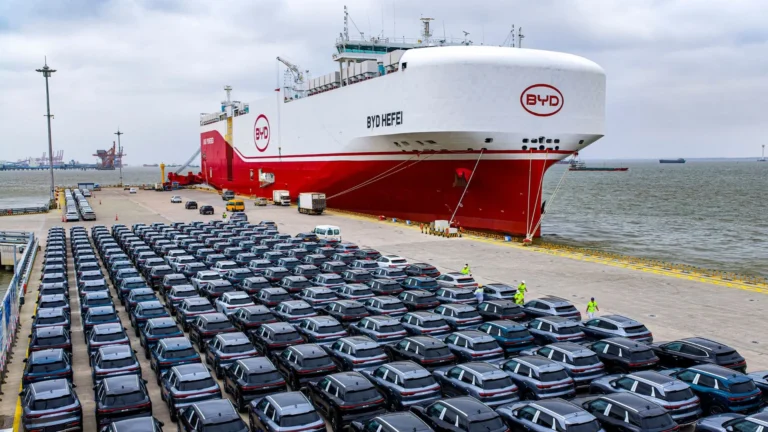
Ji Haixin/VCG via Getty Images
It has been reported that the UK looks set to follow the example of the EU in imposing tariffs on electric vehicles from China. This would be a mistake, for five main reasons.
First, we have to look at the main reason why the UK is considering doing it. The EU is using its proposed ‘Made in Europe’ provision to twist the UK’s arm by threatening to exclude it from the measure, thereby punishing British firms. I’ve written before on why a ‘Made in Britain’ policy of domestic preference would be a mistake. There is an equally strong case against ‘Made in Europe’. The EU is using an unlawful measure against the UK in order to make it do its bidding. If Britain capitulates on this, it will send a message to the rest of the world that Britain can be coerced. Just as Mark Carney does not allow Canada to be bullied by Trump’s America, Andy Burnham must demonstrate the same resolve.
Brussels might choose to force its member states to put jagged rocks in their ports, Britain is free to ignore them
Second, there is the impact such a move would have on consumers. The biggest barrier to the electric transition has always been price. Electric cars have been more expensive than petrol equivalents, and motorists have noticed. Cheaper Chinese entrants are doing more to widen the market than any government campaign has ever done. Imposing tariffs would reverse that, protecting a handful of producers at the expense of millions of buyers.
I, among many others, have long argued in CapX and elsewhere that protectionist measures are bad for consumers and that consumers are, conversely, the biggest winners from free trade. Imposing tariffs will mean they will have little choice but to stick with their current petrol models (despite crippling fuel and tax costs), or even revert to a gas-guzzler next time they buy a car. It will be the very poorest households who suffer the most as a result. This would be dreadful at the best of times, during a cost-of-living crisis triggered by a fuel shortage it is unconscionable.
There is a deeper point here about incentives. The Government has set itself the goal of getting drivers into electric vehicles, and consumers have responded to the signals it has sent. Favourable company car tax rates drove a surge in fleet EV uptake. Grants for lower-priced models have nudged private buyers. People respond to prices and rules, and when the incentive is right, they move. It makes little sense to spend public money encouraging people to buy electric cars, then raise the price of the most affordable ones through trade barriers. The Government cannot sensibly pull the accelerator and the brake at the same time.
Third, the EU’s experience should serve as a cautionary tale. Brussels imposed duties on top of its standard tariff. It has not gone well. Chinese firms are responding by building plants inside the EU or shifting to hybrids that fall outside the duties. Meanwhile European buyers pay more. It is little wonder that the EU is so keen for the UK to join in. Brussels might choose to force its member states to put jagged rocks in their ports, Britain is free to ignore them.
Fourth, there is the very real threat of retaliation. China has shown it will hit back precisely where it hurts. After the EU acted, Beijing opened investigations into European brandy, pork and dairy. As someone who has worked in trade policy, I can tell you that retaliation is very sneaky (and very fun to work on). Those tariffs on Scotch whisky which Starmer was very proud of having removed? They’ll be back and hiked faster than the SNP can demand another independence referendum. Jaguar Land Rover – which has long relied on wealthy Chinese buyers – will likely be punished. Essentially all of Britain’s key and most politically significant exports will be hit.
Fifth, it has nothing to do with two of the main problems faced by UK car manufacturers. The first of these is the frantic push towards Net Zero, via taxes, regulations and subsidies which have forced up industrial energy prices and made advanced manufacturing in Britain unsustainable.
The second big challenge for the car industry is the Zero Emission Vehicle Mandate, requiring manufacturers to hit rising quotas or face fines. This is effectively a tax on car producers, who respond to incentives in a similar way as the consumers discussed above do by changing their behaviour. They are spending more of their resources trying to compete in a field where they are at a disadvantage due to the very government which has demanded they do so.
None of this means ignoring genuine problems, and there is a lot that the Government can do both to help the car industry and challenge China.
First, it should drop the frantic push towards Net Zero. It was a laudable ambition and it is obviously right that the UK protects the environment for future generations. However, the UK has already done a lot and this should not come at the expense of prosperity and security. All the taxes, regulations and subsidies need to go.
Second, the Zero Emission Vehicle Mandate should be scrapped. There are far more market friendly and effective ways of dealing with the negative externalities of driving such as pollution and congestion. Introducing road pricing would likely be the best candidate for this.
Third, Britain can – and should – stand up to China in other ways. The CCP cheats at trade through subsidies, dumping and intellectual property theft. Its unlawful trade practices do need to be countered – but tariffs are the wrong approach.
Instead, Britain should actually use the Trade Remedies Authority. Based in Reading, it’s full of experts whose very job is to conduct evidence-based and case-by-case investigations into this kind of thing. It’s completely pointless and a waste of money for it to exist if it’s not given the opportunity to do its job and come up with some effective solutions.
Britain should also work through the proper legal channels at the WTO to mount challenges and receive the right to take appropriate action if necessary. The trade world has descended into anarchy in recent years and Britain risks being dragged into this. It should use its Brexit freedom of being an independent trading nation to make the case for free trade. It should work with like-minded allies – including the EU – to work at and with the WTO and to push for reform so it’s fit for purpose in the post-Trump era. China is also very keen to join CPTPP. The UK should continue to block its accession until it starts to play by the rules
The EU is right to try and stand up to China’s unfair trade practices. Unfortunately, by imposing tariffs on Chinese EVs it has gone about it the wrong way. The UK should not let itself be strong-armed into joining in its folly.

The UK-EU relationship must be viewed through the lens of the battle for the world’s operating system. There are three operating systems in the world. The first is a competition on the merits system where countries are free to engage in regulatory competition but inter-operate on the basis of mutual recognition and equivalence. This historically […]

Late on August 28, trade talks between Canada and the United States broke down, an escalation in the trade war that the Trump administration began with Canada in early 2025. This escalation isn’t because Canadians favour tariffs as much as the US president, but because they refuse to quietly acquiesce to American demands. It might […]
President Trump’s imposition of ‘economic D-Day’ against Iran – a series of sanctions against any nation dealing financially with Iran, as well as banks and businesses – has already been dismissed by the usual suspects whose knee jerk response is always to attack any new measures against the Tehran regime. When it comes to Iran, […]