Canada is fighting back against US tariffs
Canada's counter-tariffs against the US came into force today – with the support of a huge majority of Canadians

ANDREJ IVANOV / AFP via Getty Images
Canada's counter-tariffs against the US came into force today – with the support of a huge majority of Canadians
Late on August 28, trade talks between Canada and the United States broke down, an escalation in the trade war that the Trump administration began with Canada in early 2025. This escalation isn’t because Canadians favour tariffs as much as the US president, but because they refuse to quietly acquiesce to American demands.
It might be surprising that Canada and the United States are in trade talks at all. Canada, the United States and Mexico have been in a continental trade bloc since the North American Free Trade Agreement (NAFTA) was signed in 1994. What’s more, Canada and Mexico are the only countries in the world that have a full trade agreement negotiated and enacted under President Donald Trump.
The uncertainty, the tariffs, the loosening of commercial ties with the world are not costs the US is paying to get to some end goal – they are part of the end goal
The trade agreement negotiated with the first Trump administration (the Canada-US-Mexico Agreement, or CUSMA, in Canada) was finalised in 2018 and came into effect in 2020. The biggest change from NAFTA was the addition of reviews for renewal and a sunset clause. NAFTA, like most trade agreements, was perpetual for the sake of economic certainty. CUSMA has a 16-year sunset clause and must be reviewed every six years, when signatories can renew it for another 16 years. Failure to renew at the six-year review triggers an annual review.
Canada was among the countries hit with 25% tariffs (10% on energy) shortly after Trump took office under the US International Emergency Economic Powers Act (IEEPA), though not on CUSMA-compliant goods. CUSMA offered no protection from tariffs imposed using Section 232 and Section 338 (Section 338 tariffs are Smoot-Hawley Tariff Act tariffs) on 28 billion Canadian dollars worth of goods. Trump imposed these new tariffs in late August, with CUSMA still in effect, as a pressure point in bilateral negotiations during the review.
The week that negotiations broke down, tariffs were postponed, then came into effect. A deal was within reach, then fell apart and talks were suspended. Canadians saw rumours about the deal: that it could undercut Canada’s sovereignty in other trade agreements, that it could endanger French language protections and that it would formalise US tariffs on Canadian goods.
Trump’s musing (and trolling) about Canada being absorbed into the United States and his attempt to re-name Lake Ontario are well-known. Perhaps less so is a barrage of insulting rhetoric by the US administration that undermines support for returning to the table. JD Vance called Canadian concessions in the talks ‘hilarious’. Trump released an AI video of armed Canada geese with Trump hair around ‘Lake America’. Scott Bessent compared Canada to a yappy little dog about to be killed by a German shepherd. Canadians compare this posture towards us to fawning by US envoys in Moscow over Labour Day weekend.
A huge majority of Canadians support walking away from the proposed CUSMA renewal deal and support Canada’s counter-tariffs on the US which came into force today. It’s understood that these tariffs are going to hurt Canadians – adding to the pain from US tariffs. The best way to understand why there’s still support is that most Canadians are willing to pay some price, for some time, simply as an act of defiance.
The way that developed nations used to think about trade agreements doesn’t apply to the US today. The uncertainty, the tariffs, the loosening of commercial ties with the world are not costs the US is paying to get to some end goal – they are part of the end goal of the US administration. They’re not hoping to walk all this back.
Donald Trump seems to believe that tariffs can make the United States great, but many in his inner circle understand that they are costly and believe the costs are worth paying. They agree with the president that the important thing is power and leverage for the US government and submission by other sovereign nations.
Tariffs are hurting Canadians. Small businesses can’t ship to the United States. Iconic soda flavours disappear. And Canadians were already struggling with the cost of living, which is part of the reason that trade retaliation has less support among younger adults, compared to more financially secure older generations. Canadians can’t pay these costs forever or permanently defy our largest trading partner.
And Canadians don’t expect to end the uncertainty. We already have a Trump trade agreement, and all the certainty and protection anyone can expect from that.
We Canadians, frankly, have few options. We cannot replace the United States, with whom we share a land border almost 8,900 km long, with economies we must cross oceans to reach. Much has been made of Canada’s internal trade barriers, but one important barrier is that crossing the country is harder than crossing the border to reach a larger population. Reducing dependence on our unreliable neighbour can only limit our exposure, and it’s a long-term hope, not a short-term fix.
Canadians probably understand the reality: we’ll need to secure some sort of short-term deal with the United States (the only kind on offer under CUSMA) to bridge the gap to a time when Americans agree again to a trade agreement passed by, and enforced by, people who understand that freer trade makes us all better off. We’ll need to do this because we are so much more dependent on the United States than the United States is on us, and reducing that dependence is a long-term strategy.
But Canadians have decided, it seems, that we won’t go quietly. The trade war has morphed, in some ways, into an information war. The question is whether it can wake up American voters, who have the agency to start reining in their government’s use of trade as a weapon.


A rare glimmer of sanity as Reuters reports that the British clothing retailer Next ‘has won an appeal allowing it to keep paying warehouse workers more than sales consultants’. The report adds that: The ruling on basic pay overturns a key part of a 2024 Employment Tribunal decision in favour of over 3,500 current and […]

This morning, John Healey delivered his first major speech as Chancellor. He set out his vision for the economy and, while it was encouraging to hear his determination to drive growth and solve the NEET crisis, all while claiming to be committed to fiscal discipline, it was quite light on detail. However, one specific point […]
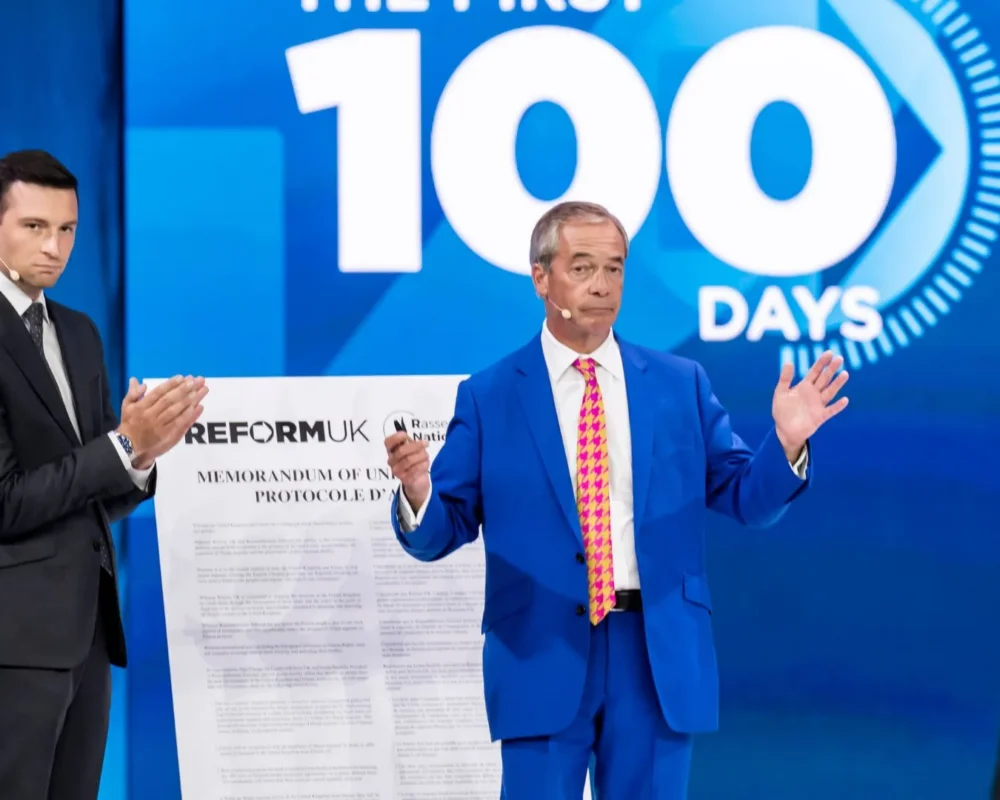
The last time I wrote about Reform UK’s annual conference I was doing it as the Deputy Editor of this fine publication. A year on, how much has changed? Greeting you as you enter the conference hall is the familiar fare for the familiar fee. Chicken and chips stands sit next to anti-Labour propaganda, accompanied […]