Burnham’s reset with the EU fails his own tests
The UK-EU reset will cost the British taxpayer billions of pounds, spent on things like bigger subsidies for EU students
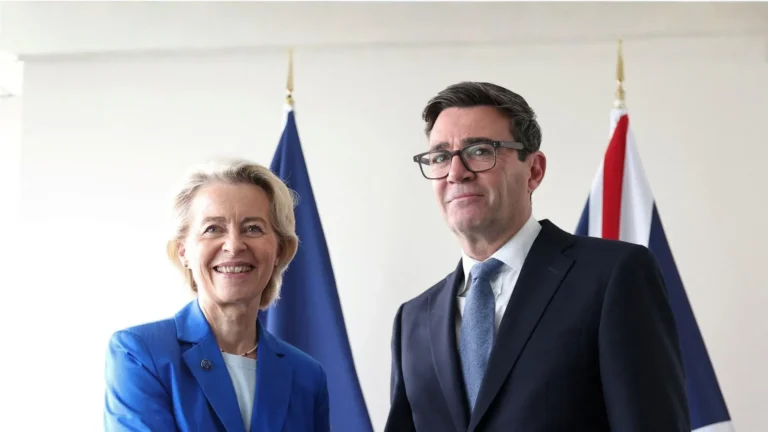
Toby Melville - WPA Pool/Getty Images
The UK-EU reset will cost the British taxpayer billions of pounds, spent on things like bigger subsidies for EU students
The Prime Minister’s speech at the Lord Mayor’s Banquet last night was catnip for those wanting the UK to rejoin the European Union. But it also exposed the feeble logic at the heart of the push to transfer more powers back to Brussels.
For a start, the Prime Minister is wrong to claim that Brexit has not worked, or that Britain has lost more than it gained from Brexit.
Outside the Single Market, the UK Government has gained greater freedoms – for good or for ill – to provide more state aid, reduce VAT and ‘Buy British
The British people voted in 2016 to leave the EU and restore sovereignty to the UK government. Westminster has since regained control over laws and borders, run its own trade policy and saved tens of billions of pounds in contributions to the EU budget. On this crucial test, Brexit has been a success.
This democratic choice has also laid the foundations for a stronger economy. Benefits can already be seen in many areas where the Government has begun to take advantage of the Brexit freedoms.
Outside the Customs Union, the UK has used its independence to secure faster, better trade deals worldwide, and to cut tariffs unilaterally. These deals are all at risk from the reset.
Outside the Single Market, the UK Government has gained greater freedoms – for good or for ill – to provide more state aid, reduce VAT and ‘Buy British’. Again, all these are at risk.
Looking ahead, there is enormous potential to benefit from smarter regulation of new technologies, including AI. There have already been important Brexit wins in fields such as gene editing.
The financial services sector was nervous about Brexit. But after seeing the benefits from pro-growth reforms, the City is now campaigning against realignment with EU rules.
Ironically, the Prime Minister has half-acknowledged these points by recognising the UK’s strengths in AI and financial services and saying these two sectors should be excluded from any realignment with EU rules.
But he is still failing to join the dots. If regulatory independence is good for these two sectors, why not the rest of the economy? And if these two sectors are off the table, how will it ever be possible for the UK to rejoin the EU?
Crucially, whether Brexit ultimately strengthens or weakens the British economy will depend on the choices the UK government makes – which is as it should be.
Instead, the Prime Minister fell back on some tired and long-discredited numbers which are supposed to prove that Brexit has already been an economic disaster.
He cited the OBR’s ‘working assumption’ of a 4% long-term hit to productivity. This was simply a crude average of the results of 13 external studies, all done well before the final shape of the exit deal was known.
He then cited the infamous 8% figure from the paper published by the NBER. This has been debunked many times, including by economists at Bloomberg.
The speech also included the usual tropes about how Britain has lost global influence since Brexit and how this was what Russia wanted. But he then celebrated the UK’s leading role in supporting Ukraine, which was presumably not what Russia wanted.
Burnham concluded by setting out three new tests for the UK’s proposed ‘reset’ with the EU. Unfortunately, the deal on the table fails on all three.
First, it must be consistent with Labour’s 2024 general election manifesto pledge that there would be ‘no return to the single market, the customs union, or freedom of movement’.
But the proposed agri-food deal and participation in the EU’s internal electricity market both breach the red line about ‘no return to the single market’.
Participation in the EU’s protectionist ‘Made in Europe’ scheme is likely to mean that the UK has to impose the higher EU tariffs on imports from China, including on popular electric vehicles. That would be a return to a partial ‘customs union’.
Second, the deal must improve the original Brexit deal and bring it closer to what people thought they were voting for in 2016.
Burnham’s deal fails this test too. The result of the referendum in 2016 was a vote for independence and sovereignty. The British people voted to regain control of laws, borders and money. The ‘reset’ drives a coach and horses through that, notably by forcing the UK to ‘dynamically align’ with EU rules.
Worse still, the UK taxpayer is having to pick up the bill. There will be additional costs running into billions of pounds, including contributions to EU solidarity funds and bigger subsidies for EU students.
Third, the ‘reset’ must pass the ‘Makerfield test’ by providing tangible improvements to people’s everyday lives.
This is perhaps the biggest fail of all.
The ‘reset’ is likely to increase the cost of living in many ways, including higher prices for food and energy, higher tariffs on energy-intensive commodity imports and higher tariffs on goods from China.
Moreover, the cross-party campaign group Britain Unbound (on whose Advisory Council I sit) recently published new polling of voters in the Prime Minister’s own constituency.
The survey asked who should decide UK economic policy on 10 different issues, ranging from medicine approval to state aid. In every case, a clear majority said policy should be decided by UK governments alone.
Just to rub it in, even the dodgy official estimates suggest that the ‘reset’ will boost the UK economy by no more than 0.4% in the long run. Moreover, these estimates do not take enough account of the wider economic and financial costs, including the additional regulatory and tariff burdens and the extra bills for taxpayers.
Rarely has so much control been given away in return for so little.

‘Just when I thought I was out, they pull me back in,’ says Michael Corleone in ‘The Godfather Part III’. A decade after we voted to leave the European Union, much of the establishment is still in denial about the verdict that was delivered. Andy Burnham has been absolutely shameless. Campaigning in the Makerfield by-election, […]
Whenever I think about Boris Johnson, the old French proverb ‘après moi le déluge’ comes to mind. It means a blithe, even nihilistic disregard for whatever ruination ensues after one’s own time. For many years, it was thought to have originated with Louis XV or his mistress Madame de Pompadour in the 1750s. It thus […]
At a few minutes past six on Friday morning, in a leisure centre on the Essex coast, the returning officer reached the bottom of a ballot paper roughly a metre long and announced a number that deserves more attention than it is likely to receive. Nigel Farage, 22,239 votes. The commentary had settled into its […]