Are Putin’s threats to Britain more than hot air?
The fierce response to Ukraine's use of British drones from the Kremlin suggests that they have been effective
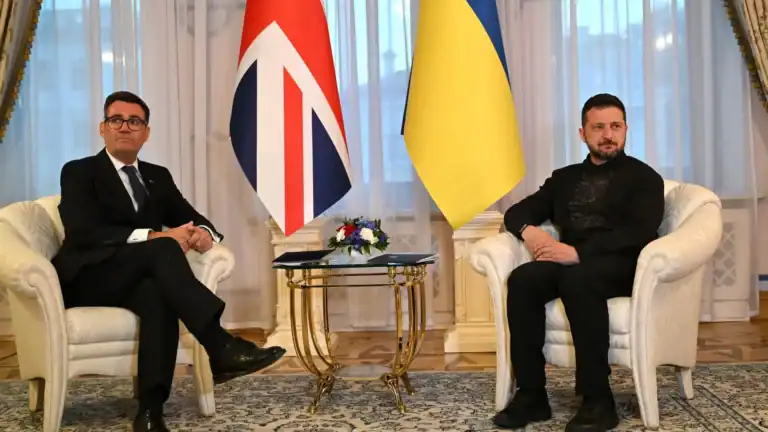
UK and Ukraine officials meet to discuss bilateral relations and security issues.
The fierce response to Ukraine's use of British drones from the Kremlin suggests that they have been effective
Ukraine has recently stepped up its campaign of long-range missile and drone attacks against Russian critical infrastructure. Last week, after confirmation that some of the drones used in these operations were British-made, the Kremlin attempted to intimidate the new Prime Minister away from continued support for Ukraine by warning of ‘consequences’. Russia accused the United Kingdom of ‘deliberately opting for an escalation of the Ukraine crisis’, and warned that ‘the deeper its involvement in the conflict… the higher the price it will pay’.
There is dark humour in the regime of Vladimir Putin accusing a third party of ‘escalation’ in a conflict he took from local disputes over sovereignty and autonomy to a full-scale war, in which his soldiers have perpetrated war crimes and crimes against humanity as a matter of policy rather than occasional regrettable excesses. But that does not mean we can or should ignore the Russian president and his hypocritical schemes of revenge.
The Russians are masters of hyperbole, bluff and whining self-pity, and we can recognise all of those elements. Mostly it is empty oratory, but one day it might not be
Andy Burnham, who travelled to Kyiv on Monday, will have been thoroughly and meticulously briefed on the possible and likely courses of action Russia has available to it. An unnamed security source told The Daily Mail:
An attack on the UK’s defence and security infrastructure is inevitable, based on our high-profile support for Ukraine. Ourselves and the French are front and centre, and Burnham’s visit to Kyiv and his forthright stance will have been noticed at the Kremlin.
Realistically, what kind of ‘consequences’ could we face? It is important to keep this in perspective. By any meaningful metric, we are not in a relationship of peace with the Russian Federation, nor have we been for years.
It is 20 years since former FSB officer Alexander Litvinenko, a naturalised British citizen, was fatally poisoned by Russian agents in Mayfair; in 2018 an attempt to kill former Russian intelligence officer Sergei Skripal and his daughter Yulia with novichok was carried out in Salisbury, probably by the GRU’s Unit 29155; in 2024, Russia orchestrated an arson attack on a warehouse in Leyton connected to Ukraine; the same year, Russian criminals conducted cyber attacks against several London hospitals; a number of arson attacks directed at Sir Keir Starmer in 2025-26 were carried out by Russian proxies.
While it is unlikely that Russia will carry out full-scale military operations against Britain, such as a ballistic missile attack or direct engagement with RAF or Royal Navy assets around the world, Putin has options to raise the temperature. The Russian intelligence collection ship Yantar has been sighted repeatedly in British and Irish coastal waters, including very close to undersea data cables on which the UK is heavily reliant; it is likely the vessel has been using small autonomous underwater craft to assemble a detailed picture of these infrastructure vulnerabilities.
Equally, Russia could increase its level of hostile cyber activity; we recently learned that in July Iranian-linked hackers caused an undisclosed UK energy facility to shut down for four days. If Iran can arrange that level of disruption, it is certain that the Kremlin can.
Russia wants to be taken seriously. On July 21, it withdrew its ambassador, Andrei Kelin, to London and has made no effort to appoint a replacement. This is the diplomatic equivalent of a teenage girl’s eye-roll and hair-toss, but it is designed to downgrade normal relations between the UK and Russia and indicate that we have nothing to talk about.
To an extent, all of this is a potential indication of Russian weakness. If the use of UK-manufactured drones by Ukraine has provoked such a fierce response from the Kremlin, it suggests that they have been effective. Burnham’s visit to Kyiv this week and his announcement that the government will provide Ukraine with technical details of British components used in Storm Shadow cruise missiles means Ukraine will be able to manufacture the Anglo-French weapons – known in France as SCALP-EG –domestically. It will no longer be at the mercy of imports.
There are also signs that Putin misjudged Burnham, believing the new Prime Minister would be less committed to assisting Ukraine than was his predecessor. Certainly, Burnham should be commended for making Kyiv the destination for the first official overseas trip of his premiership. He has been resolute in his public words: when the Kremlin accused him of adding ‘fuel to the fire’ of the war in Ukraine and diminishing the chances of a peaceful resolution, he shot back ‘Who started the fire?’
The UK remains Ukraine’s staunch ally, as the Prime Minister attested this week.
Despite Russia’s outrageous threats to my country, we will continue our support for Ukraine… Ukraine has been Europe’s protector, not a drain on our security but the front line in keeping Europe safe.
The bottom line is that Russia has the capability to act against British interests more intensely and on a more widespread basis than it has done so far. We must acknowledge that and prepare for it; and our national security and resilience needs to be strengthened considerably. But Russia is also testing the UK and Nato and forever probing our vulnerabilities and resolution. On that point we cannot afford to fail or flinch.
The Russians are masters of hyperbole, bluff and whining self-pity, and we can recognise all of those elements. Mostly it is empty oratory, but one day it might not be. But the surest way to make sooner and more certain that day is to show weakness now. Stand firm and calm, and remember what Vegetius wrote 1,500 years ago.
He, therefore, who desires peace, should prepare for war. He who aspires to victory, should spare no pains to form his soldiers. And he who hopes for success, should fight on principle, not chance.

Just as there is a battle on the Right in Britain, so too is there a battle inside the Conservative Party for what the party should focus on. There are those who are concerned about the threat of political Islam, the damage to the social fabric of the Boriswave and other elements of mass immigration, […]
Britain and America have spent a decade arguing about Nimbyism as if it were a housing problem. It is much bigger than that: our inability to build, in a broad sense, has grown into a source of geopolitical weakness. The economic argument has been made already. Growth controls add anywhere from 17% to 38% to […]
This weekend the Telegraph ran a story with the striking headline ‘Burnham told to trade nuclear umbrella for access to single market’. The idea is the brainchild of Nick Boles, the former Conservative MP who quit the party in 2019 over Brexit, switched his allegiance to Labour and helped to advise Keir Starmer on the […]