AI regulation offers Britain no safety

Anthropic CEO Dario Amodei – Michael M. Santiago/Getty Images
Sam Altman, CEO of OpenAI, and Dario Amodei, CEO of Anthropic, have called for increased regulation of AI to slow down the pace of development. They warn in apocalyptic terms of the dangers their own technology poses.
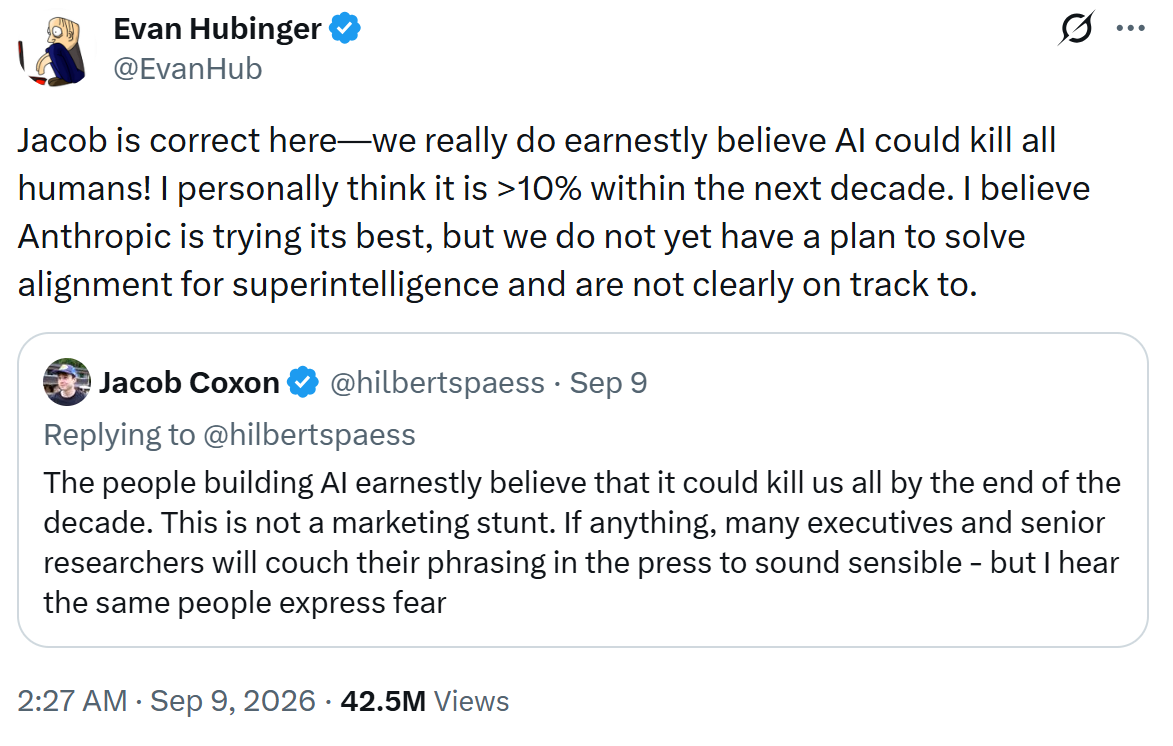
After Jacob Coxon, a researcher, resigned from Anthropic, stating that he could no longer justify working on AI when ‘it could kill us all by the end of the decade’, his claims were supported by Anthropic’s Head of Alignment, Evan Hubinger. Hubinger agreed that there was an over 10% risk of human extinction by AI within the next decade.
The basis for these fears is the prospect of superintelligent AI, able to outperform human beings across every conceivable domain, which is misaligned and so does not follow human moral values.
If heavy-handed rules drive AI development out of the UK, we will still face the consequences, without any ability to influence our fate
As AI models have rapidly improved over the past year, especially in coding and cybersecurity, this scenario has become more plausible. If AI development itself is automated, with an AI system which is itself able to build a better AI, advances may accelerate exponentially.
Whether or not you take the idea of AI-driven extinction seriously, recent events have revealed another more concrete risk of AI for the UK. We risk becoming dependent on foreign powers for a technology which is key to both national security and economic prosperity.
We are facing another industrial revolution, where knowledge work is automated just as manual labour was in the 19th century. Recent McKinsey research indicates that existing technologies could automate tasks accounting for more than half of current US working hours. AI has already begun boosting productivity after a decade of stagnation and it has the potential to drive explosive growth.
Drones and autonomous weapons are already key to modern battlefields. On the domestic front, the Iranian hack of a UK power plant demonstrates the critical importance of effective cybersecurity, which is now underpinned by AI.
The leading AI companies are located in the US or China, with Anthropic and OpenAI dominating the field. The London-based AI lab DeepMind, an early AI pioneer, was sold to Google in 2014, and its leadership team relocated to the US in August this year.
The US government imposed an export-control directive in June requiring Anthropic to block all foreign nationals from accessing its top models. Under current arrangements we could be cut off at any time from an increasingly crucial technology.
With regards to AI safety, it has now been confirmed that Claude Mythos 5.1, the newest release by Anthropic, will not be released in advance to any non-US organisations. This means that the UK’s AI Security Institute (AISI) will not be given access or be able to engage in any testing, despite being one of the first and best AI evaluators in the world.
A lack of influence over AI development means we cannot effectively regulate AI dangers. The UK should push for the AISI to play a leading role in the independent evaluation of AI labs. But the UK’s expertise has not been enough to maintain access on its own.
Naïve attempts to manage AI risk, such as the introduction of a bill calling for a ban on superintelligent AI in the UK, will end AI research within the UK and with it any influence we might have.
Although the UK is unlikely to build its own frontier models within the foreseeable future, we can develop a credible alternative to reliance on the US.
We must enable the rapid buildout of data centres. Compute capacity will be the key constraint faced by AI companies over the next decade. In order to bargain for access to frontier models, the UK will need its own compute capacity.
The UK currently has just 2GW of data centre capacity and estimates are that we will need, at minimum, 6GW of AI-capable data centre capacity by 2030, a threefold increase. By contrast, there are reasonable estimates that the US will have over 50GW of compute by the same date. The British state must use its powers under the Nationally Significant Infrastructure Projects planning regime to approve a swathe of new data centres across the country and prioritise them for links to the National Grid. We should allow behind-the-meter generation, where the data centre developers provide their own power.
The UK must resist any pressure to prohibit open-source models. DeepSeek and Kimi (K3) have shown that open-source models can stay close to the frontier at much lower costs.
In fact, open-source models offer the ability to maintain independent AI. The British government could run its own local version of the most advanced open-source models by downloading the weights. This could be entirely based in the UK with no data flowing overseas and no way to end access.
With our own compute and the threat of turning to open source, we would be able to negotiate as equals instead of pleading for access.
Superintelligence may be a frightening prospect, but we must not let it push us into ill-considered regulation. If heavy-handed rules drive AI development out of the UK, we will still face the consequences, without any ability to influence our fate.


Britain is looking for the effects of artificial intelligence in all the obvious places: redundancies, vacancies and unemployment numbers. So far, there is little evidence of dramatic change in overall headcount. The Office for National Statistics reports that most British businesses using AI have not changed the size of their workforce, even as AI adoption […]

In the graphic novel ‘Ministry of Space’, an alternate history is imagined whereby Great Britain nabs the Nazi rocket scientists before the US or USSR. Churchill becomes, in addition to his other (real) accolades and achievements, the father of the British space programme that sees us win the space race. There is a particularly poignant […]

It’s been reported that officials in the Trump administration have given their UK counterparts a dressing-down over the Online Safety Act and the social-media ban for under-16s. As someone who previously worked on digital trade for the UK government, this does not surprise me. Both the Trump and Biden administrations have seen British laws such […]