If AI ends work, we must reconsider our purpose

26 November 2026

In a novel I have begun publishing on Substack, ‘The Allowance’, I imagine a future Britain in which AI and machines do most of the work and the state provides citizens with a daily allowance. Any credits (‘money’) left unspent at midnight expire. Saving has become socially suspect, and a government that began by taking responsibility for the distribution of income has gradually assumed responsibility for how people spend their time as well.
I think most people assume that if AI and robots end up doing much of the work we do today, and at a fraction of the cost, the government will have to introduce some form of universal basic income (UBI). And you can see the logic in that. But then we should ask who owns the machines, who decides how much each of us receives and perhaps more importantly, what might be expected of us in return?
There is also a danger in assuming that because people receiving a UBI can afford everything they need, they will necessarily lead happy and fulfilling lives. For many of us, work is where we make friends, meet our partners, find a sense of purpose and derive much of our self-worth
Previous industrial revolutions put people out of work but created entire industries in their place. The descendants of the handloom weavers ended up working in factories, shops and offices rather than living off the parish. The difference this time is that AI and robotics could eventually replace 100% of human labour, including in the highly skilled professions. Even if entirely new industries emerge, why would we assume they will need people to work in them?
And what of the public finances? Much of our economy, from mortgages and pensions to the welfare system, is built around the assumption that most people earn a living through employment. If AI and robotics eventually do all the work, where does the Treasury raise its revenue when there are no wages left to tax and virtually everyone is receiving UBI?
A modest UBI of £1,000 a month for approximately 55 million adults would cost £660 billion a year before any savings from existing benefits or extra tax receipts, more than income tax and National Insurance currently raise combined. If we lived in a society where the cost of living had been radically reduced by machines, the economics would be very different. But the government would still need a source of revenue.
Presumably, governments would go after corporate profits and the economic rents that come from AI – and that’s where Britain has a particular problem. A lot of the technology on which our future prosperity may depend is in the hands of companies overseas. How much revenue could the government extract from AI companies whose intellectual property and profits largely reside outside Britain? And at what point might the government decide it needs to own some of that technology itself? Sovereign AI could become as much a fiscal necessity as a matter of national security.
We could become very effective consumers of American innovation, but fail to capture a sufficient share of the income it generates to finance our own welfare state.
Then there are the monetary considerations. If AI drives the marginal cost of producing many goods and services towards zero, prices ought to fall, something most households would welcome after four years of a cost-of-living crisis. The Treasury, with £3 trillion of debt, might be rather less enthusiastic about the implications for nominal GDP growth, while the Bank of England would still have a 2% inflation target to meet. A universal basic income could therefore evolve into a tool of macroeconomic management, with governments adjusting payments to sustain nominal spending.
Once a substantial proportion of the population depends upon government transfers for its income, the temptation to influence how that money is spent increases. The technology already exists to make payments conditional, restrict their use or impose expiry dates.
There is no reason why a universal basic income must take this form. Indeed, one of its attractions to classical liberals, as with Milton Friedman’s proposal for a negative income tax, has been the possibility of replacing an intrusive and bureaucratic welfare system with cash payments that leave recipients free to decide how to spend them. But that presupposes a political commitment to individual autonomy which future governments may not share, and on the evidence of the current one I would not bet the house on it.
If we cannot rely on governments to keep these payments unconditional, perhaps we should be thinking now about how to give more people a stake in the companies and technologies that will eventually replace their labour. Private pensions, individual investment accounts and employee share ownership could become rather more important in a world where people depend on the returns from capital to pay the bills rather than simply to fund their retirement.
The sooner we begin to broaden the ownership of productive capital, the less we may ultimately have to rely on the Treasury to redistribute the income it generates.
There is also a danger in assuming that because people receiving a UBI can afford everything they need, they will necessarily lead happy and fulfilling lives. For many of us, work is where we make friends, meet our partners, find a sense of purpose and derive much of our self-worth. A monthly payment from the government is no substitute for any of that.
The great promise of AI is that it could free us from much of the drudgery of working life. But what might we lose in the process, both in terms of our independence from the state and the day-to-day human relationships that make life worth living?
In ‘The Allowance’, Britain has solved the problem of production. Its citizens want for very little materially, but they own very little, too. Their prosperity is contingent upon the decisions of those who administer it.
What will people do with all that free time? How will they form friendships, find fulfilment and experience the satisfaction of being useful to others in a world that no longer needs their labour? The great social question of the AI age may ultimately be less about economics than about human purpose. The state may be able to provide us with the means to enjoy a life of leisure, but it cannot give us a reason to get out of bed in the morning.

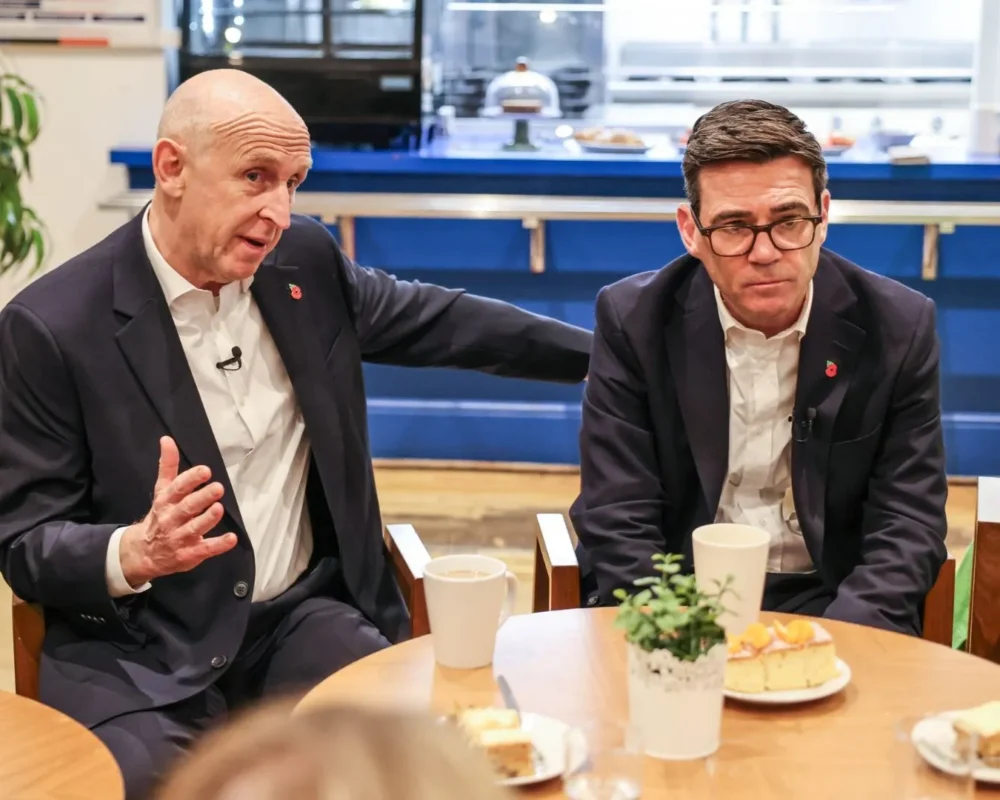
John Healey’s Budget repeated the message that the Government sees AI as a route to economic growth and better public services. From investment in British AI capability to plans for data centres and AI adoption across Whitehall, ministers are putting money and political weight behind that ambition. The success of this investment will depend on […]
Ever since Tony Blair set his ambition for 50% of young adults to enter higher education, successive governments have promoted university as the route to prosperity. The result is a bloated, expensive sector that has spent decades expanding on the assumption that more students, more degrees and more universities must somehow be a good thing. […]
Andy Burnham is set to make the same mistake that led to the ruin of Keir Starmer: lack of a domestic agenda, other than pushing the proverbial peas around the plate on energy bills, bus fares and the like, paired – like a bottle of plonk – with ambiguous statements on the big public issues. […]


