Britain’s data centre protests are built on myths
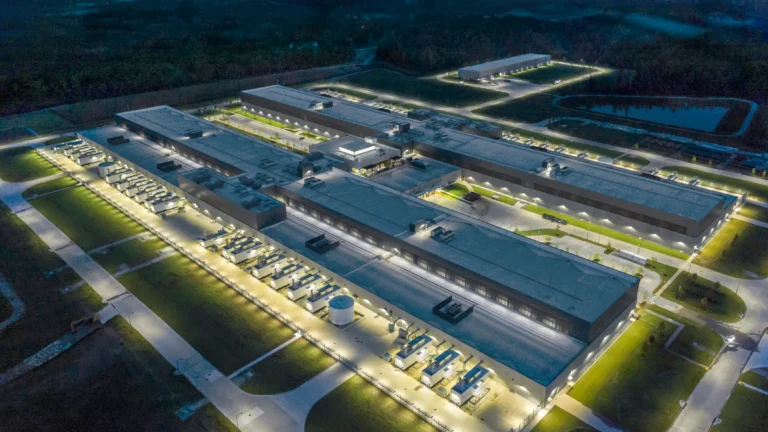
AI data centre – Getty Images
In September Labour MP Richard Burgon attended a protest of 250 or so activists in Leeds against a proposed centre at the former Skelton Grange power station in Stourton, six miles away from the city centre. He said there are ‘huge concerns about the impact of these centres on the environment, infrastructure and people’s lives.’ Those ‘concerns’ are for the most part invented nonsense by anti-tech militants.
A campaigner at the same protest said: ‘I don’t think we necessarily need such massive data centres that cause such environmental harm.’
Burgon has tabled an Early Day Motion in Parliament, signed by 27 MPs across five parties, which would oppose ‘unchecked expansion of large corporate AI data centres across the country’ as well as claiming ‘their vast energy and water needs could increase pressure on energy and water supplies, make it harder to meet climate targets, place significant additional pressure on local infrastructure and risk driving up costs for consumers.’
It calls for a ban on new centres until their ‘impacts’ can be ‘assessed,’ a process which would no doubt conclude they are an existential threat.
A peer-reviewed study in Arizona found air downwind of data centres was only 0.7°C warmer on average, which dissipated entirely after 500 metres
Vague arguments like these make up the bulk of anti-data centre sentiment, which is a mix of Nimbyism and a political, anti-tech position. It is almost all imported from America.
Microsoft is building the Leeds centre, which will be made up of three server buildings and a warehouse. Ironically it is a large company which goes out of its way to satisfy the demands of eco-campaigners. It has a goal to be ‘carbon negative, water positive and zero waste by 2030.’
Activists say that the water-hungry data centres will drain their reservoirs. One placard at a demonstration this month read: ‘We can’t drink data.’
The US activist-journalist Karen Hao’s popular 2025 book ‘Empire of AI’ overstated the water usage of data centres by a thousand times, thanks to a unit error. By the time she admitted her mistake – six months after it hit the shelves – the horse had bolted.
The Leeds centre will use closed-loop air-cooling 95% of the time. This is essentially the same system as a sealed car radiator and standard for many data centres.
A one megawatt data centre will usually use as much water in a year as five car washes. Much of its water is green – meaning it is gathered from rainfall.
Alarmist water use statistics are also drawn from the driest, hottest US sites on which centres are considered. That is a far cry from the Scottish climate, for example.
That did not stop thousands protesting data centres in Edinburgh last week.
Scottish Green MSP Srivatsan Manivannan, well known for the fact that he is only on a student visa, was at the protest. He claimed ‘if all live planning applications come through’ for data centres in Scotland ‘it would consume more than 1.5 times our peak electricity.’ More than anything this shows that the 24 speculative centre applications – which state the maximum possible electricity use – amount to remarkably low energy requirements. Remember that Scotland has an excess of renewable energy.
Manivannan went on:
Some are near nurseries, others mere meters away from homes, and there’s one planned on agricultural land that’s also on the site of the Battle of Dunbar. If we care about protecting Scottish people and culture, it’s not immigrants we should be worried about, it’s an invasion by data centres, AI bots and billionaires.
Despite the total lack of rational argument here the Scottish government has caved to the Greens and paused planning applications for these centres. These activists are simply opposed to valuable private companies inventing things.
The messaging operation against AI and data centres is co-ordinated. The Pause AI UK campaign, which organises protest marches across Britain, is hosting a conference in Parliament this week. It is hoping to expand and quadruple its operating budget from £100,000 to £425,000 next year. It is run by a global organisation that co-ordinates activity across countries.
‘Extinction’ anti-tech messaging frequently meets eco-Nimby instincts. In Edinburgh a strong Nimbyish strain of the protest was obvious. ‘At the moment it’s green fields with sheep and cows in it. It’s going to be a monstrosity on the environment,’ said an activist of one centre application. ‘The air pollution, the light pollution – it’s just not needed,’ said another. Is the air pollution in the room with us right now?
Other complaints concern ‘noise pollution’ from rooftop chillers and local heat island effects on nearby wildlife, neither of which bears out. Developers have to carry out strict noise impact assessments against existing background levels. Councils regularly set noise targets for data centres below the ambient background level. A peer-reviewed study in Arizona found air downwind of data centres was only 0.7°C warmer on average, which dissipated entirely after 500 metres. There is no study linking data centre heat or noise to harm to wildlife.
The misinformation campaign is reaping dividends already – last week Dumfries and Galloway Council said it received over 10,000 submissions protesting a new centre on an abandoned nuclear site which will create 750 jobs. That is the largest number of representations ever received by a council’s planning department.
Turning away data centre constructors who are willing to put up with Britain’s sky-high energy prices and provide nationally critical infrastructure is a fool’s errand.
A popular placard in Edinburgh read: ‘Tech billionaires don’t need more money.’ Be in no doubt, the data centre moral panic is reheated socialist luddism.
The long-overdue decision to approve the Jackdaw gas field has finally been taken. We are still waiting on a green light for the Rosebank oil field, but the small print in the Budget documents suggests that its approval will not be far behind. But we cannot treat Jackdaw, Rosebank or the wider North Sea as […]
Ambitions to get our economy growing require an equal determination to address the barriers that hold it back. This summer, half of England was reported to be in serious drought for the second year running, and the Environment Agency warns of severe consequences for the economy, environment and wildlife if conditions do not improve. There’s […]

This week it seems that another Net Zero domino will fall. The Government is reported to be on the point of announcing that the Zero Emission Vehicle (ZEV) mandate, which lays down targets for the sale of new cars, will be watered down. This follows a consultation launched in August. At present, manufacturers are under […]


