The Small State Initiative
Under-22s shouldn’t need a state pension
6 November 2026
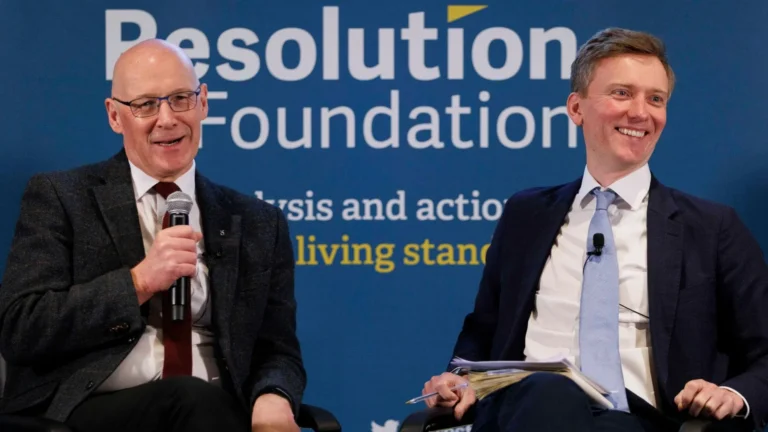
John Swinney and Torsten Bell – Belinda Jiao/Getty Images
The problem with being a political golden boy like Labour pensions minister Torsten Bell is that it paints a target on your back, putting you firmly in the crosshairs of rivals and commentators in your own party and the opposition every time you do or say anything at all.
Kudos, then, to the man widely tipped as a future Labour Chancellor or party leader, for this week’s announcement of some modest-but-promising tweaks to private sector pension schemes which might mean better value for money choices for pensioners than today’s often-criticised annuity schemes instead.
Once that happens, National Insurance will be obsolete and can be abolished completely
‘Might’ isn’t the same as ‘will’, of course, so his rivals will be watching like hawks to see if the changes work in practice. Nor will his modest reforms touch the much bigger and increasingly urgent problem of the state pension itself, where our ageing society means a smaller and smaller working age population is expected to foot an ever-growing bill for more and more pensioners. And that’s before Andy Burnham pushes costs even higher with his plans for a National Care Service too.
That isn’t sustainable but, for an ambitious young politician who’s keen to leave a mark, most of the obvious solutions look awful. To start with, Andy Burnham has only just watered down the triple lock to let state pensions grow slower from 2030, making a second cut politically dangerous so soon after the last one.
Better economic growth could help a bit too, but it’s been anaemic ever since the 2008 banking crash and, even if it creeps closer to our long-term average, it won’t be enough because the demographic timebomb of our ageing society will still push costs up much faster than any developed country can grow.
Benefits reforms would ease Budget pressures a little as well, in theory at least. But they’re the career-ending political minefield which exploded under Keir Starmer’s regime and, in any case, John Healey needs any possible savings to fund his personal pledge of extra defence spending first. Best not go there.
And of course there’s always higher taxes and borrowing. But they are both at post-war highs already and, while they might postpone the day of Budget reckoning a little, they only bandage the financial symptoms of an increasingly unaffordable system rather than fixing its underlying causes.
So how might an ambitious would-be future prime minister make his or her mark on this difficult but vital issue? By using the Government’s existing workplace pension scheme, the National Employment Savings Trust (NEST), as the template for a better and more sustainable state pension in the future.
Handily, NEST has excellent credentials because it was started by the last Labour Government in 2008. And it works too: around 14 million of us already have accounts with tidy nest-eggs building up inside them, worth a cool £50 billion in total.
How do we upgrade these impressive foundations into a full-scale alternative for a better state pension? By switching anyone who is 22 or under into an upgraded version of NEST, so it gradually includes everyone as each cohort of school and college leavers begins work and enters the new scheme.
Members would pay 3% lower employee National Insurance Contributions and divert the 3% saving into their NEST account so they are saving at least 11% of their earnings overall, which experts say is enough for a comfortable income for someone who starts saving at age 22. Family members would be able to top up each other’s pensions if someone lost their job, got sick or started caring for children or relatives, and the top ups would still get tax relief as well as being exempt from inheritance tax too. All other retirement-age benefits would continue unchanged, including Pension Credit, so people who haven’t been able to save enough would still avoid pensioner poverty in future.
Once today’s 22-year-olds reach retirement age, the number of people getting the traditional state pension will start to fall, producing a steadily-growing surplus in National Insurance Contributions which will be invested in a new UK sovereign wealth fund until it becomes large enough to pay not just Pension Credit but all other retirement age benefits too. Once that happens, National Insurance will be obsolete and can be abolished completely.
The new scheme will cut pensioner poverty by making sure most people have a bigger and better pension pot by the time they retire, but also by maintaining all other retirement-age benefits unchanged as a safety net for the few who don’t as well. And it will completely abolish National Insurance for employers and staff too.
The result will be a fundamental but slow-motion pensions reset, building a proudly-independent, financially-comfortable and worry-free retirement for more of us in future. Each of us will have our own personal pension savings pot so we won’t have to worry if future generations of taxpayers will earn enough to pay for our pensions, or whether politicians will keep the triple lock or not.
Eventually everyone’s pension will be paid by the upgraded NEST scheme while retirement benefits like Pension Credit will be funded by the investments in the sovereign wealth fund, without any help from taxpayers.
Everyone knows that pension saving takes years and that the secret is to start early in your career. These long-term reforms would turn Britain into a capital-owning democracy and bequeath our descendants a proudly-independent, financially-comfortable and worry-free future. They might even provide launch pads for ambitious young ministers’ careers as well.
In 2010, Paul Krugman wrote a New York Times column titled ‘Learning From Europe’. For decades, Europe was the model that American left-leaning economists wanted America to follow: a big welfare state, generous welfare programmes and large-scale redistribution. But it seems something has changed. Krugman has now written about France being on a ‘fiscally unsustainable […]

Making sure it always pays to work is political motherhood and apple pie: something so obvious it’s barely worth saying. Odd, then, that last week when Kemi Badenoch suggested changing childcare rules which leave successful parents facing crazy 100%-plus tax rates if they earn more than £100,000, she faced a barrage of criticism. The critics […]
I was diagnosed with Parkinson’s 12 years ago. I then started and ran a successful business, helping 339 mothers and 37 fathers back into work, and won Entrepreneur of the Year at the UK Business Awards. After five or six years, my health began affecting the business. Today I receive Personal Independence Payment (PIP). My […]