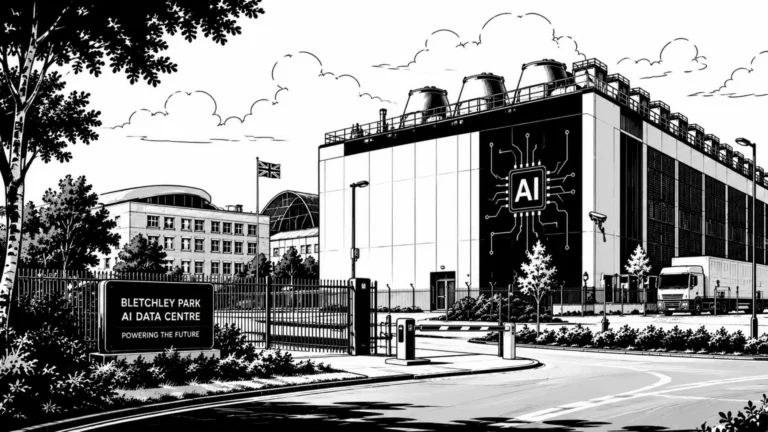
In 1943, a Post Office engineer called Tommy Flowers built a codebreaking machine out of 1,500 thermionic valves, partly out of his own pocket. Within a year Colossus, the world’s first programmable electronic computer, was cracking Nazi High Command ciphers at Bletchley Park. Britain had invented the data centre, in a large shed, and chock-full of hot electronics that quietly helped us win the war.
Alongside the Town and Country Planning Act and the squandering of the Marshall Plan money, Britain shot itself in the foot in this regard after the war. We destroyed Colossus in a colossal act of self-harm. The machines were broken up, the blueprints burned and Tommy Flowers was sworn to silence for 30 years.
In Britain, we can force £100 million to be spent on a bat tunnel; imagine what our planning system will do with a gigawatt campus
We are at it again. I have previously warned in these pages that an unholy alliance of eco-doomsters and Liberal Democrats (but I repeat myself) was trying to block Britain’s data centres with water-usage claims the figures simply do not support.
This negative spin is happening at the same time that AI is becoming the only engine of growth that the British economy has. The ONS reckons the ‘information and communications sector’ provided nearly half of last quarter’s growth. £22.1 billion of capex was spent on plant and machinery in a single quarter as the data centres we do have were built.
And this nonsense is happening across the West, a pollster has found that three quarters of Americans now oppose a data centre near them, a 33-point negative swing in a year. As a result, a whopping $64 billion of projects have been blocked or delayed by local opposition, says Data Center Watch, and both the GOP and the Democrats now blame electricity bills on the server farms. As a minor satrapy of the American Empire, we can expect to catch this same sickness. In Britain, we can force £100 million to be spent on a bat tunnel; imagine what our planning system will do with a gigawatt campus.
Elon Musk named his Memphis, Tennessee supercomputer Colossus in honour of Bletchley Park. He built it in 122 days, not much longer than the time an English data centre spends waiting for a pre-application advice letter. Musk grew so impatient with such permits that he put the power station that runs Colossus over the road, which just happens to be in Mississippi in an act of incredible regulatory arbitrage. As a result, he’s closing in on the frontier labs and the promise they bring of huge economic and social benefits.
Britain, though, doesn’t seem to be acting as though Artificial General Intelligence could be only a few years away. But other countries are. The Chinese Communist Party clearly understands the importance of this buildout to the Second Cold War in which we find ourselves.
As the American Enterprise Institute’s Dalibor Rohac argued here in CapX, this is verging on national security territory now. British industry already pays some of the highest energy bills in the world (that is what years of Ed Miliband treating cheap power as a moral failing gets you). But the risk of being left without compute to defend our critical infrastructure from advanced AI attacks by our enemies will soon be existential.
We can take inspiration from other countries getting it right, in the face of challenging odds. The UAE, for example, are well ahead of the curve. Dubai is already home to the world’s largest solar-powered data centre, has installed chief AI officers in 22 government departments and has a clear, serious and ambitious plan to invest in AI and to integrate it across its public sector. Of course, it’s easier with no parish council to placate but the comparison is staggering. Later this year, the UAE is set to open a 200 megawatt data centre cluster, making Britain’s best efforts – a 148 megawatt site outside Cardiff – seem more pygmy than colossus. In terms of AI companies, Dubai intends to lap London by reaching 10,000 firms by 2030. If compute can be conjured out of the literal desert, surely Slough can do it too.
Stay informed with our free daily briefing.
In Japan, SoftBank has gone into business with OpenAI and is converting a defunct Sharp television factory into an AI data centre, showing how we could use brownfield. And even Singapore, which has real land, energy and water constraints, is creating compute in extremely humid conditions.
Back in Britain, Bletchley Park, where Flowers made that first data centre, is a museum now. We go and watch a rebuilt Colossus clatter away, buy a fridge magnet and glow with pride at what the Britain of our grandfathers managed to do when it was serious. Then we drive home past empty fields where we know the future will not be built.
James Price is a senior fellow at the Adam Smith Institute.
More AI
25 Aug 2026
AI
Jennifer Holly
Three questions the new AI Minister must answer
The elevation of an AI Minister to the Cabinet Office appears like a triumph for the technology. But Kanishka Narayan is, essentially, on his own island, floating between Andy Burnham’s inner circle and the Department for Business, Innovation, Science and Trade (BIST) – unmoored from AI’s former home, the Department for Science, Innovation and Technology […]
Popular
12 Aug 2026
AI
Alys Denby
An editor’s guide to spotting AI writing
How do you know this wasn’t written by an AI? If you’re reading CapX, you are presumably interested in free speech, critical thinking and originality. So you should care that what you’re reading was written by a person with a mind. But public life is becoming colonised with ‘copy’ generated by AI. It’s become so […]
04 Aug 2026
AI
Valentin Boboc
The AI doomers are wrong about maths
There are certain things I expect very few people to care about. For example, if someone found a counterexample to an obscure mathematical conjecture from 1939, I would expect approximately three people in my group of friends (all three maths academics) to even pretend to care. And that is a very niche and self-selected group […]
Manage Consent
To provide the best experiences, we use technologies like cookies to store and/or access device information. Consenting to these technologies will allow us to process data such as browsing behavior or unique IDs on this site. Not consenting or withdrawing consent, may adversely affect certain features and functions.
Functional Always active
The technical storage or access is strictly necessary for the legitimate purpose of enabling the use of a specific service explicitly requested by the subscriber or user, or for the sole purpose of carrying out the transmission of a communication over an electronic communications network.
Preferences
The technical storage or access is necessary for the legitimate purpose of storing preferences that are not requested by the subscriber or user.
Statistics
The technical storage or access that is used exclusively for statistical purposes.The technical storage or access that is used exclusively for anonymous statistical purposes. Without a subpoena, voluntary compliance on the part of your Internet Service Provider, or additional records from a third party, information stored or retrieved for this purpose alone cannot usually be used to identify you.
Marketing
The technical storage or access is required to create user profiles to send advertising, or to track the user on a website or across several websites for similar marketing purposes.
To provide the best experiences, we use technologies like cookies to store and/or access device information. Consenting to these technologies will allow us to process data such as browsing behavior or unique IDs on this site. Not consenting or withdrawing consent, may adversely affect certain features and functions.
Functional Always active
The technical storage or access is strictly necessary for the legitimate purpose of enabling the use of a specific service explicitly requested by the subscriber or user, or for the sole purpose of carrying out the transmission of a communication over an electronic communications network.
Preferences
The technical storage or access is necessary for the legitimate purpose of storing preferences that are not requested by the subscriber or user.
Statistics
The technical storage or access that is used exclusively for statistical purposes.The technical storage or access that is used exclusively for anonymous statistical purposes. Without a subpoena, voluntary compliance on the part of your Internet Service Provider, or additional records from a third party, information stored or retrieved for this purpose alone cannot usually be used to identify you.
Marketing
The technical storage or access is required to create user profiles to send advertising, or to track the user on a website or across several websites for similar marketing purposes.