The Price Mechanism
Nimbys are holding back British tech

21 May 2026
Getty Images
I walked the dog recently along the Thames Path, around the source (or one of the sources, so as not to cause a fight) of the River Thames. This time of year, much of it is all dried up, and you can walk along the bed of what in the winter is full-flowing river. Wondering when the river will return is the closest I come to worrying about water loss.
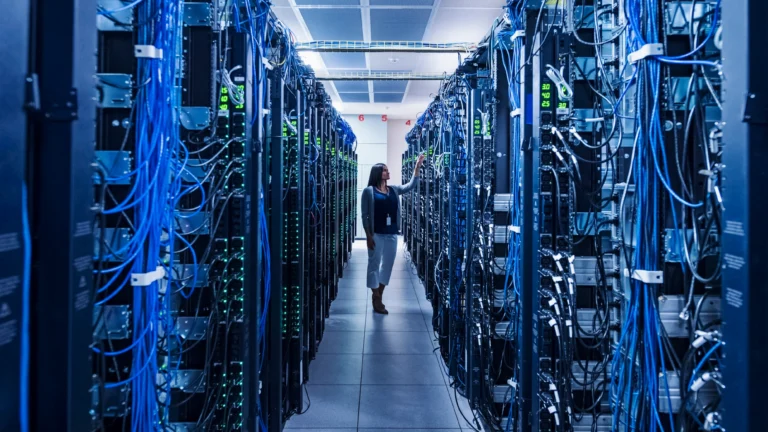
For growing numbers on either side of the pond, however, water loss has become an eschatological concern. The cause of their ire? Data centres. Campaigns – led by a terrifying combination of eco-loons, Nimbys and Liberal Democrats – have decided that these innocuous but essential parts of our critical national infrastructure are not just dark, satanic mills that must be opposed at every turn, but that they are drinking the country dry.
Unsurprisingly, this isn’t true. But a bit of history, before we get to that.
The world’s first data centre was built in Britain, in Bletchley Park, of course. Colossus Mk I was housed in the unassuming Block H, and was soon joined by nine more colossi across the Park. The purpose was raw compute designed to crack the Nazi Lorenz teleprinter encryption, which was distinct from the Enigma cipher that Alan Turing’s bombes were built to defeat.
In recent years, though, artificial intelligence models and the spread of software into everyday lives have seen the need for compute grow at an enormous rate, with demand far outstripping supply. Nvidia, a company you once only heard as a video game booted up, is now worth north of $5 trillion, greater than the entire FTSE 100.
Protesters love to go after these warehouses, despite the fact that the figures simply do not bear them out
A lack of physical compute is not just one of the main bottlenecks in the AI race, it is one of the bottlenecks holding us back from untold developments in healthcare, science, maths and much more. Elon Musk understood the imperative for more compute was so important that he managed to create his own Colossus (named, one assumes, after its predecessor in Bletchley) outside Memphis, Tennessee. It is the world’s largest single AI training centre.
This incredible feat of engineering, in just 122 days, ensured that Grok, Musk’s LLM, could be competitive against the models from Google, OpenAI and Anthropic. In the long run, control of the compute might prove crucial in that competition, not least as Musk is now renting out much of the original Colossus (he’s already built a second data centre, Colossus II) to Anthropic, whose development of Claude was being restrained by lack of access to compute.
Given that just yesterday these centres fuelled OpenAI’s disproof of an 80-year-old conjecture in discrete geometry, the planar unit distance problem first posed by Paul Erdős in 1946 (don’t ask me to explain it), you would think that people might be able to appreciate the future benefits to mankind of this infrastructure.
Alas. Campaigners fight their construction everywhere, and the idea that they consume vast quantities of water (to cool the servers from the heat they produce) has become widespread on ‘normie’ social media sites and real-world protests. Ironically, one of the big protests in Britain happened in Buckinghamshire, down the road from Bletchley Park.
Protesters love to go after these warehouses, despite the fact that the figures simply do not bear them out. While data centres do consume water (mostly through evaporative cooling), Britain’s entire sector gets through around 10 billion litres a year on the best published estimates. Meanwhile, on conservative estimates, the water usage of the Californian almond farming industry alone is around 85 times worse than all the water consumption of data centres across the entire USA. Thames Water alone loses roughly 20 times more water to leaks each year than the entire British data centre sector consumes.
The same campaigners against data centres are almost certainly those who also campaign against the solution to this, which is building more reservoirs, something Britain hasn’t managed in 35 years. It’s been almost a year since Bill Gates conceded that climate change is not the existential threat it has been claimed to be. But millenarian millennials are still tilting at the wrong targets. Instead of wanting water back, we should worry about Britain becoming a tech backwater.


Britain is looking for the effects of artificial intelligence in all the obvious places: redundancies, vacancies and unemployment numbers. So far, there is little evidence of dramatic change in overall headcount. The Office for National Statistics reports that most British businesses using AI have not changed the size of their workforce, even as AI adoption […]

In the graphic novel ‘Ministry of Space’, an alternate history is imagined whereby Great Britain nabs the Nazi rocket scientists before the US or USSR. Churchill becomes, in addition to his other (real) accolades and achievements, the father of the British space programme that sees us win the space race. There is a particularly poignant […]

Sam Altman, CEO of OpenAI, and Dario Amodei, CEO of Anthropic, have called for increased regulation of AI to slow down the pace of development. They warn in apocalyptic terms of the dangers their own technology poses. After Jacob Coxon, a researcher, resigned from Anthropic, stating that he could no longer justify working on AI […]