Young people need culture, not condescension
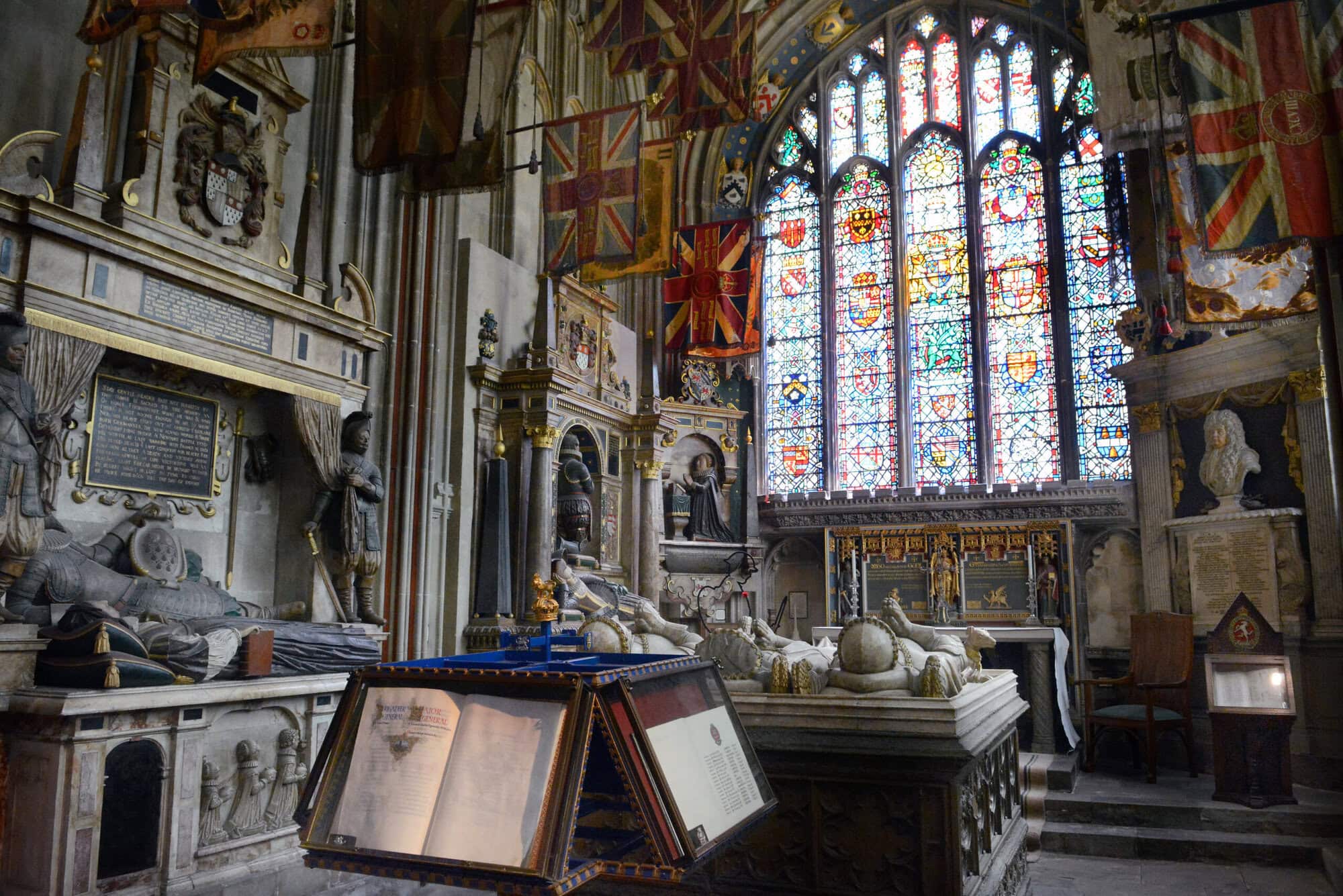
Saint Michael's Chapel, also called Warriors Chapel, in the south west transept of Canterbury Cathedral. Photo: Getty Images.
It is easy to scoff at the middle-class pretensions of Canterbury Cathedral’s current graffiti display. As Joseph Dinnage, the deputy editor of this publication, notes on X, it looks as though the cathedral has been turned ‘into a South London youth club c.2005’. The style of the temporary graffiti they have plastered on the ancient cathedral pillars is so laughably contrived and cartoonish that the whole enterprise falls flat on its face from an aesthetic standpoint alone.
For this reason, it is unintentionally comical to read the Dean of Canterbury, David Monteith, refer to the sticky-back graffiti as possessing ‘authenticity’ and ‘rawness’ because ‘it is unfiltered and not tidied up or sanitised’. Although I am sure his thoughts are well-intentioned, you can almost imagine the 57-year-old priest unveiling the graffiti work while donning a backwards cap over his dog collar and posing with Ali G, c.2005.
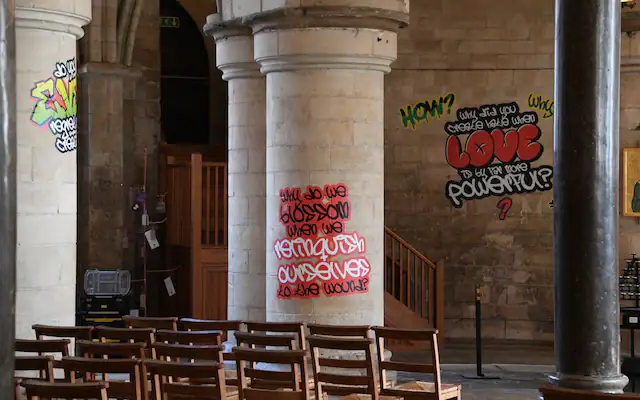
Photo: Canterbury Cathedral
But there is a more serious concern that many of us have when we see and hear this type of thing. The idea expressed by the Cathedral Dean – that graffiti ‘allows us to receive the gifts of younger people who have much to say and from whom we need to hear much’ – is a terrifying insight into these people’s thinking. It insists that, since we can associate criminal graffiti in run-down areas with some young people, it is the channel through which we should reach all young people.
As well as being risibly cringeworthy, it is palpable nonsense and hugely counterproductive. The focus on marginalised young people specifically makes it even less palatable.
As a teacher, I have had the pleasure of seeing talented young students from all walks of life – including first-generation migrants and children from low-income families – construct beautiful art pieces, imbued with depth and daring. I have heard them perform Mozart, Berlioz and Chopin. I have read their powerful poetry, saturated with profundity and weighty consideration of the mysteries of the human condition. In the classroom, I have been lucky enough to witness what young people are truly capable of when they are supported and challenged to go beyond their current thinking and doing, and it is definitely not something worthy of condescension.
Children from all walks of life should be encouraged to go beyond the confinements of their current environment in order to achieve what Aristotle called Eudaemonia – the ‘good spirit’, or deep happiness, that one attains from human flourishing. We don’t need to glorify graffiti to reach young people. Indeed, many marginalised young people whose housing estates have been dirtied and defaced by illegal graffiti might wish to escape those depressing scenes at points; not least in a beautiful, sacred place of worship such as Canterbury Cathedral – a hallowed refuge for those who have sought healing for centuries.
This debasing sentiment towards marginalised young people finds its grim expression elsewhere in modern society; in the idea that working-class children should not bother with Shakespeare, that orchestral music is too posh for state school kids, or that less-affluent children should not be expected to have to wear proper school uniform and so keep to standards expected of other children. Unfortunately, it is a corrupting attitude that can now be found in the corridors of power, manifested in the Labour Government’s inexplicable mid-year cancellation of funding for Latin excellence programmes or the recent termination of the International Baccalaureate in state schools.
This attitude has often been referred to as the soft bigotry of low expectations, and it is damaging young people, closing off opportunities and realities to those who would most benefit from them. For that reason, recent talk of making the national curriculum more ‘relatable’ should send a shiver down the spine of anyone who believes in social mobility. The David Brent ‘Equality Street’ levels of cringeworthiness might be almost humorous in the context of a solitary cathedral. This same approach throughout English state schools would be catastrophic, though.
The antidote to all this can be found in the magnificent words of Tomiwa Owolade, who argues:
Making the case for the universal resonance of the high arts is the inclusive thing to do: it doesn’t condescend to children from poor backgrounds but treats them with the greatest dignity. It says to them, it doesn’t matter where you come from: the best of what has been said and made in our civilisation belongs to you.
This is surely what we believe. People like me – who were educated in the state school system and the first in our families to go to university – live with immense gratitude. Had we been treated with less dignity and closed off from the best that has been said and made in our civilisation, our lives would have been immeasurably poorer.
Canterbury Cathedral, of course, is not just a solitary cathedral. It is a focal point for Christianity in this country and, as such, it is a location that binds us to much of the best that has been said and made in our civilisation. Like other cathedrals, it was built beautifully and meticulously, revering God and demonstrating faithful gratitude to the almighty. It has been a refuge of beauty and majesty to some of the poorest people in society for centuries, and so its temporary aesthetic conversion to a disused multistory car park does seem particularly distasteful.
Putting sticky-back graffiti up on the walls is not just distasteful, though. It also reflects something more concerning. The idea that we should uglify that which is beautiful and magnificent may seem compassionate and inclusive to those well-intentioned middle-class people doing it. However, the real impact of this approach is the complete opposite.
People, marginalised or otherwise, should not be condescended to. They should be respected, and the best and most beautiful aspects of our civilisation – for which anyone with any sense would be grateful – should be made accessible to them. Not in a dumbed-down, distorted form; in its full glory, offering escape from profane mediocrity and unleashing the good spirit in all of us – ‘not conformed to this world, but be ye transformed’.

Margaret Thatcher is back in the news. But it is not her admirers on the Right who have put her there. It is our new Labour Prime Minister, whose diagnosis of our country’s ills seems to be that Britain was on the right path up until 1979, when the Conservatives got into power and precipitated […]

Dear Andy Burnham, Firstly, I must congratulate you on your new role. I am sorry that I have not written to you sooner and I know that you’ve technically been in post for a while now. In my defence though, you did go away almost immediately after taking office. The reason that I am writing […]

The Stanford Encyclopedia of Philosophy is not a publication most would be familiar with. It is meant as a repository of overviews of big topics in philosophy broadly defined, inclusive of political theory. As such, entries added to it are unlikely to generate strong responses by the experts deeply familiar with each individual entry. Every […]