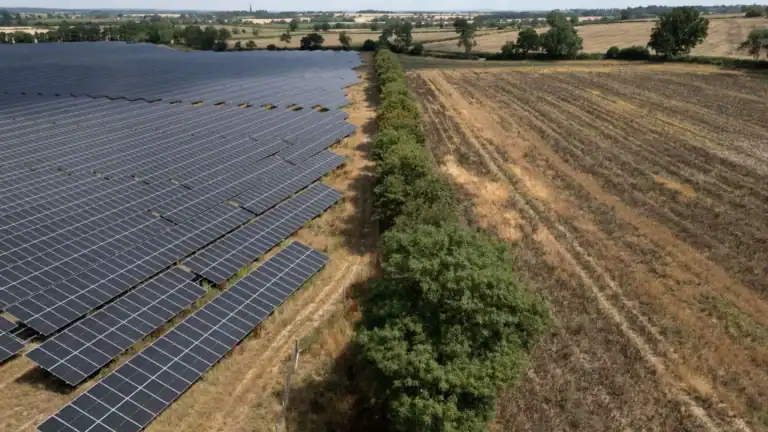
Extensive solar panels installed in the countryside, highlighting renewable energy efforts in rural areas.
Share this article
This week, Nimby Watch is in Axminster, because where else would you go to talk about the technologies of the future?
Alright then, where are we off to this time? In this edition of Nimby Watch, we’re focusing in on Axminster, where –
Oh, I love that we’re finally doing something different! I’m a huge fan of Axminster carpets – you just can’t fake the results of a proper, traditional weaving process, and we’re long overdue the comeback of bold, elaborate patterns, instead of all that damned laminate, and… why are you looking at me like that? I was talking about the town of Axminster, in Devon. I wasn’t talking about carpets.
If we allow local planning inspectors to override expert agencies on everything, they’re understandably always going to err on the side of caution on topics they’re not experts in
Oh. I guess that makes more sense, in the context of this column. It does, yes. But the type of carpet is named for the town, and Axminster Carpets is still based in the town, and makes them there to this day.
I’m getting the feeling this isn’t going to be about carpets, though… No, we are pretty much done with carpets now. Instead, a company has been trying to build a battery energy storage system – often abbreviated to BESS – on the outskirts of the town.
Am I supposed to know what that is? I knew what a carpet was. You might not know the term, but the idea should be familiar. Devon is one of the best areas of the UK for large-scale solar power: it’s got lots of land, and lots of sun. The problem with solar, of course, is that the sun doesn’t always shine – sometimes, it’s nighttime. So if you want lots of solar power generation in your grid, you also want some industrial-scale batteries to store power for when the sun isn’t shining.
So a BESS is just a big battery, then? How big are we talking? Pretty much, yes. Or, to be a little bit more accurate, it’s an array of lots of high-capacity lithium batteries, all on one secure site. The one proposed at Axminster would be able to supply enough energy to power 75,000 homes for around 10 hours, on a full charge.
We wouldn’t be talking about this if someone hadn’t objected to it, though, would we? So, what’s the problem? Well, you’d be shocked to hear that I’m going to say the problem is Nimbys. But on the surface here, the stated complaints from the local groups here are pretty decent – they’re worried about fire and explosion risk, which given this is a site with a lot of lithium batteries in it, doesn’t seem entirely irrational.
Isn’t that my line? I’m supposed to defend the Nimbys, and you attack them. You’ve got no respect for the format of this column. I just wanted to make a point of being fair before I laid into this one.
Why? What’s so wrong about this? Well: if we want clean, green power generation – and some of us do – batteries are just part of the deal. None of this works without them: there’s no point having wind and solar if you can’t store it. So, we need lots of these BESS sites. And if what’s happened in Axminster is any sign, that’s going to be all but impossible.
Okay, what happened? As ever, all of this took years. Clearstone Energy announced this project in 2023, having secured a deal to get a grid connection at Axminster substation. It applied for planning permission in early 2024, and then spent more than a year trying to get East Devon District Council to approve the plans – only for them to be rejected in May 2025.
What were the grounds for rejection? Mostly, it was due to concerns raised by locals about the flood risk and the risk of fires – but Clearstone Energy appealed, and they set out their arguments so well that East Devon District Council actually withdrew their own opposition to the plans in January this year… only for the pressure groups to be allowed to continue with their opposition alone. On August 13, 2026, the decision went in their favour. The plans were denied.
Ah. Why were they denied? Basically, the planning hearing was allowed to hear evidence on the fire safety of the plans, and both sides put up expert witnesses of their own – it turns out that the Campaign to Protect Rural England (CPRE) was involved, and has a successful playbook for blocking BESS schemes, particularly in Devon. The planning inspector, understandably enough, didn’t want to look like she was playing fast and loose with fire risks, and erred on the side of caution.
Well, I wouldn’t want to err on the side of risking fires, either. Well. This is where it gets tricky. There is a whole process for certifying whether technologies are fire safe or not, overseen by the National Fire Chiefs Council, and using standards set out by the National Fire Protection Association – and the technology for this BESS site passed those. It’s already in place at nine sites in the UK, and 100 worldwide.
Well, can’t be too safe, can you? Well, you can: if we allow local planning inspectors to override expert agencies on everything, they’re understandably always going to err on the side of caution on topics they’re not experts in. If instead of proving your technology once, you have to do it in every single planning application, and each takes years, you’re never going to be able to roll it out. It’s game over – and the CPRE has caught on to that, and is shamelessly exploiting it.
Stay informed with our free daily briefing.
You sound like you’re saying this isn’t just about legitimate fire safety concerns for the CPRE? I’m sure some of its campaigners are deeply worried about fires – especially if those concerns have been agitated to help mobilise opposition to plans. But the group’s spokesperson did rather give the game away when she told the BBC the victory ‘should give encouragement to others opposing similar BESS proposals in the countryside’.
Among the other concerns she listed, she celebrated that ‘the powers that be are starting to take notice of… the threat of industrialising the countryside’. Heaven forbid we ever try to make the countryside work for the good of society, eh? Next we’ll be trying to use it to grow food.
James Ball is an award winning journalist, broadcaster and author.
More Nimby Watch
09 Nov 2026
Nimby Watch
James Ball
Britain’s housing crisis is worse than we thought
This week, Nimby Watch is paying a visit to the University of Warwick Warwick! What a beautiful place to visit. We’ve got the River Avon, a truly historic castle – begun by William the Conqueror himself – and a beautiful series of heritage buildings. What a delight. I assume you want to bulldoze half of […]
26 Oct 2026
Nimby Watch
James Ball
Andy Burnham’s devolution drive has a Nimby problem
This week, Nimby Watch is in Cardiff Bay, at the site of the Welsh Senedd Oooh…Wales. Why are we here? Surely you’re not about to kvetch about the Senedd building. They finished it 20 years ago! I’ll admit it’s not my favourite building from the outside – very generic glass-and-steel – but the inside is […]
Popular
12 Oct 2026
Nimby Watch
James Ball
Sevenoaks’ Nimbys prefer a derelict golf course to housing
This week, Nimby Watch is golfing in Sevenoaks, a leafy town firmly within London’s commuter belt. Hang on, we’re golfing now? Since when did either of us play golf? Hey, I’ll have you know I placed third in a golfing competition just last month. I take my time at the tee deeply seriously. That was […]
Manage Consent
To provide the best experiences, we use technologies like cookies to store and/or access device information. Consenting to these technologies will allow us to process data such as browsing behavior or unique IDs on this site. Not consenting or withdrawing consent, may adversely affect certain features and functions.
Functional Always active
The technical storage or access is strictly necessary for the legitimate purpose of enabling the use of a specific service explicitly requested by the subscriber or user, or for the sole purpose of carrying out the transmission of a communication over an electronic communications network.
Preferences
The technical storage or access is necessary for the legitimate purpose of storing preferences that are not requested by the subscriber or user.
Statistics
The technical storage or access that is used exclusively for statistical purposes.The technical storage or access that is used exclusively for anonymous statistical purposes. Without a subpoena, voluntary compliance on the part of your Internet Service Provider, or additional records from a third party, information stored or retrieved for this purpose alone cannot usually be used to identify you.
Marketing
The technical storage or access is required to create user profiles to send advertising, or to track the user on a website or across several websites for similar marketing purposes.