Why the Ras Laffan attack matters to the world
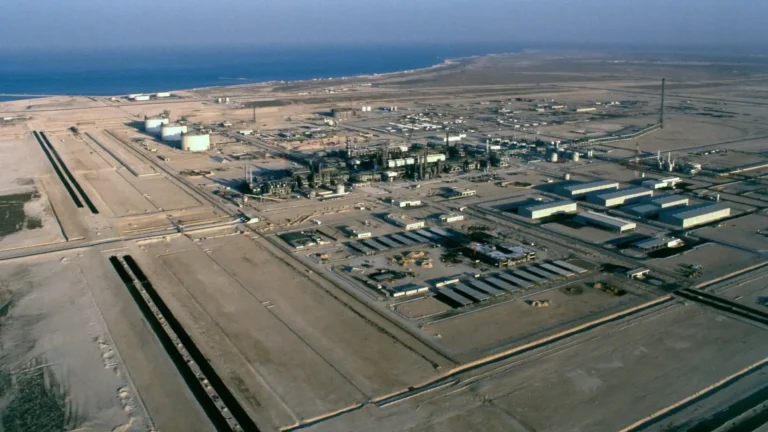
Photo by Barry Iverson/Getty Images
Iran’s strike on Ras Laffan this week was not just an attack on Qatar, but on one of the most important energy hubs on the planet. In this extract from his book ‘Material World’, Ed Conway explains why this vast LNG complex matters so much – and why damage there could reverberate through gas markets, inflation and geopolitics for years.
Ras Laffan sits on the headland of the Qatari peninsula. It is a sprawling jungle of pipework in the desert: some of it cleaning and processing natural gas, some of it condensing and cooling the gas into its liquefied form. When I visited a few years ago I spent some hours driving through the maze of steel in a little electric golf buggy, trying to identify where the liquefaction actually took place, and failing. It was another baffling experience much like the Wesseling refinery in Cologne. Only here, the hydrocarbon is somewhat lighter, somewhat different.
If oil marked the world’s third great energy transition – the moment we discovered how to refine petroleum, diesel and other petrochemicals from crude oil – then natural gas is sometimes described as marking the fourth energy transition. While oil is considerably more energy-dense than most types of coal, better-equipped to fuel internal combustion engines, gas is better still at turning fuel into power. Today’s gas turbines are the very best energy convertors in existence, which helps make gas the most efficient and least pollutive of all fossil fuels. Were China to shift all its coal-fired power stations on to gas, then the world would immediately be on track to hit its climate goals.
However, this transition has taken some time to get going. Oil overtook coal as the world’s biggest energy source in the mid-1960s but gas was only beginning to overtake coal at the time of writing, in the early 2020s. In part this is because gas is a lot trickier to move about than oil; it necessitates vast distribution networks, which take many years to build. Today there are transcontinental pipelines across North America and China, across much of the Middle East and the Caucasus; there are pipelines connecting the Russian gas fields in Siberia with Europe, though some are now inactive and the biggest of them, Nord Stream, was sabotaged in 2022. Then there’s an increasing number of terminals that do what they do at Ras Laffan, compressing natural gas into a super-cool liquefied form, which can then be shipped in special LNG vessels, much like those mammoth oil tankers circulating the globe.
And this place is even more important than the other ports and plants along the Gulf coastline, for it sits next to what is the single biggest energy source on the planet. While Ghawar is the world’s biggest oilfield the North Field, which sits under the sea just off Qatar, is comfortably the world’s biggest natural gas field. And since we can turn natural gas into heat or power far more efficiently than any other fuel, the amount of useful energy we can extract from here is greater than anywhere else on the planet – bigger even than Ghawar and all the oil flowing through the Ras Tanura terminal in Saudi. At the time of writing, nowhere else came close to the North Field, making it the single most important energy source on Earth.
The North Field is huge – a massive underground reservoir of gas covering 3,750 square miles, most of it under Qatari waters but some stretching into Iranian territory. Qatar pumps the gas up through pipes and the CO2 and sulphur are removed at the steel jungle of Ras Laffan. It is hard, even as one paces through this astonishing complex of metalwork, to comprehend just how much this place matters. This single place provides around 4% of global energy – comfortably more than every solar panel and wind turbine in the world combined.
And as the world continues to shift across from coal and oil towards gas, Ras Laffan will become even more important. So it is somewhat unsettling that this place is also firmly in the sights of Iranian cruise missiles. These two nations – one small, one large, one aligned with the West, the other a part of the so-called ‘axis of evil’ – are both poking their straws into the very same reservoir. They are both uneasily tapping the same hydrocarbons, the fossilised plankton laid down in a tropical sea hundreds of millions of years ago, beneath this, the world’s most energy-rich region.
Extracted from ‘Material World: A Substantial Story of Our Past and Future’ by Ed Conway (Penguin Books, paperback £10.99).
President Trump’s imposition of ‘economic D-Day’ against Iran – a series of sanctions against any nation dealing financially with Iran, as well as banks and businesses – has already been dismissed by the usual suspects whose knee jerk response is always to attack any new measures against the Tehran regime. When it comes to Iran, […]
Last week, the Community Security Trust’s (CST) report covering incidents between January and June 2026 showed alarming results. The unprecedented wave of antisemitism that started on October 7, 2023, when Hamas massacred and kidnapped over 1,200 people in Israel, shows no sign of easing. On the contrary. The 1,926 incidents recorded represent a 21% rise […]
The Iran war has created the largest supply disruption in the history of the oil market, beating the shocks of the 1970s and the war in Ukraine. Whatever happens with Donald Trump and the Strait of Hormuz, the Middle East oil industry cannot afford to be this exposed again. The Gulf has the money and […]