The robot race is on, and Britain is falling behind
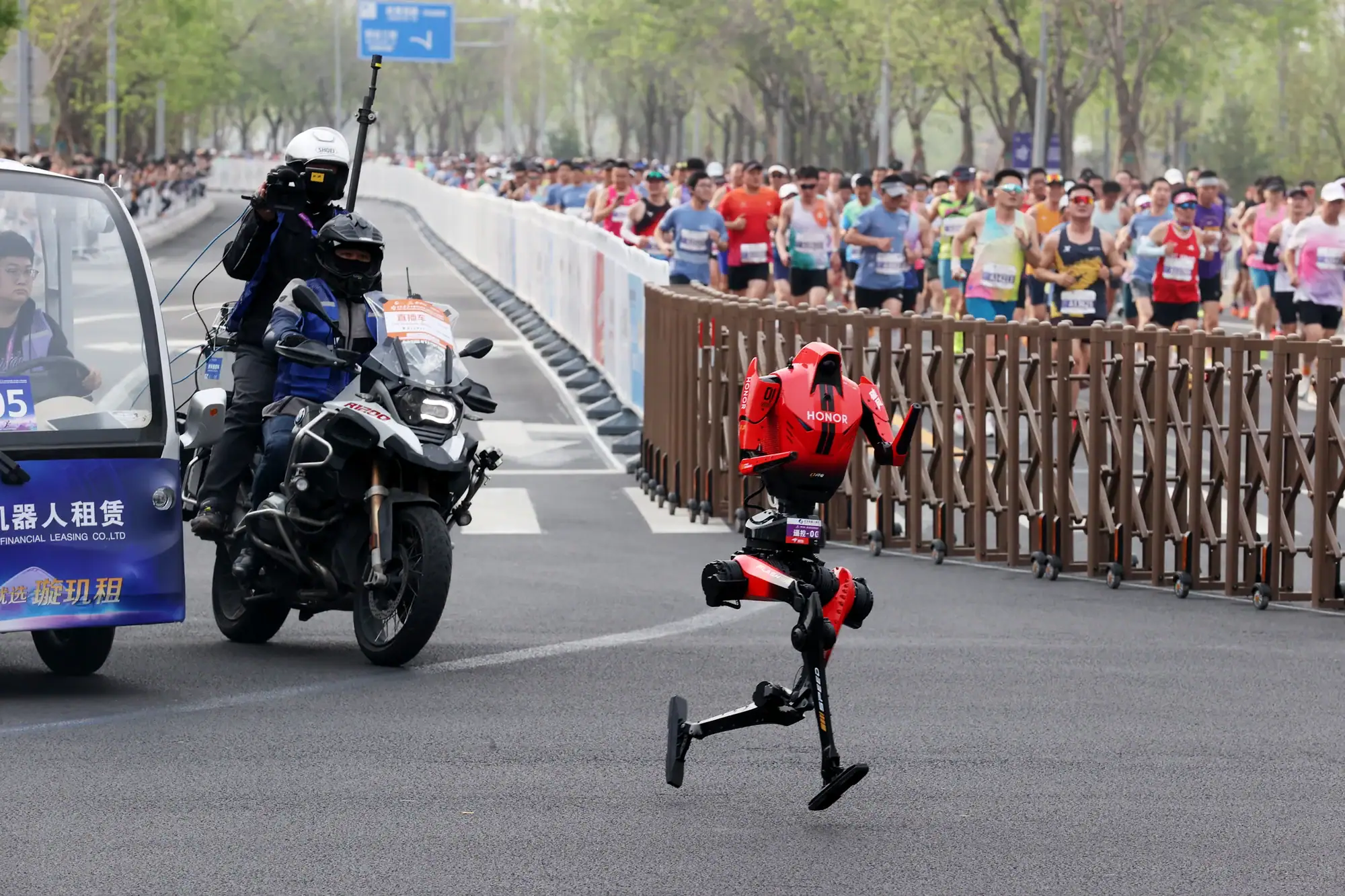
Photo: VCG/VCG via Getty Images
Can a robot write a symphony? Can it turn a canvas into a beautiful masterpiece?”
Can you?
This exchange from the film ‘I, Robot’ (and later parodied in a million memes) captures human fears and concerns about coexisting with robots, and what it means to be human. Fast forward 20 years, and artificial intelligence is getting pretty good at composing both music and paintings, while my artistic efforts are worse than Shia LaBeouf’s performance in that film.
It has been weird to see AI become so effective at these skills before machines have become competent in the physical world, where they have long been hopelessly poor. No longer.
Last weekend, the ‘Lightning’ humanoid robot won the Beijing E-Town Humanoid Half Marathon in 50 minutes 26 seconds, beating Jacob Kiplimo’s human world record by nearly seven minutes. Last year, in the inaugural event, the winning robot took 2hrs 40min 42sec, something even I can just about beat. In 12 months of progress, that is a 70% improvement. As impressively, in 2025’s race, only 6 of 21 robots even finished. Last weekend saw more than 300 robots, including entries from all around the world – 40% ran autonomously.
Ok, so one robot face-planted 200 feet from the start line and finished the race held together with duct tape. That also sounds a bit like my running. But this kind of rapid (pun intended) improvement in humanoid robotics is astonishing, and means we are not so very far away from a revolution at least as big as any we have seen so far.
Elon Musk is producing his own humanoid robots, Optimus, calling them the ‘biggest product ever of any kind’. As such, Tesla are converting their Model S and Model X car manufacturing lines to Optimus production and have dropped those car models completely to free up capacity.
And these are just the fully humanoid-shaped robots. The level of robotic automation is increasing massively in every corner of the world. The most obvious and terrifying is in warfare. Just last week, Ukraine’s President Zelenskyy made a statement that was largely ignored in Westminster, but will undoubtedly go down in the history books. He told how, for the first time ever, an enemy position was taken with no humans; Russian soldiers instead surrendered to drones and robots. According to the Ukrainian defence ministry, there have been more than 22,000 robotic ground missions in the first quarter of 2026 alone.
There is, alas, one advanced country that is not racing ahead into this sci-fi future. Britain. In 2023, we boasted 119 robots per 10,000 manufacturing workers. This compares poorly to Germany with 429, China with 470, and South Korea with 1,012. In fact, the global average is 162, putting the UK below Slovenia, Turkey and down in 24th globally.
Ryan Bourne has written persuasively in these pages about the ways that Britain can and should address this lag in a proper free market way. Indeed, he points out that in some areas, Britain is going backwards. In the decade to 2016, the number of automated car washes fell by 1,110, displaced by cheap hand-car-wash labour propped up by mass low-skilled immigration.
But beyond technical arguments about immigration, regulation and productive capacity, I fear that there is an existential terror about the future among today’s political class.
Even since Ryan wrote that piece just under a year ago, the humanoid tech has come on in leaps and bounds (and half marathons). And yet as we sit on the cusp of an enormous revolution, the arguments are still rather 19th-century in their tone, and centre around holding back industrialisation to protect the jobs of the past, calling for more third-world labour to prop up an outdated economic model. We can’t even automate the Tube.
Nearly 3,000 years ago, Homer imagined Hephaestus’ forge, staffed by golden humanoid automata with their own, for want of a better word, artificial intelligence operating them. Aristotle took the idea and wondered as to the effects on the workforce: ‘chief workmen would have no need of servants, nor masters slaves’. The robot that faceplanted at the start of the Beijing half marathon still crossed the finish line. Let us hope that Britain can likewise pick itself up, because this race is just getting started.

What do Richard Tice, Kevin Hollinrake and Peter Kyle all have in common? I wish I had a wittier answer to what sounds the set-up to a poor joke, but unfortunately I only have one answer – they all own an electric vehicle (EV). If three men, who have wildly diverging political views, lifestyles and […]
Few people enjoy gazing into the crystal ball more than economists. Attempting to divine the future, otherwise known as forecasting, is a numerically intensive pastime of many people in the profession. It is also a common mandate of many state institutions. For instance, the Office for Budget Responsibility (OBR) produces aggregate forecasts of government receipts, […]
One doesn’t like to be a disappointment to one’s parents. But in (at least) one crucial regard, I’ve let my dad down. He is a steam train enthusiast, and I’ve never shown a blind bit of interest. So it was more with filial duty than pleasure that I took the old man to the Didcot […]