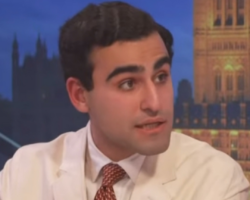
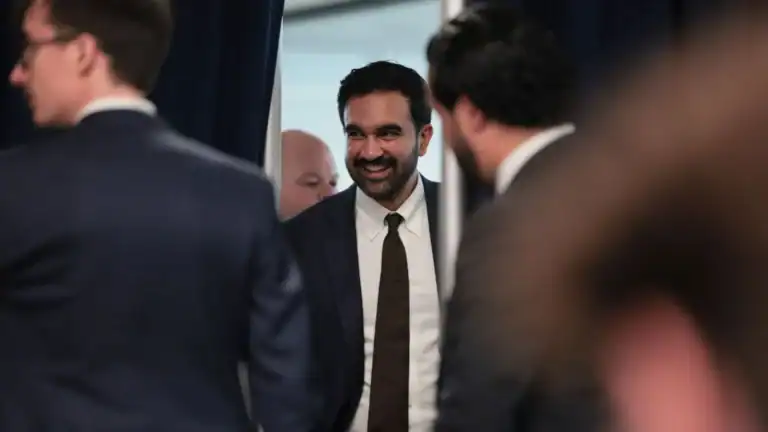
A man smiling during a political discussion at a conference, surrounded by other attendees.
Share this article
‘A Waiter in Paris’ is the story of a young Englishman who graduated from a good university in London with a humanities degree, trained and educated for a world that no longer exists. ‘All while I applied for other, more “prestigious” jobs. Jobs that didn’t appear to exist anymore.’ That’s how Edward Chisholm puts it in the book. The story of Chisholm isn’t limited to himself; it is also shaping a political force on the other side of the Atlantic.
The Democratic Socialists of America (DSA) are gaining popularity. From Abdul El-Sayed’s victory in Michigan’s primary – although he is not an official member, his views are mostly identical to those of the DSA, from his views on Israel to his support for abolishing ICE – to Zohran Mamdani, who is now the mayor of New York, and Alexandria Ocasio-Cortez, also known simply as AOC, who, according to Polymarket odds, is now the frontrunner to become the 2028 Democratic presidential nominee.
The DSA is part of a larger trend of young people who graduated from top universities, mostly with humanities degrees, who see that the job market isn’t as friendly as their university years suggested it would be
The Democratic Socialists of America have an interesting membership. Among its members, 80% have completed university with at least a bachelor’s degree, which is a huge difference compared with roughly 37.5% nationwide. But when we look at their wages, things get more interesting: about 45% of adult members report household incomes below $60,000 per year. The DSA is part of a larger trend of young people who graduated from top universities, mostly with humanities degrees, who see that the job market isn’t as friendly as their university years suggested it would be.
This goes back to economics. The overreach of the state in higher education, as well as the subsidising and incentivising of people to study degrees that don’t pay well in the job market, has created a middle class in urban areas that feels it isn’t getting what it deserves from society. Their mate who studied a STEM degree or economics now has a six-figure pay cheque and is starting a family. While they have found out that a career in student activism isn’t going to prepare them for the job market. And these educated middle class young people have, historically, been among those most attracted to ideas of socialism.
Let’s go back to May 1968 in Paris, where pictures of Lenin and Mao were all over universities and caused Charles de Gaulle to leave the country for a while for fear of revolution. One man observed it well, and it changed the course of his thinking. Roger Scruton, seeing the would-be revolutionaries, described them as ‘an unruly mob of self-indulgent middle-class hooligans.’ But why do the young and educated tend to like socialism?
The American philosopher Robert Nozick provides an answer. He believed that this class of intellectuals felt that, in a capitalist society, they weren’t in the positions of power and influence they deserved. People who were less educated than them, and hadn’t read the theory they had, earned vastly more than them. ‘This isn’t fair!’ So, in the socialist utopia in their minds, they would occupy the highest social status, managing society. Historically, however, this seems to have been one of their biggest misconceptions, because there is no guarantee that, in their socialist utopia, they wouldn’t end up in a gulag rather than in the big mansions for a few state-approved ‘engineers of human souls’.
But the feeling is real. They have been promised a world that doesn’t exist. It’s harder to get on the housing ladder, and with cuts to subsidies for humanities courses, it’s harder for them to find a career in academia. That’s the reason for the DSA’s wider appeal. As Gerard Baker wrote for the Wall Street Journal, the socialists may have the wrong answers, but ‘the questions are real’. And to their credit, the DSA have chosen a new strategy that has a higher chance of appealing to centrist voters.
AOC, in one of her latest interviews, confessed, ‘Woke 1 was crazy.’ This is a vibe shift. Although it’s hard to believe that DSA members have changed their beliefs, they have learned that the average American celebrating Thanksgiving with their family doesn’t believe we should cancel Thanksgiving, as Wisconsin State Representative Francesca Hong suggested. The Mamdani campaign focused on the ‘cost of living’. Abdul El-Sayed’s campaign has focused on proposals for reducing the cost of healthcare and housing. And the right needs to recognise this. One of the reasons for Trump’s second victory was that he was seen as a force for common sense, as Scott Jennings put it in his book, ‘A Revolution of Common Sense’.
Stay informed with our free daily briefing.
The average American doesn’t want to defund the police, cancel Thanksgiving, abolish prisons or get rid of the Senate. But they do want lower rent, more affordable healthcare and, as recent polls show, less American involvement in foreign wars. The DSA have understood this, but the Right hasn’t. Trump and his team have lately been campaigning against them by labelling them communists. Although many of them are, they are also campaigning on reasonable concerns about economic matters. And we may once again find Clinton’s famous motto to be right in US politics: ‘It’s the economy, stupid.’
Mani Basharzad is a Junior Research Associate at the Institute of Economic Affairs and an economic journalist.
More America
05 Nov 2026
America
James Price
Why the British Right should be cheering Trump’s midterm defeat
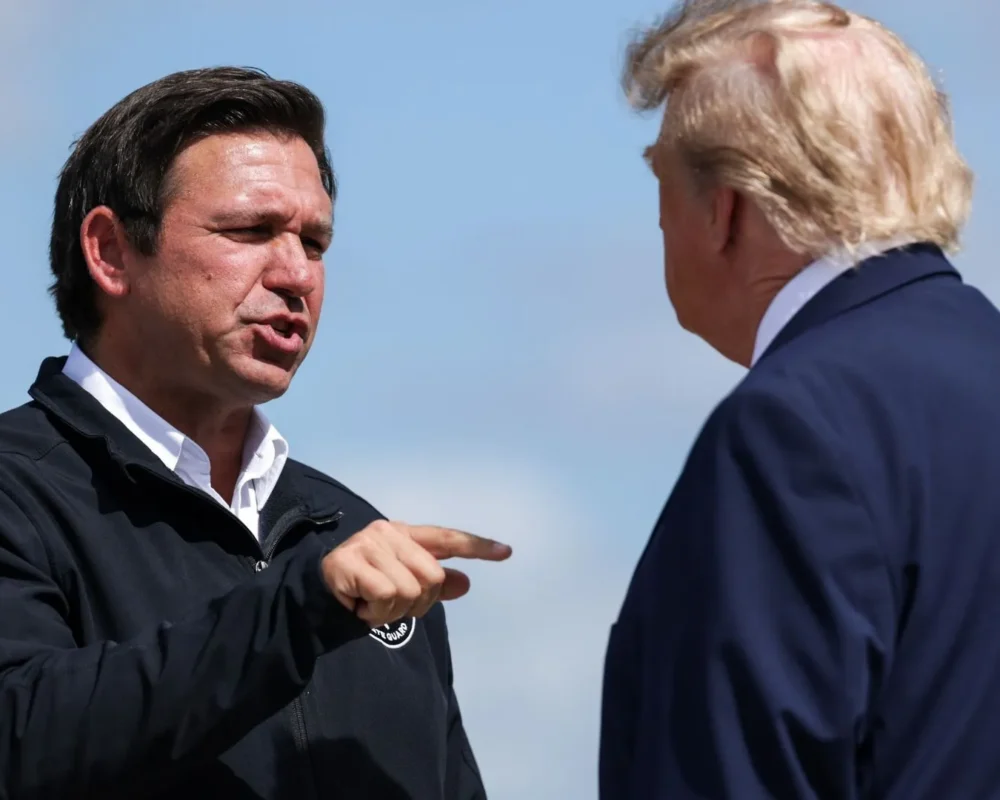
Ron DeSantis chose his moment with care. The night before the US midterms, the outgoing Governor of Florida appeared on a sports podcast. On election eve, DeSantis admitted that the Iran war had been ‘a big, big drag’ on Republicans, that the party had been ‘gaslighting’ voters by blaming Joe Biden for the price of […]
21 Sep 2026
Technology
Ben Ramanauskas
Trump is right about Britain’s technology laws
It’s been reported that officials in the Trump administration have given their UK counterparts a dressing-down over the Online Safety Act and the social-media ban for under-16s. As someone who previously worked on digital trade for the UK government, this does not surprise me. Both the Trump and Biden administrations have seen British laws such […]
16 Sep 2026
Economics
Mani Basharzad
After 9/11 we chose safety over freedom
If there was one event that ended Fukuyama’s ‘end of history’, it was 9/11. The growth and predominance of globalisation were followed by anti-Western intellectual movements. Many, especially on the Left, are still obsessed with rationalising the insanity of the attackers – most notoriously streamer Hasan Piker, who claimed in 2019 that ‘America deserved 9/11’. […]
Manage Consent
To provide the best experiences, we use technologies like cookies to store and/or access device information. Consenting to these technologies will allow us to process data such as browsing behavior or unique IDs on this site. Not consenting or withdrawing consent, may adversely affect certain features and functions.
Functional Always active
The technical storage or access is strictly necessary for the legitimate purpose of enabling the use of a specific service explicitly requested by the subscriber or user, or for the sole purpose of carrying out the transmission of a communication over an electronic communications network.
Preferences
The technical storage or access is necessary for the legitimate purpose of storing preferences that are not requested by the subscriber or user.
Statistics
The technical storage or access that is used exclusively for statistical purposes.The technical storage or access that is used exclusively for anonymous statistical purposes. Without a subpoena, voluntary compliance on the part of your Internet Service Provider, or additional records from a third party, information stored or retrieved for this purpose alone cannot usually be used to identify you.
Marketing
The technical storage or access is required to create user profiles to send advertising, or to track the user on a website or across several websites for similar marketing purposes.