The EU is closing the Temu loophole. Britain is next
Trade moves faster than regulation, and nowhere more so than in e-commerce, whose marketplaces and traders are by their very nature responsive, innovative and dynamic. For governments and regulators, that is a special challenge.
The big platforms are ruthlessly focused on ways to build margin, increase customers and simplify systems. Over the past five years, policymakers have wrestled with how to regulate international trade when millions of consumers order products directly from overseas suppliers at the click of a button.
The European Union believes it now has an answer – one which provides both a blueprint and a warning for the UK.
When the US changed its de minimis rules, Temu stopped shipping directly to consumers from China, shipping instead to local warehouses
On July 1, 2026, the EU abolished its €150 de minimis threshold, under which low-value imports were exempt from customs duty. In its place came a temporary duty of €3 on online orders worth up to €150, charged for each different type of product in the parcel. A T-shirt and a pair of trousers pay €6; two T-shirts pay €3.
Since November 1, a separate €2 handling fee has also applied to each product type, to cover the cost of customs checks. Unlike the €3 duty, this is not a stopgap: it will continue to apply even after the EU’s new customs data hub is running from July 2028, when the €3 duty will be replaced by normal tariff rates.
At first glance, these changes may look like little more than another tax on cheap online shopping. In reality, they are part of one of the most significant reforms of the EU Customs Union since its creation in 1968.
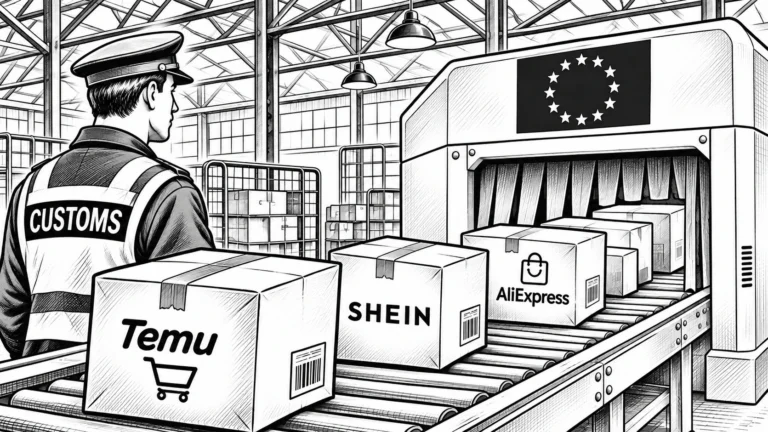
The scale explains why Brussels acted. Almost 5.9 billion low-value items entered the EU in 2025, more than four times the number recorded in 2022. More than 90% came from China, with marketplaces such as Temu, Shein and AliExpress shipping directly to customers. The European Commission estimates that up to 65% of small parcels entering the EU were undervalued for customs.
The duty-free rule was introduced to avoid disproportionate administrative burdens for customs authorities, businesses and private individuals. This logic collapsed when the large retailers and marketplaces shifted their business model. The Commission now considers the exemption unjustified given digital customs data and the scale of low-value trade.
Had the same goods been sent in bulk containers, they would have paid whatever duty applied and faced ordinary commercial controls. Sent one by one, they entered duty-free. In principle they still had to meet product rules and pass customs checks; in practice, the sheer volume overwhelmed enforcement.
Of course, this also brought large consumer benefits: cheaper goods, delivered directly. But there is a catch. The Commission reports that more than 60% of products checked in a targeted 2025 customs investigation failed EU product compliance and safety requirements. The investigation covered toys, small electronics, cosmetics, personal protective equipment and food supplements. These were deliberately chosen higher-risk categories, so the figure is not typical of online imports as a whole – but it shows how much was getting through. In May 2026 the Commission fined Temu €200 million under the Digital Services Act for failing to properly assess the systemic risk of illegal products on its platform.
The EU’s response is about much more than a €3 duty. A new EU Customs Authority, based in Lille, will coordinate risk checks on imports across the bloc, and a single customs data hub will replace the 111-plus national IT systems now in use. A new ‘Trust and Check’ regime will also reward operators who prove reliable and transparent, with simpler paperwork, fewer physical inspections and the right to ‘self-release’ goods on behalf of customs.
Will it work in practice? Customs modernisation succeeds when it not only improves compliance but also preserves the flow of legitimate trade. It fails when the administrative burden outweighs the gains.
The early signs of the impact of the changes are unclear. Postal operators report steep falls in the number of direct-to-consumer low-value packages being shipped into the EU. But when the US changed its de minimis rules, Temu stopped shipping directly to consumers from China, shipping instead to local warehouses. The reshaping of the supply chain soon saw volumes rise again. It is likely the EU will see the same shift.
This matters for the UK, which will need to learn lessons for its own replacement regime. Following concerns raised by UK retailers, the Government brought forward the end of its customs duty relief on low-value imports to October 2028 at the latest. Until then, most goods worth £135 or less still enter duty-free. Northern Ireland has separate rules, including for goods at risk of entering the EU.
In the meantime, Britain risks becoming an even more attractive destination for cheap Chinese imports as sellers look to avoid the EU’s new charges.
De minimis thresholds were created for a world in which low-value trade was the exception, not the norm. The US has already closed the loophole. The EU is in the process of closing it. The UK will soon follow suit.
Consumers will see their choices limited and pay higher prices, but gain more certainty over the quality standards of goods on offer. Customs authorities will gain revenue, but must learn how to implement systems that keep trade flowing and are practical. Brussels has shown what a modern customs regime might look like, and how quickly traders route around one.
Good news everyone. The Government has conceded the war on free trade. The Chancellor has seen the light and announced a package of tariff removals and extensions with the explicit aim of reducing household costs. That’s the good news. The bad news is that the package announced is pitiful. It should be celebrated that you […]
Ed Conway is a great economic commentator. Yet even the best of us err. In a long essay for the New Statesman, the Sky News economics and data editor recently argued that Britain runs on what he calls the ‘MoneySavingExpert model’. ‘The country’s guiding principle,’ Conway wrote, ‘from the Thatcher years to the Blair ones […]
It has been reported that the UK looks set to follow the example of the EU in imposing tariffs on electric vehicles from China. This would be a mistake, for five main reasons. First, we have to look at the main reason why the UK is considering doing it. The EU is using its proposed […]