Tactical nukes are making nuclear war thinkable again
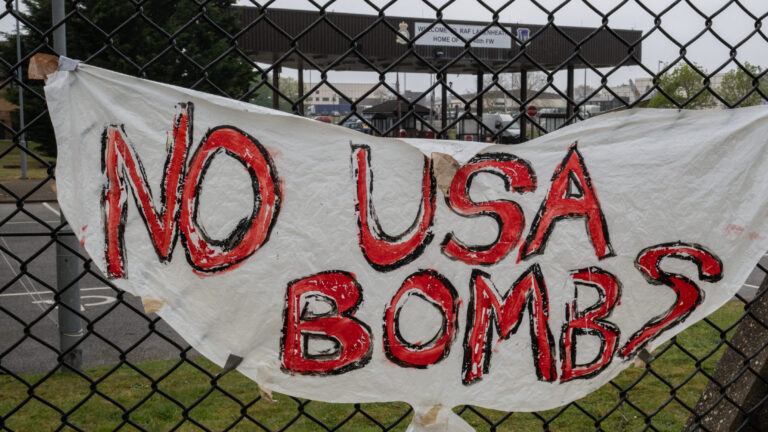
Photo by Guy Smallman via Getty Images
There is never any confirmation of such things, but a number of sources agree: a few days ago, the United States Air Force transported a number of B61 Mod 12 thermonuclear gravity bombs from the Air Force Nuclear Weapons Center at Kirtland AFB in New Mexico to RAF Lakenheath in Suffolk. This is a significant development in Nato’s military posture.
American nuclear weapons have been based at Lakenheath since the early 1950s, until they were withdrawn after the end of the Cold War. However, the USAF’s 48th Fighter Wing, equipped with Lockheed Martin F-35A Lightning II multirole strike fighters, operates from the Suffolk base; last year, it emerged that the storage facilities at Lakenheath were being upgraded to allow them to house nuclear weapons once again.
The B61 Mod 12 is a variable-yield weapon: that means it can be set to an explosive power of anywhere between 0.3 kilotons and around 340 kilotons. To put that in context, ‘Fat Man’, the Mark III atomic bomb which destroyed Nagasaki in August 1945, killing around 80,000 people, had a yield of 21 kilotons. These are devastatingly powerful weapons. But the B61 is intended primarily as a tactical nuclear bomb, to be used in the event of a conflict against large formations of enemy troops, major military bases or critical infrastructure like tunnels, bridges or harbours. These are of a different order and purpose from strategic weapons like Trident which can destroy whole cities.
There have been no American nuclear weapons in the UK since at least 2008, and the Royal Air Force and Royal Navy retired their own WE.177 air-dropped tactical nuclear bombs in 1998. The general direction of policy on nuclear weapons of all kinds since the Cold War ended has been to reduce numbers: the 1968 Treaty on the Non-Proliferation of Nuclear Weapons had already committed signatories to prevent the spread of such weapons and to work towards nuclear disarmament.
The UK had around 350 nuclear warheads in 1990; this was reduced to 250 by 1992 and further to 203 by 1996. The stockpile increased at the turn of the century but for the last 15 years has been steady at 225, its smallest since the early 1960s. The Trident missiles carried by the Royal Navy’s Vanguard-class nuclear submarines are described as providing a ‘minimum, credible, independent nuclear deterrent’. This approach – retaining only the smallest nuclear stockpile necessary – is in part recognition that using our weapons of mass destruction is almost, but not quite, unthinkable and would be an action of last resort.
The war in Ukraine has changed the tenor of the conversation, almost without comment. Vladimir Putin, foreign minister Sergey Lavrov and Dmitry Medvedev, deputy chairman of the Security Council, have repeatedly made veiled and not-so-veiled threats that Russia could be ‘forced’ into using nuclear weapons under a variety of circumstances. It has generally been assumed that the threat is of tactical nuclear weapons, and so far, they have retreated from every red line. In the West, however, it has sparked a renewed enthusiasm for these weapons which sometimes feels like the tulip mania of the Dutch Golden Age.
The UK is the only nuclear power that relies on a single nuclear delivery system, the submarine-launched Trident missiles. It has become almost an article of faith that this is insufficient, and that we must acquire an air-launched nuclear option. Last month, the Government announced that it would buy at least 12 F-35A aircraft, which can accommodate the B61 bombs, from the US in the ‘biggest strengthening of the UK’s nuclear posture in a generation’. This would allow us to contribute to Nato’s tactical nuclear capability.
The argument runs that tactical nuclear weapons, by providing an additional level of response, raise the nuclear threshold because we are not faced with the choice of doing nothing, or resorting to the massive destructive power of Trident. I am sceptical. I think there is a strong possibility that having more rather than fewer nuclear weapons in any conflict scenario is a major risk.
There is also a counter-argument that tactical weapons lower, rather than raise, the nuclear threshold. The idea of a ‘limited’ nuclear response makes their use conceivable, normalising their place among responses to aggression. They may lack the power of strategic weapons, but their use could still result in tens of thousands of deaths and the irradiation of parts of Europe for many years.
We need to think much more carefully than we have about this rush for more nuclear weapons. Only two atomic bombs have ever been used in anger, by the US on Japan in 1945, and tactical weapons have never been used at all. We are deep into the unknown, guessing and hoping. The crux of the matter is this: on what target would a British prime minister conceivably order a nuclear strike, given the potential consequences? I find it difficult to imagine. But if we acquire this new capability, we must be prepared to use it. That is a deeply frightening prospect.

The refusal of the Treasury to increase defence spending shouldn’t come as a surprise. This is exactly what HM Treasury is supposed to do: stop spending that it sees as unaffordable, unless the necessary trade-offs are made to unblock it. The point of cabinet government is for Secretaries of State to make their case for […]
In what could have been a comment on Scotland’s low-scoring, but nevertheless clean sheet-keeping win against Haiti in the World Cup, Adam Smith once remarked: ‘Defence is of much more importance than opulence’. But for too long now, Britain has had too little of either. The lack of capable military force has prompted (at the […]
When John Healey resigned as Defence Secretary last week, there was widespread praise for his principled stand. The financial settlement contained in the final draft of the Defence Investment Plan, believed to offer the Ministry of Defence an additional £10 billion or so over the next four years, was not even close to the resources […]