Starmer can barely save his career, let alone the steel industry
Does the Government really believe it can run a successful steel business where the private sector has failed?
Carl Court/Getty Images
Does the Government really believe it can run a successful steel business where the private sector has failed?
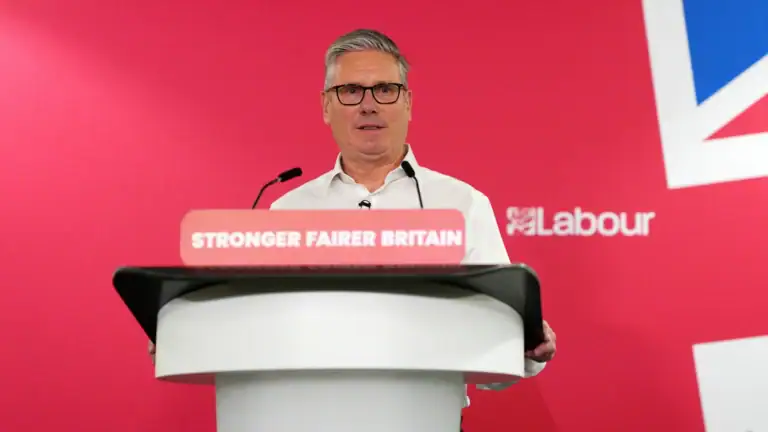
The longer he is in office, the more I realise what an odd and atypical politician Keir Starmer is. With his tenancy of 10 Downing Street under genuine threat after last week’s disastrous local and devolved election results, the Prime Minister is pursuing his own internal form of the madman theory: respond to criticism in a way which is so bizarre and disconnected from reality that even your most bitter enemy will be at least perplexed for a while.
His latest speech was very definitely not a relaunch or a reset. Aides were adamant about that. The Prime Minister has, after all, carried out enough relaunches and resets over the past 22 months to know what they look and feel like. And this was very definitely not one. However, one of the central planks of the defence of his premiership was the announcement that the Government will this week introduce legislation to take ‘full national ownership of British Steel’.
You may be wondering if this is a new episode or a repeat. It is true that the Iron and Steel Act 1949 took the steel industry into public ownership; that was later undone by successive Conservative governments, so Harold Wilson brought in the Iron and Steel Act 1967 to do it all over again. Now, however, we ae dealing with a much smaller version of British Steel, essentially the long products division of Tata Steel Europe offloaded in 2016 which is centred on the steelworks at Scunthorpe.
British Steel is owned by the Jingye Group of China. Owned, but not controlled: a year ago Parliament passed the Steel Industry (Special Measures) Act 2025, which enabled the Government to take operational control of the company. This was done principally to stop Jingye closing the Scunthorpe site by starving it of supplies, and by that metric it has been successful. But there has been a clear cost: by the end of January this year, the Government had spent £377 million on Scunthorpe just to keep the facility open. Formally this is a loan, but running at a rate of £1.3 million a day, there was no indication when or by whom the loan would be repaid.
That the Prime Minister has announced full-scale nationalisation is no surprise. If the Department for Business and Trade is minded to throw around these sums of money, the Government might as well have some nominal asset to show for it. But it is a wildly ill-conceived idea, probably brought about primarily to help Starmer look dynamic and appeal to his opponents on the Left for whom every private enterprise is an entity the Government has so far failed to seize.
Why is the Government nationalising a steel company? Ministers like to burble, as the Prime Minister did today, about steel as ‘the ultimate sovereign capability’, a product every country must be able to manufacture if it wants to regard itself as truly independent. Except they don’t: only around a third of countries have any real steel-making capability at all, and of those, only the top 20 or 30 have significant sectors.
The United Kingdom was 42nd last year: we produced 2.5m tonnes of steel, the same as the Czech Republic, a little more than Portugal and rather less than Oman, Finland or Algeria. We are not major players.
Nevertheless, the Government is insistent we must always be able to produce steel. Very well. That admits of only two possibilities: either we must be prepared to maintain the steel industry at absolutely any cost, or the British steel industry must become radically more competitive so that it can be a viable proposition on the world market. If ministers are not taking on a bottomless hole by nationalising British Steel, they have to explain what will change, what they would do differently to make the sector more efficient and profitable.
The fact is that Scunthorpe has not radically changed since the Government took control. What these hundreds of millions of pounds of taxpayers’ money have done is to fend off closure. Keeping Scunthorpe open will have cost something like half a billion pounds over the course of a year by the time the figures are next disclosed. In effect, we have left the meter running on a taxi while hoping we will somehow miraculously learn to drive.
If the Government genuinely believes, in the face of evidence and experience, that it can run a successful steel business where the private sector has failed again and again, it is time to let the public in on the secret. But it doesn’t. No one thinks the Government is packed with wily dealbreakers and sharp-eyed entrepreneurs. What the Government does have access to is lending capacity of a substantial order, but that has not proven a silver bullet over the past year.
The government has no plan for a competitive steel industry, nor even a rational assessment of whether one is achievable under any circumstances. Instead Starmer is driven by the politician’s syllogism which Sir Humphrey Appleby and Sir Arnold Robinson discuss with dismay in ‘Yes, Prime Minister’:
What will change? What will the Government do differently next year that it has not done this year? How will global circumstances change and how will they be managed? What does a future British steel industry look like? Ministers have no idea, of course, because they have avoided asking the questions. Instead they will deploy public expenditure to make everyone feel like they are being productive.
Maybe British Steel can respond by feeling like it is a successful and profitable enterprise. It is hard to see what more we can expect.

Ron DeSantis chose his moment with care. The night before the US midterms, the outgoing Governor of Florida appeared on a sports podcast. On election eve, DeSantis admitted that the Iran war had been ‘a big, big drag’ on Republicans, that the party had been ‘gaslighting’ voters by blaming Joe Biden for the price of […]

English rock fans are understandably thrilled over the announcement that Oasis will embark on another tour, including a stop in Manchester, where the band first got started in 1991. And while that may be good news, fans are still going to have a difficult time seeing them perform live – affording it, that is. Live […]
I’ll declare an interest. I sit on Reform UK’s Board and I’ve known Nigel Farage for a quarter of a century. So when Kemi Badenoch tells the country that Reform are ‘another left-wing party’, that we and Labour are arguing for ‘the same things, nationalisation, the two-child benefit cap’, that Farage is Jeremy Corbyn wrapped […]