Our universities belong to the bureaucrats now

Getty Images
With the introduction of student fees in 1998, one might have expected that universities would gain independence from the state and its agencies. They would live off the fees paid by those who wanted them, free to act in accordance with whatever academic values they chose to embody. But the opposite happened: all the movement since has been towards the state.
This was already apparent in the Dearing report of 1997 which, to widespread disapproval, proposed student fees. Perversely for an academic, in an essay for the Centre for Policy Studies, I welcomed that aspect of Dearing. But I also pointed out the manifold ways in which Dearing would cast a blight over the whole university system. No longer would universities be the institutions favoured by Cardinal Newman, existing simply to develop in their members a ‘true enlargement of mind and the power of viewing many things at once as one whole’, and for no further end, political, utilitarian or managerial.
Far from universities being left free to do their precious work as an end in itself… support and administrative staff now outnumber academics in three quarters of universities, and more than a quarter of these are what are called managers and managerial professionals
No more would they be able unhindered to afford young people what Michael Oakeshott called the ‘gift of interval’. In this interval between their youth and the adult world of work they would immerse themselves in the worlds of serious understanding and culture. In this they would be guided by scholars committed to the same vision, a vision to be pursued for its own sake, to the enrichment both of those who come under its spell, and of the wider society in which such things are valued.
But no longer according to Sir Ron, who was legislating for a hugely expanding university sector, then educating around a third of the population, as opposed to 15% in the 1970s. But instead of querying this growth, Dearing insisted that far from having no political or social goals beyond being what they are, universities should promote economic equality, as well as relating their work to what he called ‘the world of work’. He also said that they can no longer assume there is a common culture they are to foster. And then echoing the tritest of progressive educational myths opposing the centrality of good subject knowledge, he insisted that much knowledge becomes quickly obsolete (maybe, but much does not, Homer, Virgil, Dante). Because students with modest prior attainment were being admitted (even then!), he insisted that courses should adapt, into bite-sized modules with continuous assessment throughout the course, so that everyone can get some certificate or other, thus destroying the gift of interval with bite-sized chunks and frequent examining, and also opening the door to widespread plagiarism and worse. He wanted a national qualifications framework (H1-8), in which a PhD in Physics could be said to achieve the same level of intellectual rigour and depth as one in Business Studies or Popular Culture.
He said nothing about the promiscuous growth even in 1997 of courses of little or no value to anyone and certainly not to employers in his cherished ‘world of work’; nor did he speak about grade inflation, which was already beginning to manifest itself (and which now sees 30% of all degrees being awarded First Class honours, as opposed to 7% in 1994-5). He also wanted teacher training for university academics, directed by pedagogical ‘experts’ who might know nothing about the subject to be taught; and a Quality Assurance body to oversee ‘quality’ in the whole sector.
We are now in Dearing’s world, a world of multiple and confusing bureaucracies (a civil servant paradise). There is indeed a Quality Assurance Agency, with a plethora of pettifogging demands that all courses must satisfy (though little actual quality), as well as an insistence on ‘delivery’ of courses meeting diverse student needs. University teachers are pressured to undertake training for teaching. There is a Research Excellence Framework, which funds university research, and insists that a quarter of the funding is to be given for ‘impact’ beyond the academic world (so no good for Russell’s ‘Principia Mathematica’, Wittgenstein’s private language argument, or, ironically, for Turing’s research into mathematical undecidability and incompleteness – which wholly unpredictably led to his development of the computer; and heaven preserve us from academic soi-disant ‘public intellectuals’).
There is constant pressure to admit ever more underqualified students (and professors) in the name of equality and diversity, and, in the absence of a common culture, continual talk, and more than talk, of ‘decolonising’ subjects that have not already been infected with political attitudes of one sort or another. Student fees, far from freeing the system, have actually produced the scandal of massive student debt, which barely half of today’s students are expected ever to repay in full. That rather negates the idea of universities being liberated from the state, and discourages those who want nothing more from their study than the study itself.
And far from universities being left free to do their precious work as an end in itself, as in the Newman-Oakeshott vision, and partly to deal with the neurotic fiddling of governmental agencies, support and administrative staff now outnumber academics in three quarters of universities, and more than a quarter of these are what are called managers and managerial professionals.
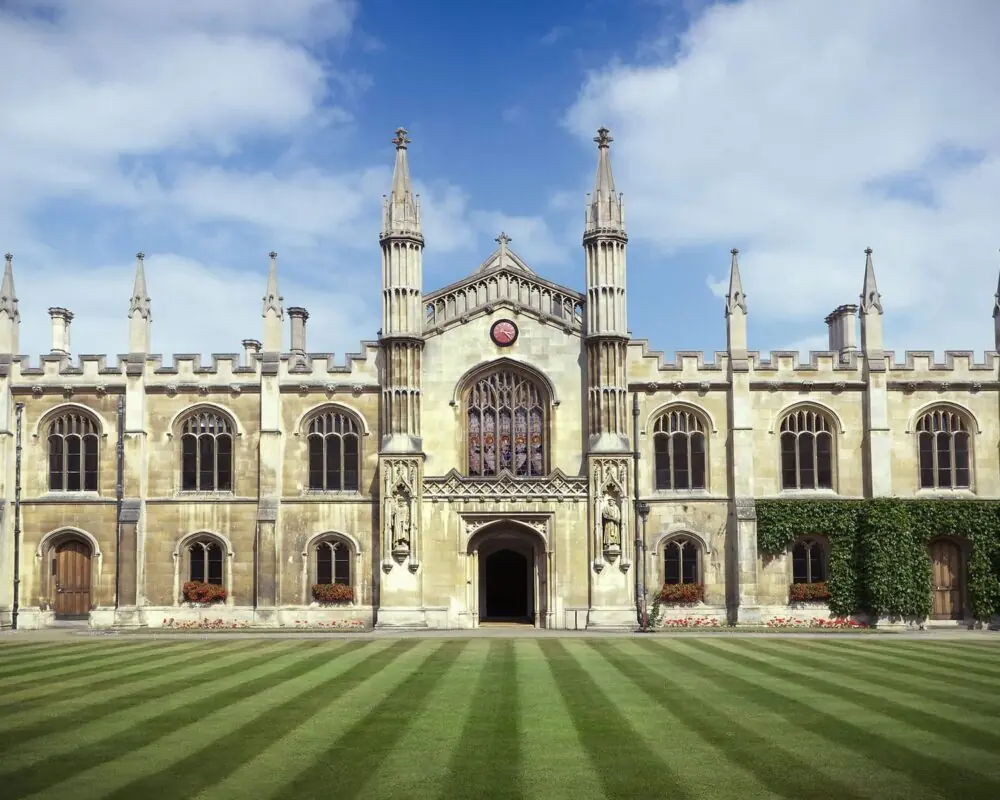
What then is to be done? Where disinterested study and teaching still exists in higher education, it should be cherished and protected. Bureaucrats and managers should be fended off. More radically it is time to think about a new type of college, truly independent of the state. I say ‘college’, because anything called a university or awarding a degree has to be authorised by the state, since 2018 via the Office for Students. But this does not forbid the setting up of genuinely independent colleges of teaching and learning awarding their own certificates. They did in 1209 when a number of disgruntled Oxfordians walked to a then unchartered place in the Fens, which before Dearing was to become the academic home of Russell, Wittgenstein and Turing, to say nothing of Crick, Watson, Dirac and Keynes.
The reforms of Michael Gove represented a profound shift in England’s educational landscape, based upon the belief that outcomes improve when there is freedom with accountability. During his tenure as Education Secretary (2010-14), it became possible for all publicly funded schools to become academies, free schools could be created, and there were substantial reforms to […]

Schools do not exist in isolation from the economy. The number of young people who are not in employment, education or training (NEET) is, in large part, a function of the economic conditions in which they leave education. When growth is weak, entry-level opportunities are scarce, employers are cautious and the public finances that pay […]
After 17 months of drift following the Government’s January 2025 reset of the Higher Education (Freedom of Speech) Act 2023, the free speech complaints scheme administered by the Office for Students (OfS) is at last going ahead. The Government has now signed the commencement regulations needed to bring the scheme into force. From 1 September […]