Japan’s ‘Iron Lady’ can lead the charge against China

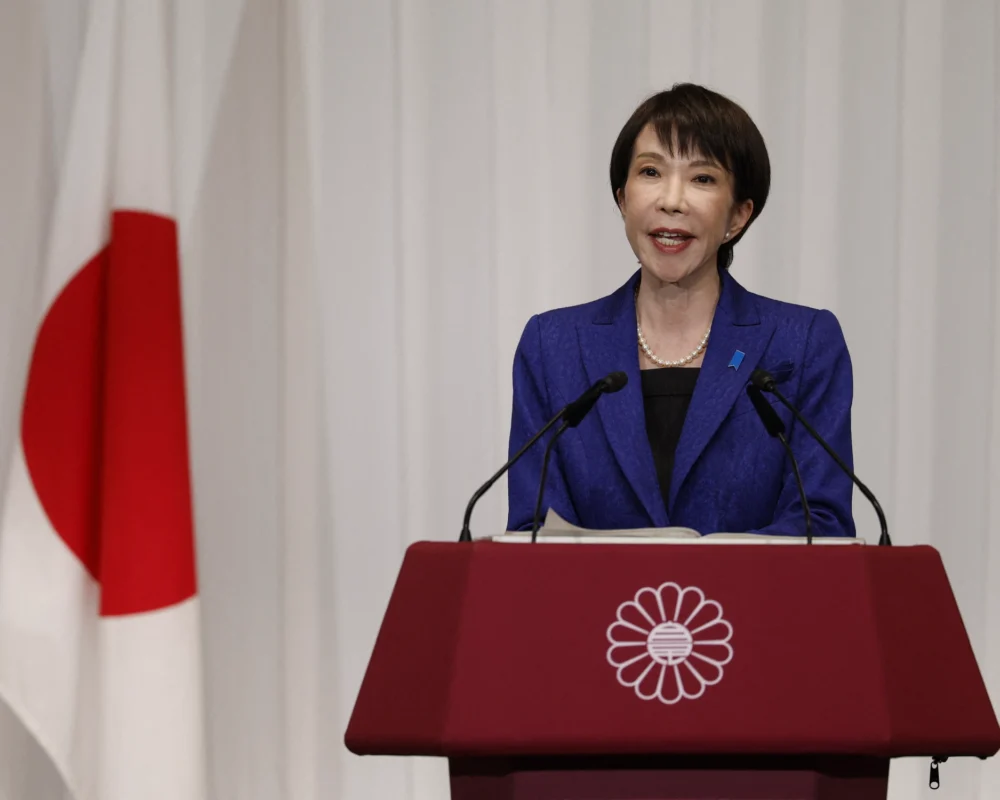
Photo: Tomohiro Ohsumi/Getty Images
Kyō no teki wa, ashita no tomo is a famous quote by Miyamoto Musashi, the renowned Japanese swordsman, writer and artist. Translated, it means ‘today’s enemy is tomorrow’s friend’ and it is interpreted as an observation on the transient nature of conflict.
History, of course, is littered with foes turned friends. Britain and France, Britain and America and, most recently, America and Japan.
But as Japan’s new Prime Minister, Sanae Takaichi, knows, where this is true we must also accept that today’s friend can be tomorrow’s enemy. Nowhere is this more evident than in the case of China and its trading partners.
It has been well documented, including on this very website, how China has gained a stranglehold over the African continent through attractive financing options; by asking few questions and throwing in added perks designed to appeal to political leaders and the local population.
The result? Many of these countries are now heavily indebted to Beijing. Unable to service their loans, they have found themselves forced to do China’s bidding – whether that means opening new ports or hosting military bases.
Accepting Chinese investment can be like making a wish on the monkey’s paw, as depicted in W.W. Jacobs’ famous story; what you ask for may be granted, but the price only becomes clear when it’s too late. When the allure of easy money fades, Xi Jinping’s mask, and that of the Belt and Road Initiative, slips.
And we are seeing this play out in the UK right now.
Shortly after their election, the Labour government signalled a desire to rekindle frosty relations with China in a bid to boost economic growth. At the same time, the collapse of the China-spy case in Westminster and the furore around the proposed Chinese ‘super-embassy’ in London serve as stark reminders of the unintended consequences that lurk behind the ‘Peaceful Rise’ façade.
Japan, however, has seen this all before.
In 2010, following a maritime dispute near the Senkaku Islands, China abruptly restricted rare earth exports to Japan. The message was clear: economic dependence comes at a price. Japan was caught off guard once. Under Takaichi’s leadership, it will continue to ensure it is not again.
In fact, Japan’s response to that crisis already provides something of a roadmap for other democracies. Within a year, Japan had implemented a range of robust policies: diversifying supply sources, investing in rare earth recycling, stockpiling key minerals and backing overseas mining projects.
These measures not only strengthened Japan’s own resilience but demonstrated what forward-thinking statecraft looks like in an era of economic coercion by Beijing.
Takaichi, a known China hawk and ideological heir to Shinzo Abe, has the instincts and platform to reposition Japan as a leader among democratic nations confronting China’s tactics.
And she has a history of doing things differently. A one-time metal band musician and amateur boxer, Takaichi is not cut from the standard political cloth. Her image and instincts signal a shift: no more polite hedging on China.
Japan’s position in the global tech landscape has changed dramatically. In the 1980s, Japanese companies held nearly 50% of the global semiconductor market. Today, that figure is closer to 10%. Meanwhile, China has overtaken Japan as Asia’s tech powerhouse, now leading in 57 of 64 cutting-edge technologies tracked globally.
The balance has shifted. But it is not irreversible.
Japan has the industrial base, institutional stability and democratic credibility to anchor an alliance of likeminded partners. It should use these advantages to work more closely with the United States and Australia to build technology partnerships, coordinate supply chains and invest jointly in critical minerals across Africa.
The UK, having recently signed the Technology Partnership Agreement with the US, should join such efforts or face more political pressure from Beijing.
Takaichi, if she chooses to lead on this front, could help define a new model of technological and economic resilience. Not simply by increasing Tokyo’s resilience to Chinese coercion but building a network strong enough to reduce dependency and reshape the global playing field.
It is not a strategy she has yet explicitly committed to – but it is one she is uniquely positioned to lead. As a former musician, she can lead the democratic band.
Japan has already shown what serious supply chain resilience can look like. Under Takaichi, Tokyo’s ‘Iron Lady,’ it could bring its allies with it.
That is why Britain, the United States, Australia and Japan should move decisively together. Not just to react to China, but to set the terms of engagement for a more secure, democratic future.
For the Labour Government, the lesson is clear. It need not wait for the next crisis to strike. Japan’s 2010 experience was a warning: its response, a blueprint. The UK should learn from that moment and avoid once again reaching for the monkey’s paw that is Chinese investment.
In the pre-dawn stillness of Tokyo’s Nagatacho district, the lights on the fifth floor of the Kantei remain stubbornly ablaze. Inside, Japan’s first female Prime Minister is likely to be on her fourth cup of tea and her eighteenth hour of work. Sanae Takaichi does not believe in Japan’s legendary ‘lost decades’ (roughly 1991-2021) of […]
The Chinese have formidable qualities, but they have rarely been credited with a sense of humour. Yet in that regard, we may be underestimating them. In response to the tariff contest, a number of witty, AI-generated memes have appeared, mocking Messrs Trump, Vance and Musk, depicting the three as unhappy-looking cobblers trying to replace the […]
What a difference power makes. From the opposition benches, Labour were robust in their criticism of China’s authoritarian regime, pushing for stronger action against its human rights abuses and its influence operations on UK soil. Now they are in government, such concerns have been sidelined in favour of commercial opportunity. This is dangerously shortsighted. Chasing […]