France is fractured – will the Fifth Republic survive?
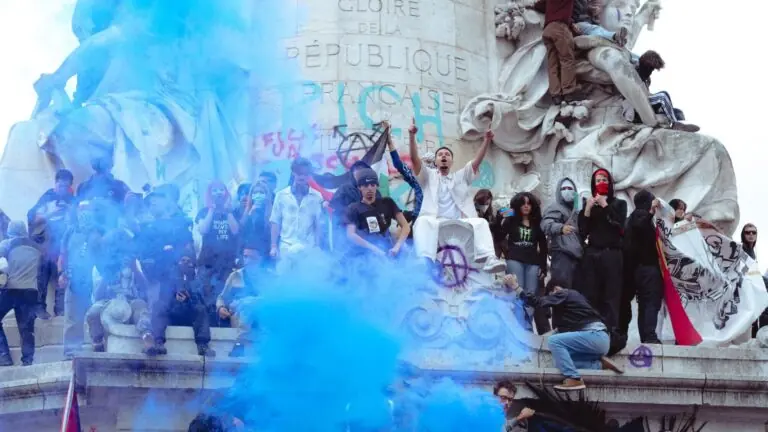
Photo by Alexandre Rault via Hans Lucas via AFP
Although competing rumours have been circulating throughout the summer, no one knew what to really expect from the Bloquons-Tout! (‘Let’s Block Everything!’) day of action announced on social media throughout France for September 10. Was this the resurfacing of the gilets jaunes movement, which frightened the country and then faded into the pandemic of 2020? Or was it a show of anger from the extreme Right, whose presence on social media is loud and ever more furious since only a few months ago Marine Le Pen was debarred from standing for election in 2027? In the end, it turned out to be the far Left which dominated the demonstrations and the headlines, joined by schoolkids, trade unionists, anarchists and eco-warriors.
Inevitably there were the now familiar scenes of violence – Robocop style gendarmes fighting with protesters, tear gas, bins, buses and cars set alight. Most dramatically on the morning of 10 September a thousand or so anti-capitalist protesters launched a failed ‘invasion’ of the Gare du Nord. Sporadic clashes between police and protesters went on far onto the evening in towns and cities across France. But as the dust now settles after the ‘day of sabotage’ – so-called by the right-wing TV channel C News – and non-rioting French people assess the damage done, the real question is whether this was only the prelude to a much harder and deeper conflict?
The signs from the French government are not encouraging. The Bloquons-Tout day of action (or rather inaction) came on the day that the outgoing Prime Minister, François Bayrou, who resigned after losing a vote of confidence on Monday, handed over his office to Sébastien Lecornu, a staunch Macron loyalist. Bayrou lost his job because neither the far Right nor the far Left, who control the French parliament, could stomach his budget and the fiscal reforms needed to bring back France from the brink of an even more serious debt crisis than it already has.
Once again it is President Emmanuel Macron who is in the firing line and the first target of the protesters. Macron is determined neither to resign (he would be the first since Charles de Gaulle in 1969) nor to give in to the protesters.
His intransigence has recently led to calls for the Fifth Republic to be abolished (in the past few days calls for the end of the Fifth Republic have appeared as graffiti in Paris). The reason for this is that the Fifth Republic, established by De Gaulle in 1958 at another time of crisis in France, gives overall power to the executive, led by Macron and which is separate from the Parliament. The problem for Macron is that the legislature, in the form of parliament, is no longer pliant to the orders of his executive, and nor are the French people demonstrating in the streets. As anger in France grows, constitutional reform may be the only way out for Macron, although this would be a humiliation.
This would not however solve France’s economic woes, which look to be getting worse sooner rather than later. France’s national debt is at 114% of GDP and the budget deficit of 5.8% of GDP is almost double the official Eurozone limit. For most people these figures are mere abstractions and have no relation to the rising cost of living and the slow degradation of public services.
There are, however, also much deeper social divisions in France beyond the economy. More to the point, in the past forty years, the French Republic, the child of the great Revolution, has been slowly fractured, corroded in gradients, by social changes which directly challenge its very existence. One of the most significant of these changes has been the growth of what is called ‘peripheral France’. The rough equivalent of the UK ‘Red Wall’, the phrase refers to places outside the affluent city centres whose distance from them is to be measured not by kilometres but by access to jobs, medical services, good schools, basic transport infrastructure and cultural events. These were the places who gave rise to the gilets jaunes.
Parallel to this process has been the growth of many of the immigrant-packed banlieues of France into something like mini-cities, with their own codes, cultures and languages. They are often at odds with mainstream France and the Republic, which in the form of the police is seen as an intrusive, oppressive presence (sometimes the word ‘colonialist’, with memories of the Algerian war, is used as a provocation). Few in these places believe in France as an ideal of civilisation, under the rubric ‘Liberty, Equality, Fraternity’, and indeed often violently oppose it.
France and the UK share many social tensions, especially mass immigration and a wavering sense of national identity. As the anti-Macron fury gathers, it is however France which is teetering much nearer, and much more dangerously, to political disintegration than even the fragile UK.
Andrew Hussey is the author of ‘Fractured France, A Journey through a Divided Nation’, published today by Granta.

Last week, Andy Burnham inaugurated ‘No 10 North’, his signature project, by working for the first time from the government’s new Manchester base, a self-styled ‘situation room for growth’. The symbolism was clear: power would no longer be concentrated in Whitehall. But the rhetoric remains stronger than the detail. The detail we have is concerning. […]

On July 27, 2025, the US President Donald Trump invited the President of the EU Commission Ursula von der Leyen and other top EU officials to his golf course, Trump-Turnberry on the West Coast of Scotland. Their meeting sealed a trade deal, which von der Leyen described as ‘huge’, but which critics described as a […]
Sweden is often held up as a role model for those wishing to expand the size of government around the world. But rather than being proof that socialism works, the Swedish experience is in fact evidence for the benefits of free markets, limited taxation, strong societal norms and robust financial institutions. Sweden historically pioneered many […]