Burnham is taking the wrong lesson from Germany
Christopher Furlong/Getty Images
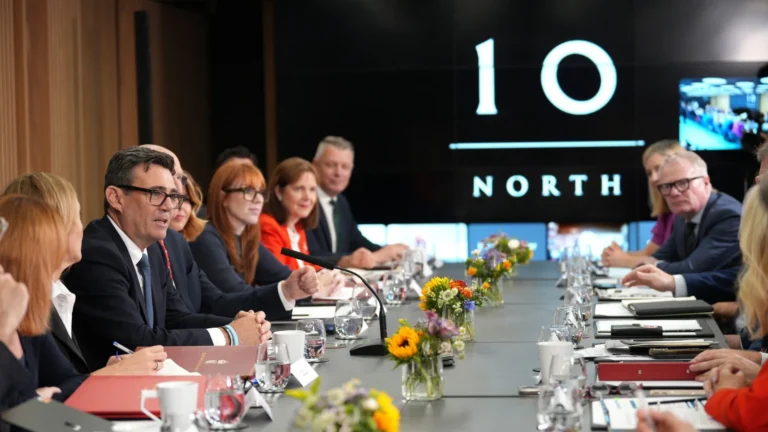
Last week, Andy Burnham inaugurated ‘No 10 North’, his signature project, by working for the first time from the government’s new Manchester base, a self-styled ‘situation room for growth’. The symbolism was clear: power would no longer be concentrated in Whitehall. But the rhetoric remains stronger than the detail.
The detail we have is concerning. Look at the agenda Burnham outlined in Manchester a few weeks earlier: the ‘greatest shift of power’ Britain has ever seen, greater regional autonomy and – as a kind of reference model – Germany’s decades-long commitment to ‘equivalent living conditions’.
Andy Burnham has taken an interest in the German model just when Germany itself is increasingly questioning it
Burnham is not wrong about the problem. Britain is unusually centralised. Too much power, money and decision-making flows through Whitehall, only to be slowed down by coordination processes and administrative routines. Seeking to change this is by no means a uniquely left-wing cause. Conservative governments drove the ‘Northern Powerhouse’ initiative for good reason. Underlying all this was the simple insight that decisions are best made where their consequences are actually felt and that local decision-makers face different incentives when economic success yields tangible local results.
The trouble begins when Germany enters the picture.
I was born and raised in the Ruhr, Germany’s former industrial powerhouse. Growing up there fosters a rather distinctive perspective on structural policy. We are familiar with the decommissioned mines turned into museums, the converted industrial sites, the landscape parks, prefabricated university buildings, the funding schemes and the ceaseless promises of structural transformation. Yet we also know the city centres where this transformation has been heralded for decades, only to never quite fully materialise.
If fiscal equalisation and regional aid were the sole keys to revitalising former industrial regions, the Ruhr area would long since have become one of Europe’s great economic success stories. For more than fifty years, literally every tool available to policymakers has been tried there: federal funds, state programs, municipal initiatives, European structural funds, special grants, development agencies and a constant stream of new projects intended to accelerate structural change.
Much of this made sense on first sight and some of it was even successful. Today, many parts of the Ruhr area are greener, more attractive and more liveable than they were in the era of coal and steel. But that is not the whole story.
Making economic decline more bearable is not the same as reversing it.
Many cities in the Ruhr area continue to struggle with sluggish investment, low productivity and unemployment that has become entrenched over decades. In June, the unemployment rate in Gelsenkirchen stood at 15.2%, compared to a national average of 6.2%. Thus, after decades of subsidies and financial transfers, one of the former heartlands of German industry still faces an unemployment rate more than double the national average.
The Ruhr area has been rehabilitated, subsidised, restructured, rebranded and reinvented time and again. Sadly, an economic renaissance has not emerged from it all. This is perhaps the most uncomfortable lesson for the region: government can do a great deal to cushion the impact of decline. It can maintain infrastructure, improve quality of life, alleviate social hardship and balance out regional disparities. What it is far less capable of doing is generating new economic dynamism and growth.
This is precisely where the crucial distinction lies for Britain.
Manchester, Birmingham and Newcastle need greater control over transport, planning and infrastructure. They should be allowed to keep a larger share of the wealth generated when their economies grow. Local officials shouldn’t have to make a pilgrimage to London every year to apply for funding schemes whose criteria can change with every new government.
But in many respects, the German model is the exact opposite. Competencies in Germany are split, responsibility is dispersed and funding streams are often intertwined. Germany has 16 states with their own governments and parliaments, alongside the federal government and thousands of municipalities. On paper, this looks like a clear separation of powers. In practice, the different levels of government constantly overlap and interact. The federal government sets guidelines or provides funds; the states handle administration; the municipalities carry out implementation. All amidst a web of shared decision-making rights.
Anyone who has ever tried to figure out why a major infrastructure project in Germany takes ten years will quickly realise that there is rarely just one person in charge. The system has its own logic. But that logic comes at a price. When something works, multiple levels of government can claim the credit. When something fails, passing the buck is remarkably easy.
This is also a key reason for the bureaucracy that almost everyone in Germany complains about these days. Disparate procedures, fragmented funding programs and overlapping jurisdictions mean more applications, more points of contact, more coordination and more time spent for businesses and citizens alike. Burnham has taken an interest in the German model just when Germany itself is increasingly questioning it.
For years, there has been debate over why planning takes so long, why investments are slow to materialise, why administrative bodies lag in digitalisation and why a constant stream of new reporting requirements and approval stages complicates even the simplest projects. The political debate has long since shifted. In Germany today, the focus is less on creating new areas of jurisdiction and institutions, and more on streamlining procedures and cutting back on red tape.
This is precisely where the weakness of Burnham’s ‘No 10 North’ lies. The name sounds powerful, almost as if a counterweight to London were finally being created. But does the North really need a second Whitehall? Or does it not, in fact, need less Whitehall?
A new political headquarters in Manchester could very quickly become yet another layer standing between decision and implementation. You would have Downing Street, ‘No 10 North’, mayors with their administrations and local authorities. And eventually, the old question arises: who is actually making the decisions?
When Burnham speaks about home, a sense of belonging and the neglect of entire regions, he sounds more credible and authentic than many politicians in Westminster. That is precisely why it is important to take a closer look at the institutional consequences of this rhetoric. What powers are actually being devolved? Who collects the money? Who is authorised to spend it? Who bears the risk? And who, in the end, has to explain why something didn’t work?
These are not trivial matters. Devolution only works if accountability remains clear. Otherwise, all you end up with is bureaucracy with a regional postcode. In any case, the real problem facing the North is economic rather than administrative.
Germany undoubtedly has much to offer that Burnham’s new government can learn from. Vocational training is one example, alongside the Mittelstand, industrial clusters and how economic and cultural life is not entirely concentrated in a single capital city. But the Ruhr, too, represents a German experience that should be taken seriously when thinking about devolution of power: federalism helped manage the decline, but did not reverse it.
Britain should therefore learn from Germany – but selectively. More local power, yes. More responsibility, too. More incentives for growth, absolutely. What the North does not need is a Whitehall of its own. It needs the freedom to grow without one.
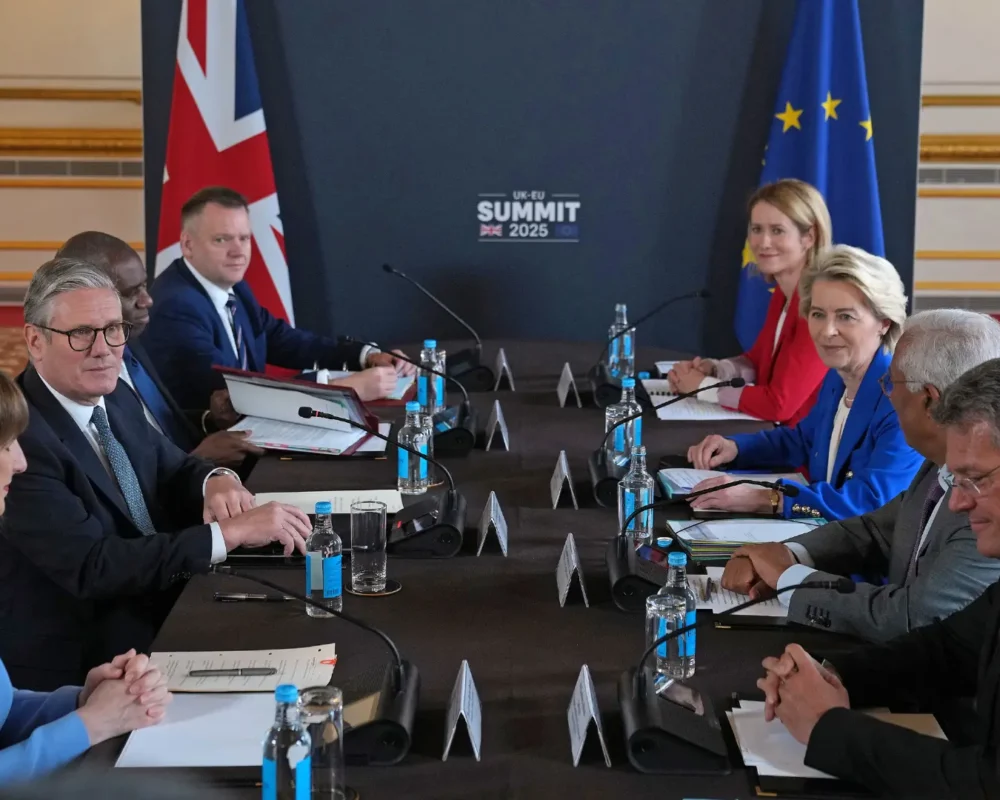
This weekend the Telegraph ran a story with the striking headline ‘Burnham told to trade nuclear umbrella for access to single market’. The idea is the brainchild of Nick Boles, the former Conservative MP who quit the party in 2019 over Brexit, switched his allegiance to Labour and helped to advise Keir Starmer on the […]
The EU was born to ‘screw’ the US. That’s what Donald Trump told reporters in 2025: ‘That’s the purpose of it, and they’ve done a good job of it. But now I’m president.’ But that wasn’t always the United States’s view of the EU. As historian Andrew Roberts wrote, the American State Department ‘enthusiastically signed […]

On July 27, 2025, the US President Donald Trump invited the President of the EU Commission Ursula von der Leyen and other top EU officials to his golf course, Trump-Turnberry on the West Coast of Scotland. Their meeting sealed a trade deal, which von der Leyen described as ‘huge’, but which critics described as a […]