Don’t blame the Budget on Brexit
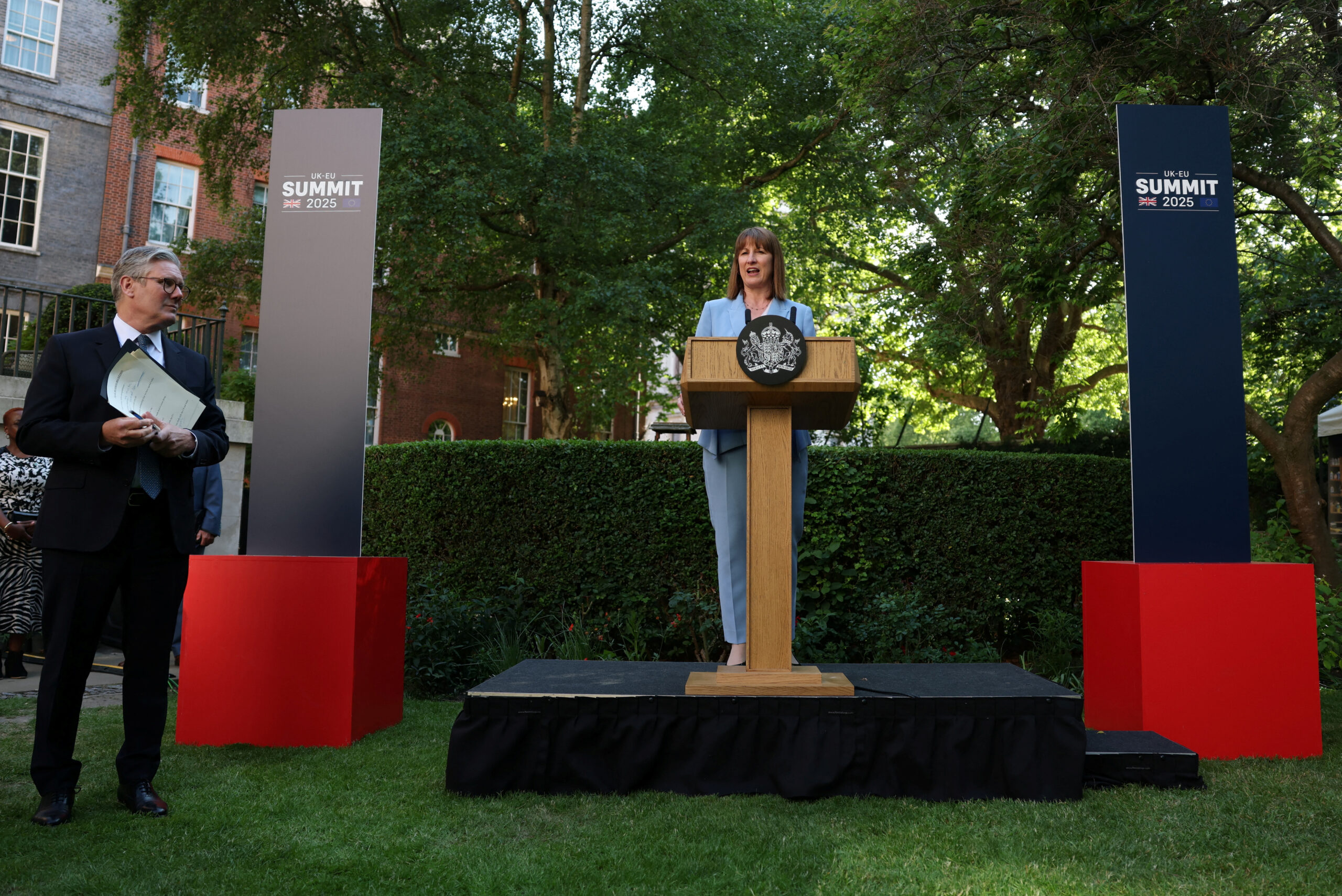
Photo by Hannah McKay - WPA Pool/Getty Images
Rachel Reeves is getting her excuses in early ahead of next month’s Budget, which looks set to be a painful repeat of last October’s ‘one off’.
The Chancellor has already blamed ‘external headwinds‘, ‘Tory austerity‘ and ‘the ongoing impact of Liz Truss’s mini-Budget‘. It is no surprise that she has now dropped the ‘B-word’ too.
Speaking to Sky News last week, Reeves said ‘already, people thought that the UK economy would be 4% smaller because of Brexit,’ adding that ‘there is no doubting that the impact of Brexit is severe and long-lasting’.
The ‘4%’ refers to the assumption of the Office for Budget Responsibility (OBR) that Brexit will eventually reduce UK productivity by 4% compared to staying in the EU.
The OBR is continuing to respect pre-Budget ‘purdah’. But Treasury officials are already briefing that the expected downgrade of the productivity forecasts will partly reflect a more pessimistic assessment of the impact of leaving the EU.
In reality, OBR’s 4% is built on some remarkably shaky foundations.
The 4% figure itself was simply a crude average of the results of 13 external studies. These studies were all done before the final shape of the exit agreement was known and used a variety of different models and assumptions, most of which now look far too pessimistic.
Moreover, the OBR’s take on the 4% relies on an implausibly large hit via the trade channel. Most economists would agree that an increase in barriers to trade is a ‘bad thing’. That is just basic economics – and firmly in the classical liberal / free market tradition. But while the theory is sound, the numbers fail a basic sniff test.
The OBR assumes that the new frictions to trade with the EU are so severe that they will permanently reduce total UK imports and exports – both goods and services – by as much as 15%. The resulting fall in the ‘trade intensity’ of the UK economy is then assumed to cause a 4% reduction in productivity, with the full impact felt after 15 years.
These strong assumptions are only weakly supported by the actual data – if at all. The UK’s exports of goods have underperformed relative to our peers, at least in volume terms, but by far less than many feared. More importantly, overall trade has held up much better than expected, partly due to the continued strength of services.
At most, the UK’s ‘trade intensity’ might be a few percentage points lower than it would otherwise have been. This is unlikely to have any significant impact on productivity in a large, advanced economy which will remain relatively open.
But even if you take the OBR’s assumption of a 4% long-term hit to productivity at face value, it is nothing new. Indeed, it first appeared in 2016. So how can it explain the expected downgrade in next month’s Budget?
One possible answer is that the OBR has decided that the initial impact of Brexit was more severe than anticipated, so that it takes longer for actual productivity to return to its trend rate.
Admittedly, some studies have suggested that the UK economy may already be as much as 5% smaller than otherwise. But these studies are typically based on ‘doppelganger’ models which assume that any divergence between the economic performance of the UK and those of other countries can only be due to Brexit. This is clearly nonsense.
In any case, looking simply at headline GDP, the UK has outpaced Italy, France and Germany since 2016. Even in terms of output per head, ‘Brexit Britain’ is continuing to track midway between France and Germany. We are certainly not an outlier.
Treasury officials have also suggested that the initial hits via trade and investment have been worse than expected. But again there is little to support this claim. In particular, business investment is clearly recovering as uncertainty eases.
The timing would also be very odd. The 4% figure was based on the expected terms of the exit from the EU back in 2016. In particular, it does not take account of the actual deal, which was relatively liberal, or any changes since then, including any benefits from the ‘reset’ and from the new trade deals with other countries.
Rachel Reeves herself has been careful (at times) to blame the ‘way in which we left the EU’, rather than Brexit itself.
Logically then, the OBR should now be less pessimistic about the long-term impact of Brexit, not more. A further downgrade now would be a damning verdict on the Labour Government’s efforts to improve the terms of the UK’s departure from the EU.
Instead, the more straightforward explanation is simply that the OBR has decided to put more weight on the UK’s dismal productivity performance since the Global Financial Crisis in 2008.
The evidence that Brexit has been a key factor here is thin. But even if you do buy into the OBR’s 4%, it is not clear why this should prompt a further downgrade now.


Almost lost between this week’s national mourning (in England anyway) over the World Cup, and the endless Westminster fantasy-football speculation about who’s going to be in or out of Andy Burnham’s first cabinet, was an oh-so-British announcement about Dartmoor ponies. The endangered breed had been put in further peril by Natural England’s plans to protect […]

Below is a speech incoming Prime Minister Andy Burnham could give – one that would unite the country around a shared vision of prosperity. Prosperity for All My fellow citizens, Today, as I stand before you as your Prime Minister, I want to cut through the political noise and give you the unvarnished truth about […]

The way we as consumers engage with news, TV and online media is continually evolving. Traditional TV has been increasingly usurped by streaming services. Apps like YouTube are taking up a greater share of viewers’ time and are now successfully competing with the likes of Netflix. It is natural that in this environment competition is […]