Britain’s next energy crisis could be self-inflicted
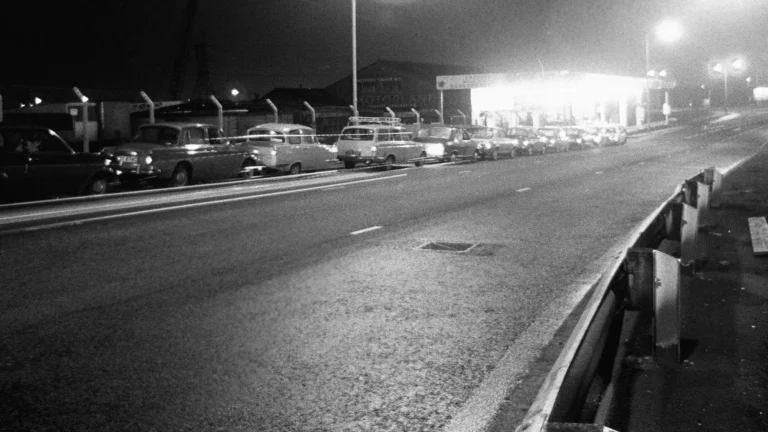
A petrol queue in Manchester during the 1974 oil embargo. Photo: Herbert Eastwood/Mirrorpix via Getty Images
The latest surge in oil prices, following the US-Israeli confrontation with Iran, has revived a familiar warning about stagflation and recession, and if Britain may be about to relive the 1970s.
That comparison is not absurd. But it is often badly misunderstood.
The central lesson of the 1970s was not that oil prices rose. It was that governments responded badly.
The first oil shock came in 1973, after the Arab-Israeli war and the embargo imposed by Arab oil producers. Prices rose with extraordinary speed. For advanced economies, the effect was severe. For Britain, it was worse.
Back then, manufacturing accounted for a much larger portion of the country’s output, making Britain’s economy much more energy-intensive. Powerful trade unions controlled wage negotiations, and productivity growth was weak. When oil skyrocketed, the shock swiftly contributed to wider inflationary pressures.
Then policy compounded the damage.
The British government sought administrative control rather than letting markets adapt. Price controls and attempts to stifle the economic signals that rising prices were sending were all implemented. Early in 1974, Britain even adopted the infamous three-day workweek, a remarkable manifestation of the country’s economic dysfunction in which industry effectively rationed electricity.
Inflation surged into double digits. Output and employment collapsed. It was classic stagflation, and policies based on Keynesian economics struggled to explain what was happening.
Then came the second blow. In 1979, the Iranian revolution disrupted oil supply again and prices jumped sharply once more. By then Britain already had inflation above 10%. The new shock intensified an already fragile economy and helped to destroy what remained of the old post-war settlement. The Callaghan government fell. The Thatcher era began. Monetary policy hardened. Price and incomes policies were discredited.
That history matters. But it is often told too crudely.
The economic carnage of the 1970s was the result of policy errors layered on top of a supply shock.
Modern economic research broadly reinforces that point. James Hamilton’s classic study of the 2007-08 oil shock made an important observation: even when the trigger differs from the embargo-driven shocks of the 1970s, oil prices can still make a material contribution to recession because demand is slow to adjust and the hit to spending is real. His point was not that every oil spike is identical, but that when oil demand is relatively insensitive in the short run and supply is constrained, a sharp rise in prices can materially weaken consumption and growth even in a modern economy.
Oil price spikes often precede recessions, but not because oil has some mystical power to collapse an economy by itself. The transmission usually runs through squeezed real incomes, tighter financial conditions, policy mistakes, or pre-existing macroeconomic weakness. Higher energy prices raise costs and erode spending power, certainly. But markets also adapt. Consumers economise. Firms change input mixes. Higher prices encourage new supply. Investment becomes viable in places and technologies that previously did not stack up.
That is what price signals are for.
The moment governments try to block that process, they begin to create a second problem on top of the first. Price caps, indiscriminate subsidies, rationing, and politically convenient market suppression do not abolish scarcity. They merely disguise it. Demand stays artificially high. Supply responds more slowly. Investment weakens. Fiscal costs mount. Inflation becomes stickier than it needed to be.
That was the real policy failure of the 1970s. And it remains the temptation today.
Britain now faces a different but related vulnerability. Unlike the United States, which has materially strengthened its energy position over the past two decades, the UK is more exposed to imported energy and to global price volatility. North Sea production has declined. Storage capacity has long been a weakness. The country is more dependent than it likes to admit on external shocks it cannot control.
We saw that clearly in the 2022 energy crisis after Russia’s invasion of Ukraine. Governments across Europe, including here, responded with vast subsidy schemes to soften the blow to households and firms. Some degree of intervention may have been politically inevitable. But these measures came at enormous fiscal cost and, in some cases, dulled the incentives to adjust demand.
Now, with fresh instability in the Middle East, the same reflex is visible again. Cut fuel duty. Freeze prices. Tax producers. Subsidise consumers. Announce an emergency package. Each step may sound reasonable in isolation. Together they risk repeating the same old mistake: treating the price mechanism as the enemy, rather than the means by which an economy adapts.

Source: TradingView.com
Governments cannot prevent geopolitical shocks. They cannot wish away supply disruptions. They cannot legislate volatility out of global energy markets. What they can do is make sure the domestic economy is able to absorb shocks without tipping into prolonged disorder.
That means more storage, better infrastructure and fewer regulatory obstacles in the way. Above all, it means resisting the familiar political itch to ‘do something’ every time markets send a signal ministers do not like.
If oil prices remain elevated in the months ahead, Britain will face a real test. But history suggests that the gravest danger does not come from the shock itself. It comes when governments panic, suppress adjustment and mistake political activity for economic seriousness.
That is how a supply shock becomes a national policy failure.
The Bank’s own modelling points to exactly that dilemma. Its August 2025 analysis suggested that a 10% oil-price shock would lift UK CPI inflation by around 0.5 percentage points at peak but also weigh on GDP. In other words, this is precisely the sort of shock that pushes headline inflation up even as it weakens demand. And, as the Bank itself notes, where such a shock is short-lived, monetary policy may not need to respond automatically.
What does this mean for the Bank of England rate decision on Thursday? In recent days, markets have fluctuated dramatically from a likely March cut into an overwhelming expectation of a hold. According to a Reuters poll released on March 12, economists anticipate rates to remain at 3.75% at this meeting, with the timing of subsequent cuts now much less certain. Today, markets are pricing a 98% probability to the Bank Rate being left unchanged.
That shift is understandable. But it may still be too reactive. Oil is a classic supply shock, and one which may yet unwind if tensions ease. That is precisely why central banks should be careful. The Monetary Policy Committee should not treat a war-driven spike in energy prices as proof of a renewed domestic inflation problem if the underlying impulse proves temporary.
My own view is that the Bank should look through this shock and cut rates by 25 basis points this week. Britain’s underlying economic outlook is too fragile for anything else. Even the more hawkish market repricing has been accompanied by downgrades to growth expectations and growing concern about the effect of higher energy costs on real incomes and domestic demand.
The real risk is that the Bank will misinterpret a temporary external price shock for persistent domestic inflation and continue to keep policy tight into an already precarious economy as a result of recent tax increases. That would be a modern take on an old central banking mistake.


Below is a speech incoming Prime Minister Andy Burnham could give – one that would unite the country around a shared vision of prosperity. Prosperity for All My fellow citizens, Today, as I stand before you as your Prime Minister, I want to cut through the political noise and give you the unvarnished truth about […]

In Gordium, the capital of Phrygia, stood an oxcart, its yoke connected to the pole by a knot of cornel bark so intricate that no one could find where it began or ended. An oracle promised that whoever undid it would rule all Asia. For generations, clever men picked at it, theorised, and organised what […]

For a nation of Nimbys, Britain – or at least London – is remarkably fond of its skyscrapers. We love them so much we give them cutesy diminutives like ‘The Gherkin’, ‘The Cheesegrater’ and the ‘Walkie Talkie’. We boast about vistas from which you can see them, marketing properties for their ‘stunning view of The […]