Labour’s steel strategy is rooted in nostalgia, not reality
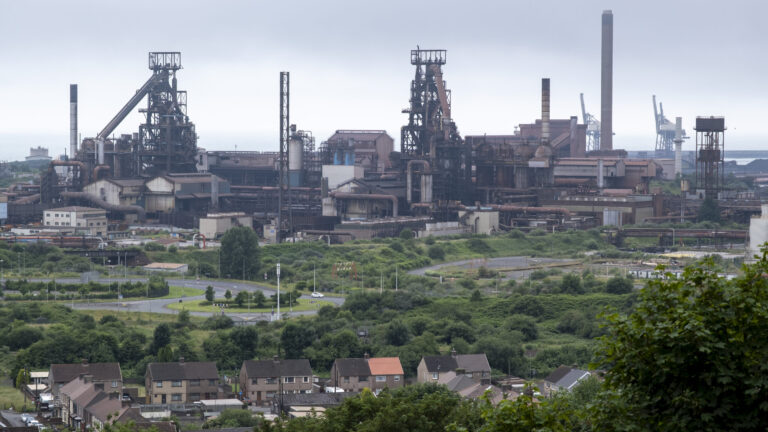
Port Talbot steelworks. Photo: Mike Kemp/In Pictures via Getty Images
We all know that nostalgia sells. It is worrying, however, when it becomes a mainstay of a political party’s offering. While Reform UK are often criticised – with reason – for selling a semi-mythical Britain with a whiff of the 1950s, Labour seem to be muscling in too. Alarmingly, their current touchstone of times past is apparently the Iron and Steel Act 1967.
Earlier this week, the BBC reported that ministers want to merge the UK’s six remaining steel companies into one entity. This is not just wishful thinking, but something over which the Government has real agency: Sheffield Forgemasters has been owned by the Ministry of Defence since 2021; the Government took control of British Steel in April; Liberty Speciality Steel is in the hands of the Official Receiver; and Tata Steel received a subsidy of £500 million last September for its Port Talbot Steelworks.
The only companies outside this group are 7 Steel UK in Cardiff, which recycles scrap into low-carbon construction steel, and Marcegaglia UK, a precision tube manufacturer which has a steel plant in Sheffield.
The Government’s position is that it wants the six businesses to come together and ideally be sold to a single buyer; ministers say that nationalisation is not their preferred option. ‘We have always been clear steelmaking has a bright future in the UK,’ a Government source said, ‘but that must come in partnership with the private sector.’
Nevertheless, the echoes of the past are strong. Much of the steel industry had been nationalised by the Attlee government in 1949, only to be returned gradually to private ownership under the Conservatives’ Iron and Steel Act 1953. Harold Wilson as prime minister then sought to placate the Left of the Labour Party by renationalising the sector: the Iron and Steel Act 1967 established the British Steel Corporation (BSC), a public body which assumed ownership of 14 steel manufacturers, representing around 90% of the UK’s total output.
The policy was not a success. BSC was saddled with outdated equipment, inefficient practices, high energy costs and a lack of investment and it faced ever-stronger international competition. Some facilities were kept open despite operating at a loss in order to sustain employment in depressed areas: Teesside, South Wales, the West of Scotland. It was privatised (again) as British Steel plc by the Thatcher government in 1988.
Even if nationalisation is not the preferred route, the Government has proved with the Steel Industry (Special Measures) Act 2025, which allowed it to take control of Scunthorpe Steelworks from its Chinese owner, Jingye Group, that it is not afraid of intervention on a substantial scale. It is possible, for example, that the industry could be taken into state ownership temporarily to make it fit for sale; but it is also possible that a buyer might never come.
Set against all this is the impending publication of the Government’s Steel Strategy. Originally due earlier this year, this is now expected in the autumn, and will, in the deathless prose of this administration, ‘set out our long-term vision for the sector and how we’ll work with industry and communities to deliver a bright, sustainable future for UK steelmaking that secures good, well-paid jobs across the country as part of our Plan for Change’.
What that vision will be is the central question. The UK’s steel industry is a very small part of our economy, only 0.1% of economic output and 0.8% of manufacturing, and it supports 37,000 jobs across the country. Globally, we are a minnow: the UK is the eighth biggest steel manufacturer in the world, but that represents only 0.3% of total production. China produces 54%.
The international market for steel is challenging, with prices depressed by excess production. The UK suffers from cripplingly high energy costs which further diminish the sector’s competitiveness. One of the Government’s stated aims is to ‘create more well-paid jobs in the places where they’re most needed’, and there is a feeling that ministers are unwilling to ask whether the steel industry can be viable in any circumstances. Instead, ministers simply assert that decline is not inevitable, and point to the UK’s steel-making past.
Does the Government have a plan, or simply a wish? It has made little headway in bringing down energy prices, despite having been in office for more than a year now, and has intervened in the steel industry more rather than less, though it also stresses that ‘mergers are commercial decisions for individual companies not the government’. But it already owns one firm and controls two others, so it is hardly disinterested.
Perhaps the Steel Strategy will show a plausible route forward. Time and again, however, Labour have made policy on the basis of what it would like to happen, relying on a Panglossian assumption that everything will be well. Ministers say the decline of the steel industry is not inevitable; nor, by the same token, is its survival and commercial viability. So far, the evidence is hardly piling up in support of the latter, and it is hard to see what levers the Government can pull to change that.


Most of those who, despite all discouragement, continue to invest in the UK have a sense of foreboding over an Andy Burnham premiership. We know that he will try to reconcile two irreconcilables. First, he will offer bold, exciting change from the uninspiring couple of years under Keir Starmer. Second, he will resist holding an […]

Andy Burnham is not a forward-looking man. His musical interests stop at around 1998, his approach to industry is straight out of the 1970s and his favourite football team hasn’t won a trophy for over thirty years. It’s little surprise then that he takes a dim view of the ongoing tech revolution. It was reported […]

Rachel Reeves has found another group of taxpayers to squeeze: graduates who still think they have a student loan rather than a second income tax. At the 2025 Budget, she froze the Plan 2 student loan repayment threshold at £29,385 for three years from April 2027, rather than uprating it with earnings. Freezing a threshold […]