A decade on from Brexit, and we’re still divided
DANIEL SORABJI/AFP via Getty Images
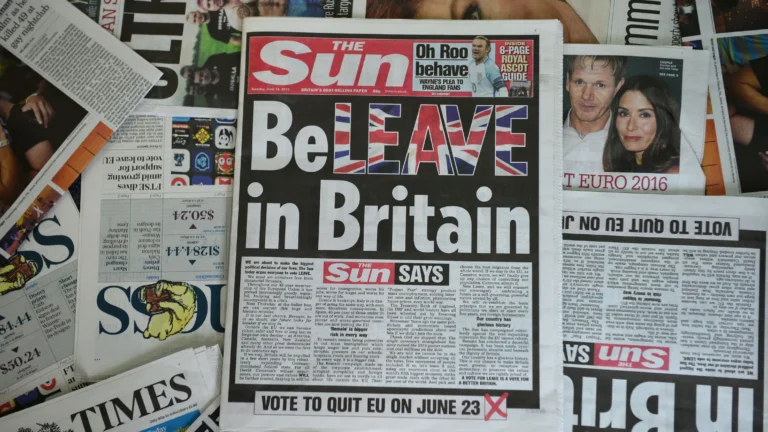
Ten years ago, the EU referendum created two new political tribes: Leavers and Remainers. As Sara Hobolt and I show in our new book ‘Tribal Politics: How Brexit divided Britain’, both tribes are very much still with us. Even today, about 60% of people in Britain identify as a Remainer or a Leaver, and people’s emotional attachments to their Brexit tribe are much stronger than their attachments to any political party.
Why are these new political tribes interesting? I think there are three reasons. The first is that we got to see a rare event: new political identities being born. Before 2016, nobody thought of themselves as a Leaver or Remainer. Although characteristics such as education, age and national identity were associated with referendum vote choice, they were fairly weak predictors of how people ultimately voted. Models that try to explain which way people voted using these characteristics do little better than chance. In reality, many people with middling, weakly held opinions about the EU were forced to make a choice in 2016, and that choice created the key political identity that shaped how people saw themselves and how they wanted others to perceive them.
If my side voted for the change, I say ‘good’; if my side voted against the change, I say ‘bad’
Second, these new political identities continue to affect our relationships with other people. Put simply, people like those in their own tribe. Most people say that they have a lot in common with others on the same side; that criticism of the group feels like a personal insult; that they say ‘we’ not ‘they’ about their group. None of this has changed over the last decade. All our measures also show that people dislike those on the other side. That dislike is perhaps most obvious in the prejudice that people express towards their opponents. Large numbers of people still say that their own Brexit group is intelligent, honest and selfless, while the other side is stupid, dishonest and selfish. Prejudice also translates into discrimination: people continue to actively avoid everyday interactions with people on the rival team. Americans often think of themselves as peculiarly politically divided, but the levels of hostility, prejudice and discrimination between the Brexit tribes are all as large as any partisan differences in the US.
The third reason, however, is perhaps the most important. Brexit identities continue to act as a lens through which we see reality. The difference between Leavers and Remainers over whether they think that the effect of Brexit on Britain has been positive or negative is enormous: nearly three points on a five-point scale. That is not surprising, but what is surprising is the lack of change. Leavers are just as positive and Remainers are just as negative as they ever were. What that implies is that people are not really looking for the truth. In fact, when we asked people, ‘What are those positive or negative effects?’, well over half of both Remainers and Leavers were unable to name anything specific. People are not assessing reality; they are creating a ‘reality’ that is convenient. If my side voted for the change, I say ‘good’; if my side voted against the change, I say ‘bad’. And the minority of people who do want to engage with reality are happy to pick and choose facts that are convenient for them. For example, while Leavers focus on the fact that economic growth rates in Germany and France have been almost identical to those in Britain, Remainers focus on the fact that most economic models indicate that economic growth would have been higher without Brexit. That selectivity is partly a way of shielding ourselves from uncomfortable truths, but it is also a way of signalling to fellow travellers that we are good members of our tribe and of making the other tribe seem less appealing.
Another obvious area in which we see this process of people rationalising away inconvenient information is electoral ‘fairness’. The referendum is particularly interesting here because, before the vote, many people thought that the Remain side would win, so the expected winners became losers and the expected losers became winners. In April, when Leavers thought they would lose, only a third said that the referendum would be ‘fairly conducted’. In December, after they had won, a big majority of the same people said that it had been fair. The exact opposite was true for Remainers. In April, a big majority said that it would be fair. In December, after they had lost, less than a quarter said that it had been fair. Perceptions of fairness depend on whether somebody won or lost.
A decade later, 60% of all Remainers, and 80% of people with a strongly held Remain identity, still think that the referendum was not ‘based on a fair democratic process’. Why? Because it allows people to feel that their group is superior (their side ‘really’ won); to signal to people on their own side that they are good group members; and to cast doubt on the virtue of the other side. This has little to do with the realities of the electoral process, and much more to do with political tribalism.
Ultimately, one of the lessons of the EU referendum, and the past ten years, is that unimportant issue differences can become hugely important issue identities that affect how we view others and the world around us. Indeed, because our perceptions are filtered through this Brexit lens, our biases do not just reflect tribal divisions; they continue to entrench them.


‘Just when I thought I was out, they pull me back in,’ says Michael Corleone in ‘The Godfather Part III’. A decade after we voted to leave the European Union, much of the establishment is still in denial about the verdict that was delivered. Andy Burnham has been absolutely shameless. Campaigning in the Makerfield by-election, […]
Whenever I think about Boris Johnson, the old French proverb ‘après moi le déluge’ comes to mind. It means a blithe, even nihilistic disregard for whatever ruination ensues after one’s own time. For many years, it was thought to have originated with Louis XV or his mistress Madame de Pompadour in the 1750s. It thus […]
At a few minutes past six on Friday morning, in a leisure centre on the Essex coast, the returning officer reached the bottom of a ballot paper roughly a metre long and announced a number that deserves more attention than it is likely to receive. Nigel Farage, 22,239 votes. The commentary had settled into its […]