Why everyone should read Adam Smith
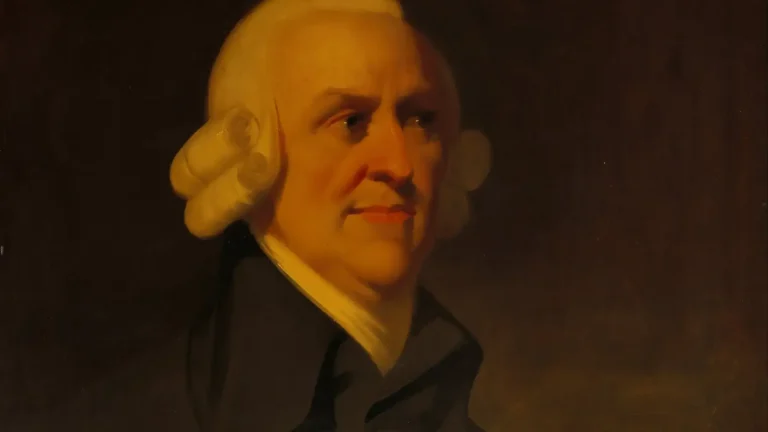
Photo: Fine Art Images/Heritage Images/Getty Images
1776 has a claim to being the single most important year in the history of the English-speaking peoples. America declared her independence, James Watt sold his first steam engine and Adam Smith invented modern economics. Edward Gibbon might also win ‘highly commended’ for publishing the ‘Decline and Fall of the Roman Empire’ in the same year.
On 9 March 1776 – exactly 250 years ago today – the first edition of Adam Smith’s ‘An Inquiry into the Nature and Causes of the Wealth of Nations’ was published. It would be an exaggeration to say it set the literary world on fire; Gibbon’s work was far more popular. But it began a process of persuasion – or indeed conversion – that continues to this day. It has inspired world leaders from Pitt the Younger to Ronald Reagan. Such was its rapid influence that, only 34 years after its publication, one German student said Smith was ‘next to Napoleon[,]… now the mightiest monarch in Europe’.
But the ‘Wealth of Nations’ is an unwieldy book, featuring characteristically-long, 18th-century sentences and a famed 65-page digression on silver, which was – at least – honestly entitled. You can hardly blame Smith: The text is the product of 20 years of thinking, ten years of writing, and hundreds of conversations with scholars across Europe. It founded the modern discipline of economics and is still anticipating modern developments in the science. But still, this is not a book tailored to the attention spans of the TikTok generation.
Over the years, we at the Adam Smith Institute (ASI) have tried our best to do this tailoring on our namesake’s behalf. Our co-founder, Eamonn Butler, has written both a condensed edition of and a primer on the ‘Wealth of Nations’. Indeed, his efforts continue, with a soon-to-be-released graphic novel edition.
But I want to also make the case for the original, which I first read (much to my economics teacher’s horror) at 14. It continues to be an insightful, clever and occasionally funny argument for free markets and limited government. After all, it was Smith who first memorably explained that ‘it is not from the benevolence of the butcher, the brewer, or the baker, that we expect our dinner, but from their regard to their own interest’.
Unfortunately, the ‘Wealth of Nations’ also still has much to teach us, 250 years on. Consider Smith’s four cannons of taxation. First, ‘subjects… ought to contribute… in proportion to their respective abilities’. Second, ‘tax… ought to be certain, and not arbitrary’. Third, ‘tax ought to be levied at the time, or in the manner, in which it is most likely to be convenient for the contributor to pay it’. Finally and most importantly, ‘tax ought to… keep out of the pockets of the people as little as possible over and above what it brings into the public treasury’. These are all thoroughly commendable rules, which are just as thoroughly violated by today’s British tax system.
This was pointed out all the way back in 2010, when James Mirrlees, another great Scottish economist, applied Smith’s cannons to the contemporary British tax system. Unfortunately, the situation has barely improved – and, in many ways, it has worsened – in the succeeding 16 years. Indeed, our tax system so badly violates the fourth canon – which modern economists call the ‘efficiency’ desideratum – that was ranked 31st out of 35 for tax competitiveness in the OECD in 2025. A recent paper by the ASI found that simply moving the burden of property taxes from transactions and buildings to land could unlock an additional 1% of GDP with no lost revenue for the government. That is a lot of extra money that could be left in ‘the pockets of the people’.
But it is not just Britain that can still learn from Smith. The current occupant of the White House seems to think that countries are made poorer by imports. This is an argument that is directly rebutted by Smith, with characteristic wit and verbosity. As he says, ‘consumption is the sole end and purpose of all production; and the interest of the producer ought to be attended to, only so far as it may be necessary for promoting that of the consumer’. Tariffs and other trade restrictions specifically make consumers poorer in order to protect producers, so they make little sense.
So, if you can handle 700-odd pages of long sentences and even longer digressions, there is still much value to be found in the original. You will learn just how old many of the mistakes we are making are and just how obvious the solutions could be. If you can’t, there isn’t long to wait for the graphic novel edition.

Elon Musk’s SpaceX has launched the largest ever public offering of stock today, selling $75 billion worth of shares. SpaceX emphasised its remarkable achievements in its IPO filing: ‘We are the primary launch provider for the US government. In 2025, we launched 11 of 12 National Security Space Launch (‘NSSL’) medium and heavy lift missions […]

September 2023: what a time that was to be alive. Aerosmith began their final ever tour, Kim Jong-Un arrived in Russia for an audience with Vladimir Putin and Rupert Murdoch stepped down from the boards of Fox and News Corp. It was a good month for news. Yet that month another turning point in world […]

June 4 marked the 37th anniversary of the Tiananmen Square massacre. It has been a long time since the China of reform and opening-up gave way to one of the strangest regimes of our age: a country with the political freedoms of the Soviet Union but economic power approaching that of the United States, capable […]