Why Britain should abolish inheritance tax
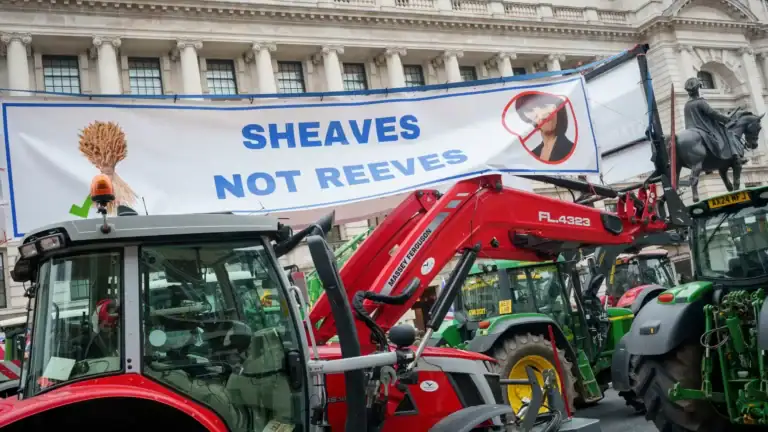
British farmers protesting inheritance tax changes. Photo by Richard Baker / In Pictures via Getty Images
The debate over inheritance tax is not a new one. Some Roman Emperors levied a form of it, and the concept was first implemented in Britain in 1694. David Cameron and George Osborne famously made cutting the tax their big-ticket pledge ahead of ‘the election that never was’ in 2007, and the latest uproar from the farming industry over this Government’s reforms has reminded everyone again just how much they hate it.
And they really do hate it. Polling shows inheritance tax is supremely unpopular. Even to those that don’t or won’t ever pay it, it is often deemed as being fundamentally unfair and unjust.
But how bad is it, really? Most of us recognise that the government does need to raise some money in some way, so why not this way rather than say on income, investment, or consumption?
A new IEA report by Rory Meakin has found that the UK levies the fifth-highest tax in the OECD on what parents can leave their children. This is a much worse picture than the one given when we look at headline rates only because, unlike many other countries, we do not give any relief or special rates to parent-child inheritance.
Britain being internationally uncompetitive on matters of tax will not be news to regular CapX readers, but this is a picture worse than we are often led to believe, and it has real economic consequences.
Just by being so uncompetitive internationally it sends yet another signal to those who want to grow businesses and create wealth that Britain probably is not for them. Waiting for the more competitive jurisdictions to be caught up in wars does not make for a sensible economic strategy. We should make the UK a welcome environment for the people who will help our country grow.
IHT also has a counterproductive effect on savings and investment, which has knock-on implications for overall capital and the productive capacity of an economy. Evidence from the US has shown how imposing a form of inheritance tax reduced overall capital stock by 3.2% relative to where it otherwise would have been, while other studies found the reverse effects of removing such taxes. When we’re struggling so much to grow our economy, these are not effects that we can afford to ignore.
The overall impact on savings and investment of removing IHT in the UK partly depends on what the alternative is. If, as it should be, it is covered by reduced government spending, then it is safe to assume that it would not represent a big hit to productivity, given our public sector’s shocking track record on this front.
How big would those spending cuts have to be to ‘fund’ an abolition of inheritance tax? The OBR forecast the tax to yield £8.7 billion in 2025-26, rising to £14.5 billion in 2030-31. But these numbers don’t tell the full story about the costs of imposing the tax.
This is mainly down to the tax’s complexity. The comprehensive ‘Tolley’s Inheritance Tax’ guide runs to over 1,000 pages. The comparable figure for the income tax guide is 2,500. The difference is that income tax raises 37 times more revenue. Clearly this is a crude measure, but it paints a clear picture of how complex IHT is.
It costs the government £66m just to collect it. When you consider the opportunity cost of all of the time and effort spent by both the government in trying to collect it, and private lawyers and accountants trying to avoid it, the real number is likely much higher.
Given the sheer scale of state expenditure today, it should not be too difficult to find the money that abolition of IHT would require. The IEA has plenty of suggestions, from healthcare to higher education to pensions and more. But even if a new government didn’t want to go this far, or wanted to prioritise other tax cuts (stamp duty, anyone?), there are still other reform options that would help lower the burden and reduce the negative effects of inheritance tax.
Streamlining measures including simplifying gift allowances and reducing the gifting period would not cost that much and would reduce some of those 1,000 pages. More substantially, reformers should look at raising the nil rate band to £2 million or beyond, which would remove the overwhelming majority of estates from liability altogether. In 2022-23, 27,920 of the 31,500 estates that paid inheritance tax had a net value below £2 million. A higher threshold would also allow the abolition of the complex residential nil rate band and the transferable allowance between spouses, delivering real simplification alongside the tax cut.
While attention may be focused elsewhere, it should not be forgotten how damaging inheritance tax can be, particularly in our competitive international environment. While we may argue there are other priorities, we must also acknowledge that if we were to build a new system from scratch it would not include an inheritance tax. That alone should be enough to make the government think again.
‘A Taxing Inheritance’ is published by the IEA.

The Green Party is proposing that CEO salaries should be capped at ten times the minimum pay within a company. Given the current leadership of the Greens, this is not surprising. But what is surprising is that, according to a YouGov poll 65% of Brits seem to agree – including 77% of Labour, 58% of […]
Not too long ago Keir Starmer was banging on about how growth is his ‘number one mission’. Now, with the economy once again faltering – real GDP grew by an anaemic 0.1% in the last quarter of 2025, following an equally disappointing 0.1% in the previous quarter – we are hearing a bit less on […]
How can people without capital be expected to believe in capitalism? This is the challenge of our age, as ‘own nothing and be happy’ hardens into a new dividing line in Western politics. Westminster risks ignoring the emerging political economy of housing, even as public anger grows. Green Party leader Zack Polanski is already courting […]


