Welcome to the new political age
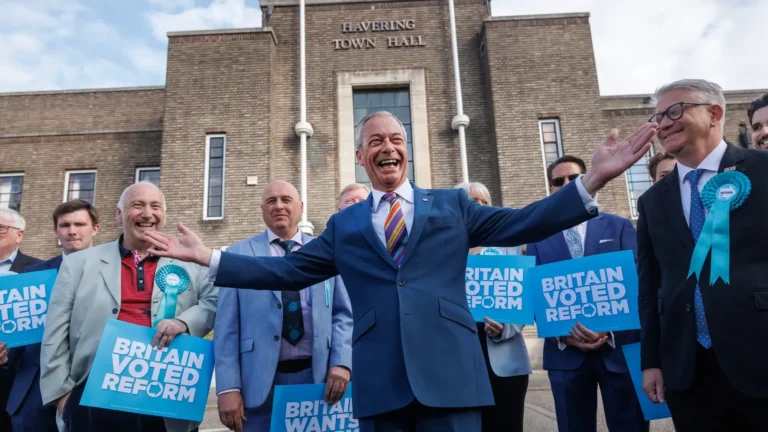
Dan Kitwood/Getty Images
I am writing this from Cardiff Bay, in the Pierhead Building, that glorious riot of Flemish Gothic terracotta and Doulton tiles, all scarlet and cream, that once housed the administrative heart of the old Bute Docks. It is a building that knows what confidence looks like.
Outside its windows squats the Senedd itself, a monument to bureaucratic self-regard dressed in slate and glass, as if Wales’s political ambitions could be expressed in an architect’s brochure. Between these two buildings, the BBC has established its election camp. And in the great hall, incongruous and magnificent, sits an old port authority safe, the vessel that once held the first cheque for one million pounds ever written. A million pounds, here, in Cardiff, in this city that once moved the world’s coal.
That safe is Wales: a memory of industrial glory, locked away, waiting for someone to remember the combination.
Yesterday, people voted across England, Scotland and Wales. And the returns, as they come in through the long Friday, tell a story that a locked safe cannot contain.
Begin in England, where the overnight counts, that great British democratic theatre, the tension of declarations at three in the morning, the rosettes and the wobbling majorities, have been largely replaced by a continental techno-drift of daytime tallying. A civilisational error. Nevertheless, the numbers, when they come, are vivid enough.
Reform gained its first London borough, Havering, and the Conservatives have defied expectations to hold Bexley and retain Kensington and Chelsea, and have recaptured Westminster City Council from Labour, taking 32 of its 54 seats. Yet the party must know, even as it celebrates, that this is borrowed time and borrowed ground.
For the true picture of where conservatism now stands, look not to the King’s Road but to the Essex lanes. Across East Anglia, it has been a sweeping night for Reform, with gains in Peterborough, 11 seats taken in Basildon, seven apiece in Brentwood and Southend, and the Conservatives look set to lose control of Essex County Council entirely. Three eastern counties – Essex, Norfolk, Suffolk – are all projected to flip to Reform. But the detail that will linger is this: in Saffron Walden, Kemi Badenoch’s own Essex fastness, the parliamentary seat she holds as leader of His Majesty’s Loyal Opposition, Reform polled 32% across the local government wards within the constituency. The Conservatives managed only 29. In the Uttlesford district that sits at the heart of that seat, Reform won the majority of the county council contests. If the leader of the Conservative Party cannot hold her own backyard against the insurgency, the question of what exactly she leads becomes rather pressing.
These are not fringe places. These are the market towns and farmsteads of England’s quiet, productive heartland, and they have rendered their verdict.
The picture is further complicated by arithmetic that flatters Labour’s position. Many English councils elect a third of their councillors each year, meaning Labour-held northern fiefdoms like Wigan and Hartlepool remain nominally in their column for now. The reckoning there comes next year, when the seats contested tonight sit beside fresh ones. Those who imagine this augurs Labour resilience are confusing the tide-table with the tide.
Now to Scotland, where the count began on Friday morning. Reform, who won a mere 0.2% of the vote five years ago, are on course to become the first party to the Right of the Conservatives to win seats in the Scottish Parliament, with projections placing them on around 19 or more MSPs. The pollsters, it seems, have significantly underestimated this surge. Reform’s support was found to be the firmest of any party’s, with 83% of its voters saying they had definitively decided to back the challengers, a degree of conviction that professional politicians in the established camps can only envy. On the regional list vote, Reform are outpacing Scottish Labour, even as the Tory constituency vote holds in scattered pockets. That Tory vote is not collapsing, it is migrating. In Cunninghame North, what was formerly a safe SNP seat against a Conservative second place has become a statistical tie between SNP and Reform, as the old Tory vote has almost entirely transferred. The Union’s defenders are changing their standard-bearer. The Conservatives may not yet have noticed.
And then there is Wales. Magnificent, tragic, extraordinary Wales.
Labour are on course to lose two thirds of their vote share from 2021, falling to around 12%, their worst result in a major Welsh election since 1906. Let that number sit for a moment – 12%. In the country of Keir Hardie and Ernest Bevin, of Neil Kinnock and the General Strike, of mining villages and steelworks and an entire civilisation built on solidarity underground. Of chapel and male voice choir and the kind of Labour loyalty that was handed down like a faith.
How has it come to this? Several forces have converged. The M4 alliance of smaller parties has nibbled at Labour’s urban base. But the deeper wound is simpler and more devastating: the Welsh people have finally drawn the obvious conclusion about their National Health Service. It is run not from Westminster but from the Senedd. Its failures are therefore not London’s failures. They are Labour’s failures. Mark Drakeford became the face of Covid in Wales, and with him, Welsh Labour became the face of Welsh healthcare, and Welsh healthcare became the face of Welsh Labour’s inadequacy. The bill has now been presented.
Intelligence from across the parties suggests a straight tussle between Plaid Cymru and Reform to become the largest party in the Senedd. Plaid will likely lead, but only just, and only into a coalition of the economically adventurous: nationalists lashed to Greens in arrangements that will compound every Net Zero error, every DEI indulgence and the particular Welsh political vice of directing resentment outward rather than ambition inward. The Conservatives are reduced to just four seats in the central projection, with the Liberal Democrats returning a single member. Parties that once shaped Welsh public life, reduced to rounding errors in a Senedd they helped to create.
The safe in the hall behind me held a cheque for a million pounds. Wales once generated wealth on a scale that astonished the world. The political class that has administered its long decline now faces, in these results, its reckoning.
Reform are not the answer to every question. They would be the first to admit, if pressed, that governing is harder than insurgency, and that the distance between a county council in Essex and a programme of national renewal is considerable. But across England, Scotland and Wales today, in East Anglian market towns and Scottish list regions and the valleys of a Wales that Labour thought it owned in perpetuity, something is happening that cannot be explained away by incumbency penalties and mid-term blues.
Reform are of the moment. And the moment, unmistakably, is now.

When a household pays £450,000 for a new home in England, a striking share of that price is not paying for bricks, mortar or even land. It is paying for planning obligations, biodiversity rules, regulatory overhead and delay-driven finance costs – none of which is itemised for the family that ultimately bears the cost. Stamp […]
An index-linked gilt – known as a linker in City speak – is a government IOU whose principal and interest payments rise with the Retail Prices Index (RPI). Inflation erodes the value of an ordinary bond; a linker compensates the holder for it. The post-Covid inflation shock showed why anybody would want one. Inflation, thought […]
During the 1979 general election campaign, Margaret Thatcher famously said: ‘I can’t bear Britain in decline. I just can’t.’ If you’re a seasoned research professional who shares that sentiment, and who wants to fight for a high-growth, low-tax, small-state Britain built on personal and economic freedom, then I have just the job opening for you. […]