We will miss Keir Starmer
His true flaw was he believed that competence and "stability" could substitute for a theory of growth

Alastair Grant - WPA Pool/Getty Images
His true flaw was he believed that competence and "stability" could substitute for a theory of growth
The Greek poets understood that the cruellest fate is not the one a man brings upon himself, but the one that was waiting for him before he arrived. Oedipus did not choose his fate, indeed he walked into it with the very best of intentions. So too, in his quieter and more lawyerly fashion, did Sir Keir Starmer.
Since last November, it has been common at dining tables, amongst friends hanging outside of ever-dearer pubs, and amongst the political class to list off the charge sheet against our departing Prime Minister. The dozens of U-turns, the adenoidal communications strategy and over-insistence on either breakfast clubs or having “full confidence” when you have nothing of the sort, the chopping and changing of civil servants (from the disgraced Peter Mandelson to the Mandarins who Starmer accused of covering up universally known truths). Even his right-hand woman, his sentient flak jacket Rachel Reeves, has received the same ridicule. One of my less politically engaged friends only knows her as “the crying one”; it is the misery of the forlorn fate hanging over this government which has been so tragic to watch. And yet it feels inevitable.
But to dwell on these charges is to mistake the symptom for the disease, and to flatter ourselves that some bolder, luckier, less tin-eared man might have slipped the noose. The office Starmer accepted in July 2024 was, on any honest reading, close to ungovernable given the options at the last election of a full suite of establishment, derivative career politicians. We owe Starmer at least the decency of admitting it.
“The dozens of U-turns, the adenoidal communications strategy and over-insistance on either breakfast clubs or having “full confidence” when you have nothing of the sort”
We can best see this in the lack of planning in the run-up to the election, and the essential belief that Whitehall would snap into order because ‘the good people will be in charge’. He promised to make Britain the fastest-growing economy in the G7; the IMF has since cut our 2026 growth forecast to 0.8 per cent, which is the steepest downgrade of any G7 nation. The tax burden is at its highest level on record. Some £75 billion of new taxes have been loaded onto businesses and households, the largest such raid in the G7. He promised that “politics would tread lightly on our lives”, only to shepherd through a new smoking ban, a social media ban, a free speech crisis, higher taxes on gambling and hospitality. The list goes on.
This Road to Serfdom is felt amongst almost all political quarters – nobody is happy, other than the central political class, which has come to be a synonym for Starmer’s government. The ideas that have come to make Starmer so derided are not those of the trade unions or the result of overly woke academics or activists. The march of insanity that was the Chagos debacle, the Assisted Dying debate which was so divorced from expert testimony, and now the popularity of those politicians and ideas which are defined for their non-Whitehall origins (of Andy Burnham and Nigel Farage), are all defined by the centrality of the Whitehall mindset losing its effectiveness. Starmer and co are entirely signed up to this habit of thinking.
Here, if anywhere, is Starmer’s true flaw — and it is not the one his critics name. He believed that competence and “stability” could substitute for a theory of growth. You do not manage your way out of a structural crisis. He arrived with a temperament where better concepts of economics should have been. The bond markets, the OBR, a manifesto vow not to tax “working people”, and a parliamentary party with the collective survival instinct of a lemming saw to the rest.
In May, Labour shed more than 1,100 council seats whilst the heterodox Reform took some 1,450. More than eighty of his own MPs called for him to go immediately and Wes Streeting walked out of the Cabinet in protest. Now, Andy Burnham, the great hope of the Labour left despite his neoliberal governing record in Manchester, takes his seat in the Commons, and in all likelihood the keys to a house that is already ablaze. His party has concluded that the remedy for failing at growth is to install a man who will fail at it faster, and with far greater conviction.
We do not yet know what Burnham would bring to the table – we have an idea of what his Cabinet will look like, with Wes Streeting touted to be Chancellor of the Exchequer in order to placate the Labour Right, and Ed Miliband moved into MHCLG in order to kick-off a nationalised housebuilder by purchasing the troubled Vistry, whilst DESNZ plumbs Rosebank away from ‘Red Ed’s’ gaze. But on the big structural questions, which have doomed Prime Ministers from Theresa May to Starmer, we are left clueless.
We will miss Keir Starmer. He was misguided from the beginning, and commanded a disaffected majority in the Commons and in the country. He, nonetheless, did his best within the structures that his training in governance allowed him, and was held hostage by his backbenchers. For the chaos that comes next, let’s hope the Bond Vigilantes take mercy on us all.

The refusal of the Treasury to increase defence spending shouldn’t come as a surprise. This is exactly what HM Treasury is supposed to do: stop spending that it sees as unaffordable, unless the necessary trade-offs are made to unblock it. The point of cabinet government is for Secretaries of State to make their case for […]

The ‘Burnham effect’ that propelled Labour to victory in Makerfield is only the latest example of regional and devolved democratic leaders who are miles more popular than their opposite numbers in Westminster. Political talents as diverse as Boris Johnson and Alex Salmond prospered after being sprinkled with devolved political fairy dust. So do these roles […]
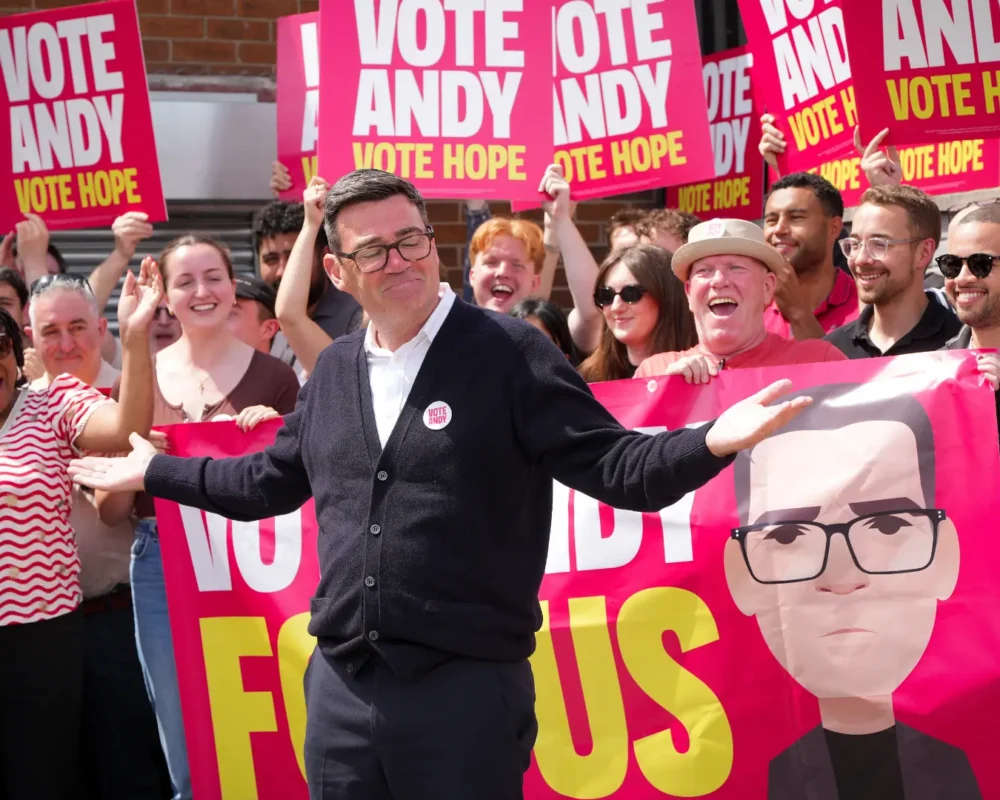
The numbers are not in dispute, whatever the spin. Andy Burnham took Makerfield with 54.8% of the vote and a majority of 9,231, on a turnout of 58.7%, the highest at any parliamentary by-election in almost seven years. Labour’s lead over Reform, 13 points at the general election, widened to 20. A seat Reform UK […]