The war on pastiche is fuelling Nimbyism
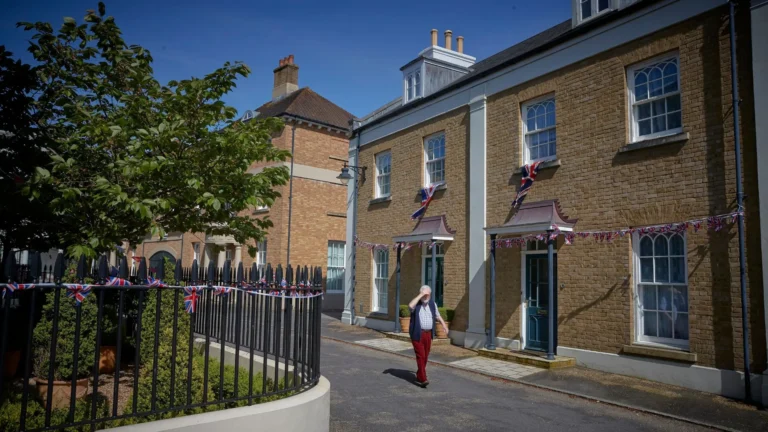
Poundbury – Kiran Ridley/Getty Images
Under Westminster City Council’s planning policies you couldn’t build Parliament today. In the eyes of modern planners, the gothic revival Palace of Westminster would be considered ‘pastiche’ – and Westminster City Council writes on pastiche that:
…pastiche designs, which are pale imitations of historic buildings, [are not] appropriate or desirable.
There are lines like this in Local Plans across the country, disincentivising new builds to fit in with their surroundings and therefore encouraging Nimby protest.
Whether something ‘fits in’ does affect whether it will get the full force of the Nimbys or not. It was new builds not fitting in that took down the only ever openly Yimby council planning policy in 2022
Hillingdon’s Local Plan says that ‘pastiche features will not be supported’ in extensions. Cheshire East says ‘pastiche design will be discouraged’. Waverley Borough Council writes that: ‘The objective of good design is not to copy vernacular architecture, creating imitation or ‘pastiche’ development’.
The problem is that surveys show again and again that copying vernacular architecture is what the majority want developers to do.
Even if it’s not in the Local Plan, councils still fight against traditional architecture. By Clapton Common in Hackney there is a dismal-looking car dealership which is only there because the council rejected (several times) a terrace of three Georgian-style buildings. These tried to match the surrounding architecture, and so were ‘pastiche.’
Sometimes policy goes beyond a demonisation of pastiche and into a promotion of incongruous buildings that get people really riled up and Nimbyistic. New builds that ‘fit in’ often attract fewer complaints than those that do. A recently approved six-storey building in Stockport, styled to match the Victorian industrial fabric of the town, received no complaints. Compare this to the palaver over Liverpool Street Station.
People don’t mind new builds that ‘fit in’, but because of pastiche Nimbyism eyesores and carbuncles are literally policy. Reading’s draft Local Plan summarises this nicely:
The aim is not to copy existing heritage […] Good, modern design that is complementary to the historic environment will be acceptable and preferable to ‘pastiche’.
Planners have this idea that it is better to build something that obviously doesn’t fit in with the local area rather than to build something that does.
Worse, this view is often supported by influential local conservation trusts. The Bath Preservation Trust in 2023 objected to an application to replace two 1970s bungalows with two semi-detached traditional townhouses, writing that: ‘…the use of a pastiche Georgian townhouse design is not appropriate in this area’. It’s hard to imagine anywhere more appropriate for Georgian architecture than Bath.
This sounds tangential to the issue of housebuilding, but whether something ‘fits in’ does affect whether it will get the full force of the Nimbys or not. It was new builds not fitting in that took down the only ever openly Yimby council planning policy in 2022.
Croydon’s 2019-2022 rules-based planning system gave it the highest housebuilding rate in London. But in 2022 both Labour and the Conservatives campaigned against it – both on the grounds that deregulation was creating buildings that didn’t ‘fit in’. The Conservatives promised a ‘design-led approach to planning’, and Labour stood against homes that are ‘the wrong sort of design and colour.’ Between them the parties received 68% of the vote. Planning in Croydon has been re-regulated, and housebuilding is down.
A Yimby policy that lasts three years only to be rejected by voters isn’t much of a win. Policy has to take people along with it.
If a deregulatory policy that was actually delivering homes in London can be overturned because they didn’t fit in, then why are Local Plans – in theory the vehicle for approving housing – working against ones that do? Yes, to some extent it’s all Nimbyism, but maybe Croydon could have carried on building if it had been in the pastiche 1930s ‘Tudorbethan’ style characteristic of the borough. Certainly that’s what its mayoral candidates claimed.
This is a problem. For a few years now there has been an idea, bought into by successive governments (not to mention the King), that the solution to Nimbyism is building beautiful things so that people don’t object. Pastiche Nimbyism attacks this solution and leaves us with even less being built.
What these throwaway lines about ‘pastiche’ in Local Plans mean is that developers will shy away from even trying to build in attractive and popular styles. Nobody knows exactly what ‘pastiche’ means, so to make sure a development is in line with policy it’s safer to make sure it doesn’t look traditional at all. Regulations are encouraging less attractive and less popular buildings that fit in even less to their surroundings, and fuelling the Nimby fire of planning objections, or voting for Nimby policy, as they do so.
Pastiche is a good thing that creates popular places to live. The most pastiche place in the country is Poundbury, where houses have a 34% premium against the local market. This premium exists because the other things we build are not as in demand. By demonising pastiche, planning policy is encouraging the Nimbys while also making our towns and cities less beautiful in the process.


This is a highlight from the event programme of the Centre for Policy Studies (CPS) – CapX’s parent organisation – at this year’s Conservative Party Conference. You can watch all the panels and interviews on the CPS YouTube channel. The housing market has ground to a halt in London – in large part because of political decisions […]

In the mid-90s, you could save up a deposit for a house in a year; now it takes about a decade. That’s a really meaningful change. That’s a whole stage of your life where 30 years ago you might reasonably have expected to become a homeowner and now that is highly unlikely In a room […]
Among the eye-catching announcements from the Labour Party Conference in Liverpool is a proposal to allow councils to seize privately owned homes. Matthew Pennycook, the Housing Minister, tweets: ‘It’s not a silver bullet, but bringing more empty homes back into use can help solve the housing crisis. Today, we’re announcing strengthened powers for councils to […]