Our shameful indifference towards Africa is a gift to China
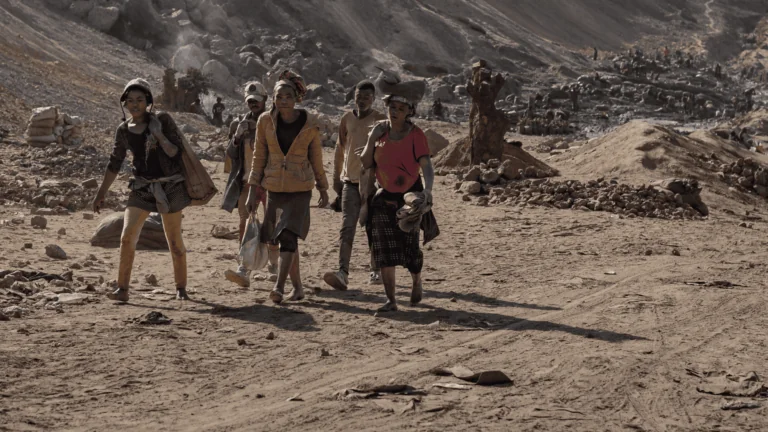
A group of men and women pass through a mine site on May 26, 2025 in Kolwezi, Democratic Republic of Congo. Photo: Michel Lunanga/Getty Images
Drills smash through rock. Machines hiss in the heat. A child cries out, clutching his hand after burning it on the metal casing of a generator. These are the sounds of the Democratic Republic of Congo (DRC).
In the mines of the DRC, you are a long way from the tranquility of the African savanna – but closer than you might imagine to the engine room powering the economic and military interests of the People’s Republic of China (PRC).
Here, in the copper-red earth, children dig for cobalt with nothing but shovels or – in extreme cases – their bare hands.
Many of today’s exploited child labourers are freelance ‘artisanal miners’ working for as little as a dollar a day, in dangerous, unregulated conditions, often without permits or safety equipment. Their labour feeds the global supply chain for cobalt – the mineral underpinning electric vehicles, battery storage and much of the West’s green energy transition.
That is one of the disturbing issues to have emerged during a current Parliamentary Inquiry, chaired by the co-author of this article – Lord Alton.
The DRC, like many of its African neighbours, is heavily dependent on the exports of its natural resources. The unique geopolitical importance of cobalt is where the DRC differs from its continental counterparts.
Enter the PRC.
The People’s Republic of China is a world leader in the development of batteries and other essential components in the transition towards renewables. While the PRC’s use of energy sources, and its current relentless use of coal, is well documented, and often cited in the debates about the West’s emissions – they are also a green energy superpower.
Internationally, they are one of the few countries with the capability to build the materials, from cobalt and similar rare earth minerals, to meet the demands of the rest of the world’s net zero ambitions.
We spoke to Dr Helena Ivanov, author of ‘The Geopolitics of Critical Minerals’, and she told us, ‘The West is incredibly dependent on China – which currently controls around 60% of the global market for rare earth elements (REEs) and about 90% of their processing.’ She continued, ‘(…) with China’s more aggressive geopolitical posture, this dependency has become a major strategic risk.’
Indeed, the PRC’s stranglehold on the DRC has been tightening – securing its grip on this increasingly important market. That grip extends well beyond minerals.
Since the early 2000s, China has spent over $155 billion in Sub-Saharan Africa, using infrastructure and development finance to expand its economic and military influence. It is a strategy that has paid dividends – particularly in the DRC. According to the Strategic Studies Institute, of the ten largest cobalt mines in the world, nine are in the DRC’s Katanga region, and half are owned by Chinese companies.
It has done this as the West increasingly appears absurdly indifferent to Africa.
China has become the gatekeeper to the materials required to reach net zero. And do not imagine that this is part of a programme to enable the DRC to assert its own independence or to escape the exploitation which began with European colonisation.
In 2023, during a US congressional hearing, Joseph Mulala Nguramo, Non-Resident Fellow at the Atlantic Council, testified about the dire conditions in the China-controlled mines, ‘They are dehumanising (…) African children are exploited like slaves to serve a global market for new and cleaner energy.’
He warned over 40,000 children are reported to work in these mines – mostly without pay.
China’s role in this market poses both ethical and geopolitical concerns for Western powers as they look to move away from fossil fuels.
After Russia’s full-scale invasion of Ukraine, many countries – particularly in Europe – realised that, by depending heavily on Russian gas, energy prices were dangerously exposed to geopolitical events. A green transition, therefore, could serve as a means of reclaiming energy sovereignty.
The PRC influence in the DRC makes that impossible to achieve.
Meanwhile, since the election of the Labour Government in last year’s UK General Election, Prime Minister Sir Keir Starmer has pushed ahead with plans to reach net zero by 2050.
There have also been efforts to ‘reset’ the UK’s relationship with China following previous tensions after the Conservative Party ditched its ‘golden age’ romance with Beijing, designating the PRC as a strategic threat.
But, increasingly, a cross-party alliance in both Houses of Parliament is challenging the new pro-PRC policy. The work of this group led to the UK Government backing down when confronted with an amendment to its Energy Act, backed by the Inter-Parliamentary Alliance on China. The amendment aimed to ban products using slave labour.
However, the early evidence during the ongoing Human Rights Committee inquiry into forced labour in UK supply chains has been sobering.
Speaking to the inquiry, the CEO at Institute for Human Rights and Business, John Morrison, told members of the Human Rights Committee, ‘The question is not whether it [forced labour] is there; the question is what you do about it.’
Over 200 years ago, William Blake, Lord Shaftesbury, Richard Cobden, William Wilberforce and other political reformers, confronted such inhumanity and insisted that there were better ways of building economies and societies.
Would the likes of Blake accept the human cost associated with sourcing batteries whose origins begin in the artisanal mines in DRC?
As we venture into what can only be described as another industrial revolution, we should not repeat the mistakes of history and rebuild the Western world on the backs of the exploited.
Western governments must build long-term mineral partnerships with each other, pooling expertise and resources, for this is an existential challenge. They must also support developing nations like the DRC to move up the value chain, not just extract raw materials but refine and process them too.
This is the key to curbing authoritarian abuses perpetrated in the Global South and to improving working conditions for those in the supply chain.
There are effective, tangible ways of achieving this – such as the ‘rebuttable presumptions’ used in the US – where importers are required to show that certain products or goods from certain regions are not tainted by modern slavery.
Consumers do not want to fund supply chains marked in the blood and sweat of innocent children. Identifying marking products which are likely to have used child or slave labour in their manufacturing would help us in exercising such choices.
The sounds of the mines echo far beyond the copper earth of the Congo – they reverberate from London to Tokyo, from San Francisco to Beijing. If we are serious about building a cleaner, fairer planet, we must ensure those sounds are no longer cries of pain, but a cheer marking the start of something better.
One thing is clear, knowing what we now know means that doing business as usual cannot be accepted anymore.
Last month’s Commonwealth summit in Samoa was not supposed to be about the past. But despite Downing Street’s pledge that the issue would be off the biennial summit’s agenda, the topic of reparations inevitably stole the headlines. All 56 of the bloc’s heads of government, including Keir Starmer, signed a document acknowledging calls for ‘discussions […]
It’s no secret that development aid has a paltry level of success in terms of bringing about long-term growth. For years, critics of aid like Professor William Easterly and Lady Dambisa Moyo have repeatedly argued that aid can often do more harm than good, enabling corrupt actors to stay in power while very little assistance […]
In May 1963, leaders from 32 newly independent African states gathered in Ethiopian capital Addis Ababa to create the Organisation of African Unity (OAU), an intergovernmental initiative dedicated to furthering “African Socialism”. Kwame Nkrumah, the first leader of Ghana and the driving force behind the OAU, had a simple message: a “united socialist Africa” was […]