Labour are squandering Britain’s AI opportunity
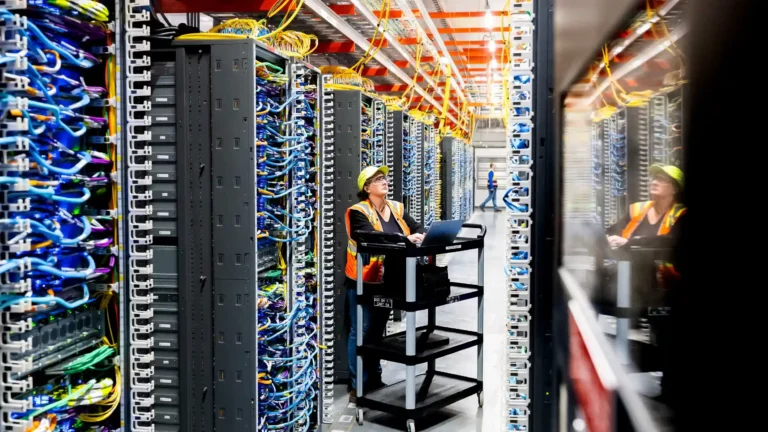
Noah Berger/Getty Images via Amazon Web Services
Britain stands at a rare strategic inflection point, embrace AI or continue on a path of sluggish economic growth for the foreseeable future.
The International Monetary Fund recently forecasted that the energy shocks from the Iran war will hit the UK the hardest of the world’s advanced economies, cutting its estimates for UK growth this year to 0.8%.
Meanwhile, artificial intelligence is about to reshape every aspect of our economy and society. Deployed properly, AI will boost productivity, strengthen our public services and turbocharge economic growth. It’s no longer just another emerging technology but an era-defining, transformative force like electricity or the internet.
But moments like this do not last. They are seized – or they are lost.
More than a year into Labour’s flagship AI Opportunities Action Plan, the gap between rhetoric and delivery is now alarmingly clear. After six months, independent analysis confirmed little or zero progress in 12 of the plan’s 50 recommendations, and only partial progress in 23. After a year, the Government announced that 38 of the 50 had been met, but key areas, including regulatory reform and changes to our data mining regime, are still delayed.
This approach to Britain’s tech capability of ‘dither, delay, damage’ is unsurprising given one of Labour’s first policy decisions on entering office was cancelling Britain’s new £1.3 billion exascale supercomputer. They eventually U-turned after a campaign I helped to lead, but their initial decision meant our country lost precious time. The National Audit Office has now warned that Britain is falling behind our supercomputing competitors like Germany and Japan.
If Britain is serious about becoming a ScaleUp Nation – a country that builds, scales and retains world-leading technology companies – then AI must sit at the centre of our economic strategy. That means mobilising capital, securing compute and reforming the state to adopt technology at scale. Speed compounds but so does delay. AI could add over half a trillion pounds to the UK economy over the next decade. But analysis from Public First suggests up to £220 billion of this could be lost if we allow other countries to set the rules.
In contrast, our competitors are acting with urgency, ambition and purpose. In the US, capital and compute are scaling together. Gulf states are deploying sovereign wealth at an extraordinary pace. Across Asia, governments are aligning energy, semiconductor strategy and infrastructure to power the next generation of AI models.
Investors do not wait indefinitely either. Nor do founders. We are already seeing the consequences: OpenAI recently ‘paused’ plans for its Stargate UK compute investment, citing high energy costs and regulatory uncertainty as barriers to long-term infrastructure deployment. This is not an isolated case. Industry has raised concerns about a lack of coordination across planning, grid connections and energy policy, while key questions about the viability of Labour’s AI Growth Zones policy remain unresolved. When firms at the AI frontier hesitate to invest, they’re sending a clear signal that Britain is not yet offering the conditions required to become a ScaleUp Nation.
If Britain becomes known for indecision and incoherence rather than speed and clarity, capital will flow elsewhere. AI firms will train models elsewhere. Data centres will be built elsewhere. And the economic spillovers – jobs, tax revenues, clusters of expertise – will go elsewhere.
That would be a fatal blow to Britain’s future, because having a powerful AI sector in the 21st century is not just an economic opportunity, it’s a geopolitical necessity. State power in the coming decades increasingly depends on technological capability, not just military strength. Nations that build frontier sectors shape global standards and accumulate power while those that do not must accept rules written elsewhere.
Britain has won races like this before. We led in financial services because we combined talent, capital and credible regulation. We built a thriving life sciences sector because we aligned research strength with commercialisation pathways. The same must now happen in AI.
A serious strategy that helps Britain become a ScaleUp Nation means acting on several fronts at once. It means launching a new Tech ISA so that billions in retail savings can be channelled into backing high-growth tech firms and funds. It means reversing the cut to Venture Capital Trust tax relief introduced in Labour’s last Budget, protecting the incentives that drive early-stage and scaleup investment. It means introducing a new Reinvestment Relief for founders and investors, allowing gains from successful exits to be rolled tax-efficiently into new UK-based technology ventures, strengthening our domestic scaleup ecosystem from within. And it means reforming grid connection queues to prioritise strategic sectors such as AI and advanced computing, cutting the delays that currently deter investment and hold back growth.
Put simply, it requires a government whose AI strategy matches the ambition of the moment. Labour are not operating at the scale or speed required to seize this historic opportunity.
Britain cannot afford to miss the biggest growth opportunity in history. If Labour continue to move at half-speed, Britain risks becoming a country that invents but doesn’t scale. Instead, we must continue pressuring the government to act with urgency and ambition, so Britain doesn’t lose the ability to become a ScaleUp Nation powered by AI.


Nigel Farage, the Member of Parliament for Clacton and leader of Reform UK, has resigned, triggering a by-election in the constituency. This follows weeks of speculation regarding an undeclared £5 million gift Farage received before he became an MP, as well as other gifts he allegedly should have declared. Farage intends to stand in the […]

Andy Burnham is not a forward-looking man. His musical interests stop at around 1998, his approach to industry is straight out of the 1970s and his favourite football team hasn’t won a trophy for over thirty years. It’s little surprise then that he takes a dim view of the ongoing tech revolution. It was reported […]

Last Friday, the most capable AI model in the world went dark. Anthropic had released Fable 5 three days earlier; on June 12, a U.S. executive order cut off access for foreign nationals. With no clean way to wall Americans off from the rest of us inside a global system used by hundreds of millions […]