If Britain wants growth, innovation is not enough
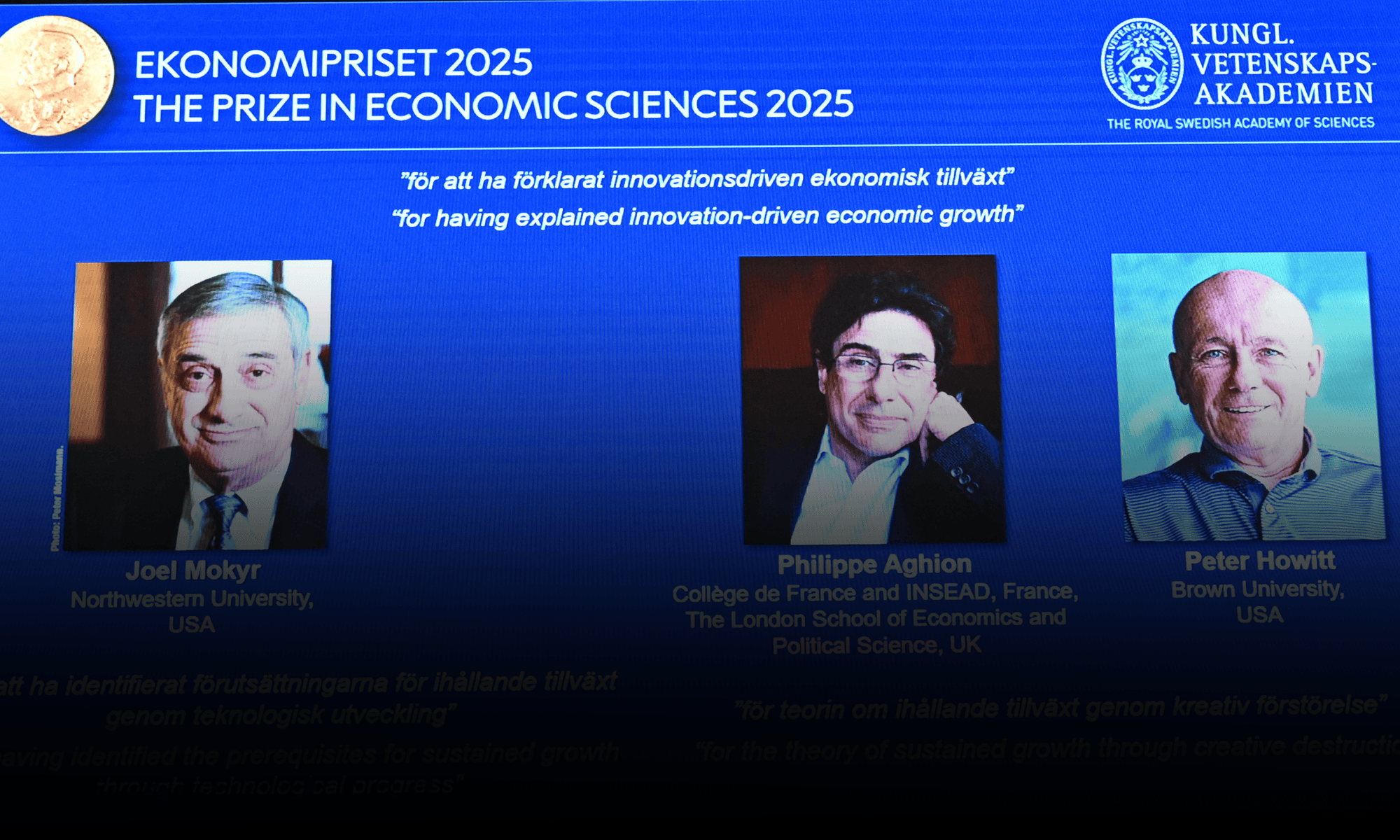
Photo by JONATHAN NACKSTRAND/AFP via Getty Images
It is a familiar lament of British policymakers that the UK invents everything and profits from nothing. The world wide web, nuclear energy, the ARM processors that now power every iPhone and many AI data centres – not to mention railways. All were invented in the United Kingdom; all are now largely scaled and monetised by overseas firms. Innovation alone, it seems, cannot power growth at the frontier.
This is a theme that has been advanced by all three winners of the 2025 Nobel Prize in Economics: Joel Mokyr, Phillipe Aghion and Peter Howitt.
In his magisterial work on the Industrial Revolution, Joel Mokyr demonstrated that it was not innovation per se that distinguished the Industrial Revolution from Europe’s stagnant past. Much was invented in the centuries before the development of the spinning jenny, steam engines and railways. But those inventions alone seem to have unlocked a rapid and (so far) unfinished process of continuous growth in living standards and population.
So, what made the Industrial Revolution different? Mokyr points to the culture of ‘industrial enlightenment’ that was peculiar to eighteenth-century Europe and especially strong in England. Uniquely in human history, it combined bright scientists, curious businessmen and a skilled workforce with a society that was tolerant of – and, indeed, often positively giddy for – change and improvement. This delightful cocktail was the fuel of industrial progress.
If Mokyr explains the emergence of modern economic growth in the eighteenth century, then Aghion and Howitt explain why it has continued to the present day. Together, they have developed Joseph Schumpeter’s famous theory of ‘creative destruction’ into the mathematical language of modern economics.
The theory is reasonably straightforward. In a world of limited resources, all new innovative firms must necessarily deprive older, less productive firms of workers, capital and customers to grow. But the implications are profound. A society that refuses to permit destruction cannot enjoy the fruits of creativity.
Aghion and Howitt’s work shows that this holds across sectors in the US. Those sectors where firms enter and exit often, and workers gain and lose jobs often, are the sectors with the fastest productivity growth. They also persuasively link America’s decline in dynamism to her decline in growth.
This finding holds with perhaps even more force in the UK than across the pond. In 2001, the annual labour reallocation rate – which measures the sum of absolute job creation and destruction – was 31%. Since 2009, it has been stuck at around 20% per year. Land is also being reallocated much less often. According to HMRC data, the value of non-residential property transactions has fallen from 7% of GDP in 2006/07 to 3% in 2023/24 – even as land prices remain at all-time highs.
The lessons for Britain could not be clearer. Our brilliant engineers, world-leading universities and genius creatives will surely continue to innovate. But the British economy will not grow if the rest of us do not welcome change and tolerate destruction.
The obvious place to start is the planning system. Because the UK’s system requires case-by-case approvals of most significant projects – whether industrial, commercial or residential – it has a built-in resistance to change. This slows down the process of creative destruction and locks in inefficient existing land uses. One particularly egregious consequence is that young people are locked out of jobs in highly productive cities: a paper published by the Adam Smith Institute found that freeing up the planning regime across our cities would boost everyone’s welfare by 11.7%.
The labour market also needs reform. This will involve staring down powerful trade unions, such as the train drivers, and demanding that they accept technological progress – like the fully automated train systems that operate safely and efficiently across Asia. It also means opposing changes, such as those embedded in the Employment Rights Bill and the recent increases in employer National Insurance, that make it more difficult for companies to expand or contract in response to innovation.
Change can be uncomfortable. But, as this year’s economics Nobel laureates have taught us, it is the necessary corollary of economic growth. If the UK is to grow again, she will need to rediscover the culture of change and creative destruction that powered her world-beating success during the Industrial Revolution.

An index-linked gilt – known as a linker in City speak – is a government IOU whose principal and interest payments rise with the Retail Prices Index (RPI). Inflation erodes the value of an ordinary bond; a linker compensates the holder for it. The post-Covid inflation shock showed why anybody would want one. Inflation, thought […]

When I was born in 1998, Britain had reached an optimistic point. It was the era of ‘Cool Britannia’: Tony Blair had won a landslide majority the year before to the tune ‘Things Can Only Get Better’, business was confident in our economy, employment was rising and we had low inflation. Yet by the time […]

Outgoing governments often try to craft a legacy for themselves by introducing policy traps that incoming governments find hard to undo, such as Rishi Sunak’s National Insurance cuts in 2024 or Gordon Brown’s introduction of the 50p top rate of income tax in 2010. Keir Starmer just did something similar by initiating a huge expansion […]