How Theresa May and Rachel Reeves rewrote history
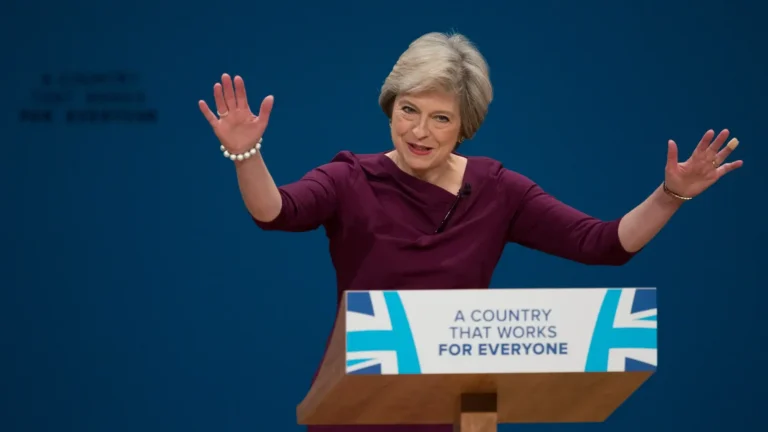
Photo: Matt Cardy/Getty Images
In her Mais Lecture earlier this month, Chancellor Rachel Reeves announced:
A new industrial strategy to […] get Britain firing on all cylinders again.
It’s not about picking winners, propping up failing industries, or bringing old companies back from the dead.
It’s about identifying the industries that are of strategic value to our economy and supporting and promoting them […]. Not just sitting back and seeing what happens – but putting in place a plan and getting on with the job.
So we will identify the sectors of the economy […] that are of strategic importance to our economy, and do everything we can to encourage, develop and support them.
Except, Reeves didn’t say that. The above quote is from Theresa May’s Conservative Party Conference speech in 2016. The two speeches were delivered ten years apart, by politicians from different parties, and against very geopolitical backdrops. But in sentiment, the two speeches were very much alike.
Both May and Reeves presented their respective economic policy approaches as a departure from a libertarian status quo. Reeves promised ‘a break […] with the laissez-faire politics of the passive state’. Her approach, ‘Securonomics’, was about ‘correcting […] the persistence of an outmoded view – a doctrine of the passive state – holding that the best thing a government could do was stand aside and leave markets to their own devices’.
Similarly, May had already said ten years earlier:
It’s time to remember the good that government can do. Time for a new approach that says […] government can and should be a force for good […] and that we should employ the power of government for the good of the people. Time to reject the ideological templates provided by the socialist left and the libertarian right and to embrace a new centre ground in which government steps up – and not back – to act on behalf of us all.
But while both politicians promised a more active state, and in particular, an activist, hands-on industrial policy, both also insisted that this did not mean a return to the 1970s. ‘It’s not about picking winners, propping up failing industries’, said May; ‘it’s not […] a retreat to a naïve, twentieth-century statism’, echoed Reeves. This time is different. This time, the industrial strategy will be smarter, more agile, more strategic.
Be that as it may: an outside observer may wonder how it is possible to break with the laissez-faire politics of the passive state twice within a ten-year period. If Theresa May already broke with the laissez-faire politics of the passive state ten years ago, how can Rachael Reeves now break with it again? Isn’t this a bit like trying to do Brexit again, which you cannot do unless you rejoin in the meantime? Once you’ve broken with laissez-faire, you no longer have a laissez-faire economy. Once you’ve brought back an activist state, your new status quo is an activist state. Sure, you can then move from an activist state to a hyperactivist state, or you can turn a state that’s activist in some way into a state that’s activist in a different way. But that’s not what Reeves was talking about.
It’s not that Theresa May was secretly a libertarian, who only talked about all the wonderful things the state can do without actually doing anything. In 2018, the May government released the report ‘Forging Our Future: Industrial Strategy – the story so far’, which said that ‘the Industrial Strategy is working for the UK economy’, and mentioned ‘£45bn already committed across the UK through the Industrial Strategy’. Yes, I know: I’m sure it’s debatable how much of that money was genuinely new spending, and how much was just repackaged preexisting spending commitments. But would a passive libertarian laissez-faire state even have that kind of money to repackage?
This pattern of British politicians defining themselves against an imaginary recent past, in which the state did nothing, did not start with Theresa May either. I first encountered it almost exactly 27 years ago, at the start of my final year at school, in 1999. I had to write a school essay on Tony Blair’s ‘Third Way’ and its implications for Europe, for which I had to read ‘The Third Way’ by Blair’s guru Anthony Giddens. Giddens defined his Third Way in opposition to what he called the ‘Old Left’, which thought that the state should control everything, and the ‘New Right’, which thought that the state should do nothing. He associated the latter with the status quo as it was at the time, and the former with a past he did not want to return to. The Third Way, on the other hand, was an alternative to both: a state which did less than everything, but more than nothing. It would do just the right amount, but more importantly, it would do the right things, and it would do so in a smart, modern and strategic way.
Britain was, of course, not a laissez-faire economy in the late 1990s either. The last time one could plausibly describe Britain as approximately laissez-faire was in 1913, and even then, one could describe the British Empire as an industrial policy of sorts. Within living memory, the British state has always had industrial policies and regional development policies of some sort, even if not always on a scale that would satisfy Mariana Mazzucato. The British state has never been passive and indifferent with regard to economic events, or the composition of the economy.
I realise that if you’re a politician, you want to exaggerate the differences between yourself and your predecessors a little. You don’t want to be the boring continuity candidate; you want to be the one who does something new and exciting. The problem is that if everyone pretends that the state was completely passive until ten minutes ago, and that it has only just sprung back into action now, we never properly evaluate the effects of past government activism. Because the official version is that they never happened. If the state didn’t do anything until ten minutes ago, then there’s nothing to evaluate. Government action only starts now!
Until the next government comes along and retroactively erases it.


Elon Musk’s SpaceX has launched the largest ever public offering of stock today, selling $75 billion worth of shares. SpaceX emphasised its remarkable achievements in its IPO filing: ‘We are the primary launch provider for the US government. In 2025, we launched 11 of 12 National Security Space Launch (‘NSSL’) medium and heavy lift missions […]
Britain’s national debt is on course for £3 trillion this year. Servicing it costs £30 billion a year at 1% interest and £150 billion at 5%, near where long-dated gilts have recently been trading. That’s a number so big it almost becomes meaningless. So, let’s try another way: it’s about the yearly gross pay of […]

The World Cup starts today and for the first time in over 30 years it is being held in North America. Not only is this exciting news for football fans, it should also be of interest to free trade enthusiasts, as the last time it was held there the North American Free Trade Agreement (NAFTA) […]