A classical education would civilise Britain’s children
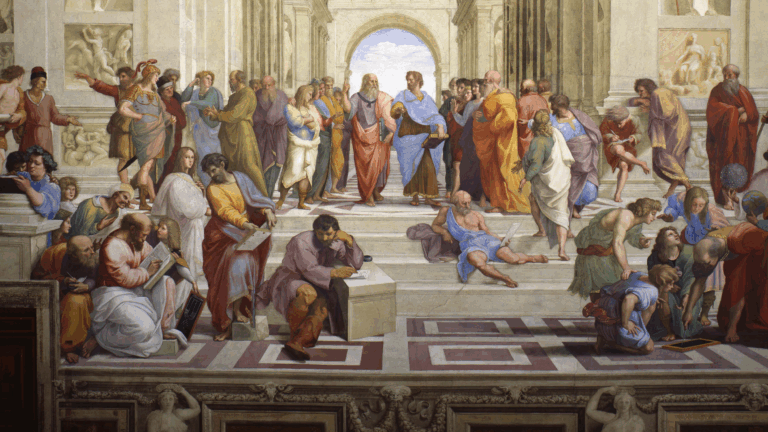
Raphael's 'The School of Athens'. Photo: Bildagentur-online/Universal Images Group via Getty Images
For all the heat around education policy, there is one cooling consensus: England’s schools are performing better than they were 15 years ago. The knowledge-rich reforms since 2010, combined with more disciplined pedagogy, have raised expectations and improved outcomes. According to the OECD’s latest figures, English teenagers now outperform almost every other Western country in reading, maths and science. This is an achievement worth celebrating.
But it risks masking a deeper problem. Despite endless discussions about ‘raising standards’, the British system remains oddly incurious about what education is actually for. The prevailing assumption – shared across political lines – is that schooling exists to prepare children for employment and productivity. Qualifications become passports to future income; the value of knowledge is measured by its utility. The result, as the new Civitas report, ‘Renewing Classical Liberal Education’, argues, is a system increasingly adept at producing competent test-takers while neglecting the harder, older task of cultivating human beings.
This narrowing of purpose shows up vividly in the English Literature GCSE. On a technical level, the syllabus allows for breadth: Shakespeare, a 19th-century novel, a post-1914 text and poetry. But the choices schools make reveal the real incentives. Because accountability pressures reward safe, predictable results, pupils are overwhelmingly steered towards the shortest and simplest works. Last year, more than 80% studied ‘An Inspector Calls’, a 72-page play that BBC Radio can read aloud in under an hour and a half. In the 19th-century category, 70% were given ‘A Christmas Carol’, despite its recommended reading age of 8-12. In comparison, the major (and much longer) novel ‘Great Expectations’ is studied by just 0.4% of pupils.
These choices are not accidents. GCSEs are the last compulsory national assessment, so their structure must accommodate every pupil. A simple syllabus makes the exams more accessible, that, in turn, protects schools’ performance metrics. But what works for equity actually undermines excellence everywhere else. A child may leave school with a string of high grades yet without ever having encountered a demanding work of literature, without grasping the chronology of Western history or without having committed a single line of poetry to memory.
As authors Briar Lipson and Daniel Dieppe note, this is now an accepted feature of modern schooling rather than an embarrassment. Teaching at Oxford since 2018, in both music and French, I have watched this shift play out in real time, a trend only accelerated by the lockdowns. Each year, more students arrive having read less, and occasionally without any sense of why the great works matter. Some simply do not see the need for demanding books, which they might find intimidating, irrelevant, or exhausting. To be clear, this is not because the students lack ability. Rather, many were never given the habit, and therefore the appetite, for serious reading in the first place.
The truth is that the English system remains trapped in a false dichotomy. On the one hand, a progressive orthodoxy that equates freedom with life unbounded by any limits, sometimes enabling contentious ideas in the PSHE and sexual education curricula. On the other, a narrow utilitarianism that sees children chiefly as future workers. What has quietly disappeared between these poles is the Greek idea of paideia: the formation of the whole person through an initiation into the ‘the best which has been thought and said’, in the words of Matthew Arnold.
Crucially, classical liberal education is not nostalgia. It is a 2,500-year-old tradition, the purpose of which was not to maximise economic output, but to cultivate wisdom, virtue and what Lipson and Dieppe call ‘the fullness of humanity’. Where today’s system treats knowledge as a set of examinable fragments, classical education treats it as an inheritance: a coherent narrative that situates a child in time, culture and civilisation. It insists that young people read old books because they enlarge their inner world rather than shrink it, confront timeless questions and draw us into the struggle for a life lived well.
In the United States, this tradition is already experiencing a successful revival. Hundreds of new classical schools have opened in recent years, teaching complex canonical texts and cultivating mores and habits of attention, judgment and self-restraint. Their success shows that this approach is not only possible but popular – especially among parents who are exhausted by ideological swings and bored by educational minimalism. England could take the same path, but doing so requires recovering the courage to say that education cannot be value-neutral. Schools either transmit a culture – its stories, virtues and aspirations – or they transmit nothing of real substance.
The current political direction does not inspire confidence. Labour’s instinct is to modernise by stripping away perceived ‘irrelevancies’ in favour of competencies and practical tasks, a trajectory already visible in the proposed 2025 curriculum review. Indeed, Education Secretary Bridget Phillipson’s enthusiasm for ‘life skills’ and digital, machine-readable content sits squarely within the same narrowing logic that has hollowed out the curriculum for decades.
We should be honest: renewing classical liberal education is not a quick fix. But the alternative is a system that mistakes adequacy, if not outright mediocrity, for excellence, and confuses employability with human flourishing at a moment when AI is already eroding the very low-skilled jobs schools prepare pupils for. If we want young people capable of judgment rather than ideology, wonder rather than cynicism, then we should begin by giving them something worth thinking about.
The reforms of Michael Gove represented a profound shift in England’s educational landscape, based upon the belief that outcomes improve when there is freedom with accountability. During his tenure as Education Secretary (2010-14), it became possible for all publicly funded schools to become academies, free schools could be created, and there were substantial reforms to […]
Schools do not exist in isolation from the economy. The number of young people who are not in employment, education or training (NEET) is, in large part, a function of the economic conditions in which they leave education. When growth is weak, entry-level opportunities are scarce, employers are cautious and the public finances that pay […]
After 17 months of drift following the Government’s January 2025 reset of the Higher Education (Freedom of Speech) Act 2023, the free speech complaints scheme administered by the Office for Students (OfS) is at last going ahead. The Government has now signed the commencement regulations needed to bring the scheme into force. From 1 September […]