Would Nigel Farage abandon Hong Kong?
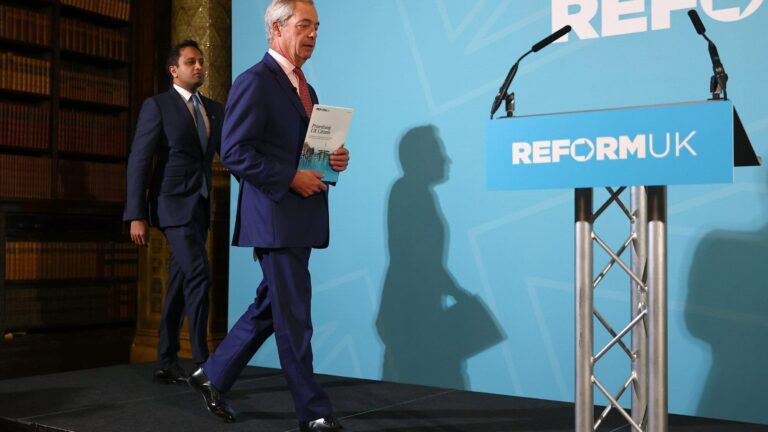
Photo: Peter Nicholls/Getty Images
Amid the distraction of whether Nigel Farage’s latest party is racist, it’s worth casting your minds back a decade. Amid the rancour of the EU referendum, those wanting to leave were caricatured as a mix between ‘little Englanders’, whose horizons barely stretched beyond the next green and pleasant field, and imperial nostalgists desperate to get the band back together.
It was and is a ridiculous combination. But there was a remarkable lack of warmth – less hostility, and more a dismal kind of apathy – towards people who once would have also been referred to as ‘British subjects’.
That coolness was evidenced last week, as Farage refused to confirm whether Hong Kongers would be exempt from his plans to jettison ‘indefinite leave to remain’ (ILR) status. Asked about those fleeing Beijing’s authoritarianism in the former city state, the Reform leader was unequivocal: ‘800,000 people are due to qualify for indefinite leave to remain over the course of the next few years. This press conference is to say none of them will get it.’
Roughly analogous to the permanent residency status granted elsewhere, people with ILR are free to live, study and work in the UK without time limit, while also qualifying for most benefits. As a step towards naturalisation, it’s also a key means of recruiting new British citizens from around the globe.
The attack on ILR is part of the nativist turn in British politics, explicitly positioned in response to the so-called ‘Boriswave’. Under the previous Conservative government, inward net migration soared to more than 900,000 in 2023 – figures that are justifiably seen as a betrayal of voters who wanted to ‘take back control’ of the country’s borders.
While Reform’s plan is severe, it’s not exactly unusual among the major parties. Even Labour, whose instincts tend towards the cosmopolitan, are planning on tightening the criteria for ILR. Under Home Secretary Shabana Mahmood’s new proposals, those seeking to settle in the UK will need strong English skills, no criminal record and evidence of voluntary service.
Such policies seek to assuage a public who have been repeatedly snubbed on immigration policy. Earlier in September, YouGov reported that migration was now voters’ top concern for the first time since the Brexit referendum. Nobody is much buying the argument that migrants are necessarily an economic boon, huge numbers having pushed up house prices, put pressure on public services and damaged social cohesion.
An effective government response to this democratic demand is long overdue. And yet the risk – indeed, the likelihood – is that policy swings too much the other way. And Hong Kongers are among the first to be struck by the pendulum.
Since Beijing began its attack on Hong Kong’s democracy in 2020, more than 160,000 people have fled from there to the UK. Most of the new arrivals will have come on the British National Overseas Visa, created in response to the increasingly authoritarianism of mainland China. For those planning on staying for five years, ILR was the natural next step, opening the path to permanent residency and full citizenship.
While much of the pushback against migration has concerned incomers’ low skills, tendency to bring over dependants and criminal inclinations, Hong Kongers are in many respects model migrants. Six in ten have a degree, including a quarter with postgraduate qualifications, according to British Future. And unlike other arrivals, more than half are proficient in English, according to the territory’s 2021 census.
Indeed, the evidence suggests that at this point Britain is underutilising the skills of arriving Hong Kongers, many of whom are overqualified for the jobs they work. Alongside that untapped potential, the China Strategic Risk Institute reckons there are £4 billion in pension funds that Hong Kongers are likely to move into the UK if they are allowed to obtain ILR.
All that’s without considering Britain’s moral responsibility to Hong Kong, undoubtedly greater than with many of the other places we take refugees from. As the then Prince Charles put it in a diary entry written during the handover of the territory to China in 1997: ‘We left Hong Kong to her fate.’
He was hardly alone in having ‘the sneaking worry about creeping corruption and the gradual undermining of Hong Kong’s greatest asset – the rule of law’. With China having abandoned the rule of law, Britain can make amends by embracing arguably an even greater asset: the Hong Kongers themselves. Far from pushing them away, we should continue to make them welcome.
The Commonwealth is an anachronism in the 21st century – an imperial hangover that shows no signs of abatement but is instead getting worse. As King Charles addressed his subjects in Antigua and Barbuda ahead of this week’s Commonwealth Heads of Government meeting (CHOGM), our Prime Minister was throwing out statements about possible apologies and […]

Just as there is a battle on the Right in Britain, so too is there a battle inside the Conservative Party for what the party should focus on. There are those who are concerned about the threat of political Islam, the damage to the social fabric of the Boriswave and other elements of mass immigration, […]
Whenever I think about Boris Johnson, the old French proverb ‘après moi le déluge’ comes to mind. It means a blithe, even nihilistic disregard for whatever ruination ensues after one’s own time. For many years, it was thought to have originated with Louis XV or his mistress Madame de Pompadour in the 1750s. It thus […]


